The short answer
There is almost nothing to compare. The four brands recorded sell the same product: 100% creatine monohydrate, under the same Creapure label, with the same one-line ingredient list. The only criterion that sets them apart is price, and it varies by a factor of two between the powders. Capsules cost 2.8 times the price of the powder for the same creatine.
Why this comparison does not score the products out of 20
Because a score would assume differences to score. Here are the ingredient lists recorded on 23/09/2026 from the official pages:
- Nutrimuscle: “Créatine monohydrate Creapure… et c’est tout.” (creatine monohydrate Creapure… and that’s all)
- Dynveo: “100% creatine monohydrate powder.”
- Nutri&Co: “100% creatine monohydrate”, with no additive or excipient.
- Nutripure: Creapure creatine stated as “100% pure”, 3 g of pure creatine per dose (recorded on 23/10/2026).
Four products, one ingredient, the same German label. Their purity, particle size and recommended dose (3 g a day) are identical or indistinguishable on public data. A ranking with scores and nuanced verdicts would be a performance.
What this comparison can honestly do: compare the price per gram of creatine, which nobody does, and say what science establishes about the product itself.
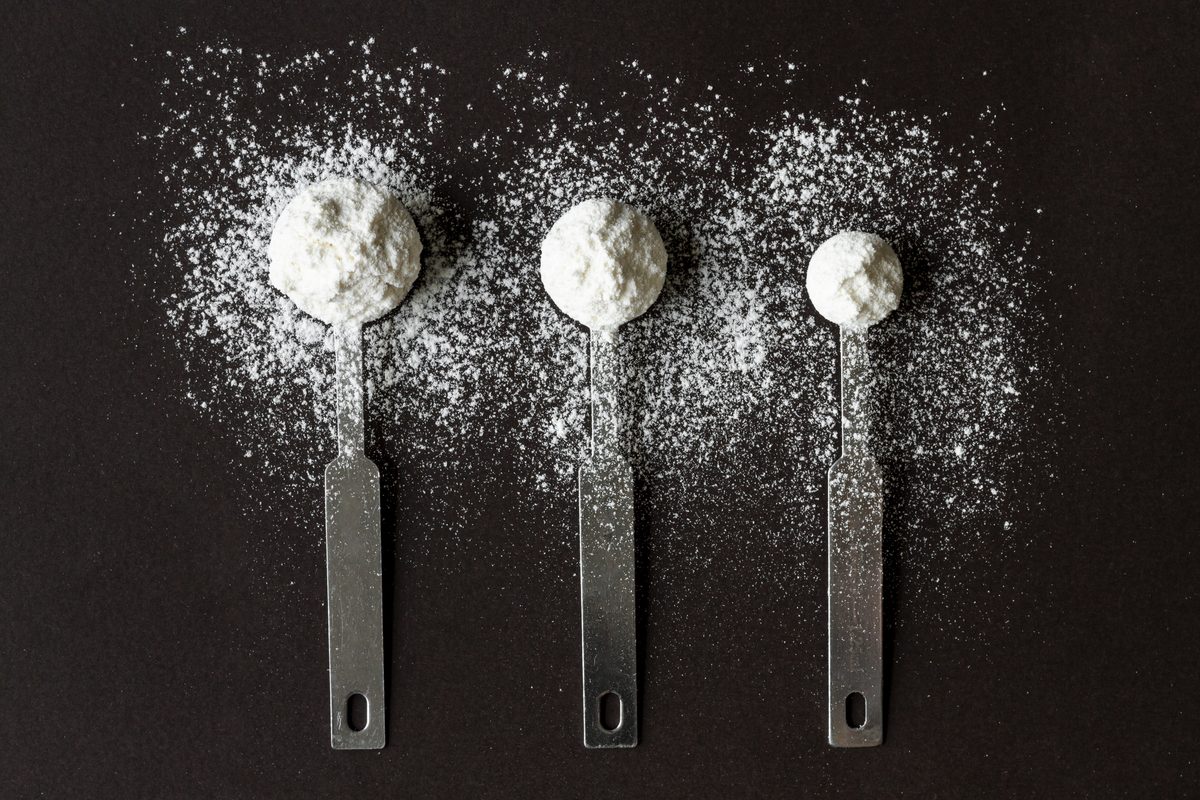
The price of 100 g of creatine, recorded on 23/09 and 23/10/2026
| Product and size | Price | Price / 100 g of creatine | Cost per day at 3 g | Over a year |
|---|---|---|---|---|
| Nutripure, powder 1 kg | 59.90 EUR | 5.99 EUR | 0.18 EUR | 66 EUR |
| Dynveo, powder 1 kg | 69.90 EUR | 6.99 EUR | 0.21 EUR | 77 EUR |
| Dynveo, powder 250 g | 24.90 EUR | 9.96 EUR | 0.30 EUR | 109 EUR |
| Nutripure, powder 450 g | 39.90 EUR | 8.87 EUR | 0.27 EUR | 97 EUR |
| Nutripure, powder 150 g | 14.90 EUR | 9.93 EUR | 0.30 EUR | 109 EUR |
| Nutri&Co, powder 300 g | 29.90 EUR | 9.97 EUR | 0.30 EUR | 109 EUR |
| Nutrimuscle, powder 350 g | 34.95 EUR | 9.99 EUR | 0.30 EUR | 109 EUR |
| Nutrimuscle, powder 150 g | 16.95 EUR | 11.30 EUR | 0.34 EUR | 124 EUR |
| Nutrimuscle, powder 90 g | 10.95 EUR | 12.17 EUR | 0.37 EUR | 133 EUR |
| Dynveo, 180 capsules of 680 mg | 23.90 EUR | 19.53 EUR | 0.59 EUR | 214 EUR |
Capsules cost three times the powder
This is the most spectacular gap in the table, and it comes down to one thing: a capsule contains 680 mg of creatine, so you need four to five a day, and the vegetable shell costs more than what it contains. 19.53 EUR per 100 g against 6.99 EUR, which is 137 EUR more a year for the same molecule, from the same brand. Creatine monohydrate has a neutral taste and dissolves: the capsule buys no real convenience.
Size decides, not brand
At Nutrimuscle, going from the 90 g pot to the 350 g pot brings the price down from 12.17 to 9.99 EUR per 100 g. And the 1 kg bags come down to 6.99 EUR at Dynveo and 5.99 EUR at Nutripure, 30 to 40% below the mid-sized formats, which all sit around 10 EUR per 100 g. Creatine keeps very well when dry: buying big is the only useful trade-off.
One last honest detail: Nutrimuscle offers a 40 g size at 3.00 EUR, which is 7.50 EUR per 100 g. It would be the second-best price in the table, but it is a trial size lasting thirteen days of a course, so it cannot be compared with the others, and we do not rank it.
What science establishes
The International Society of Sports Nutrition position stand on the safety and efficacy of creatine points out that studies consistently show an increase in intramuscular creatine stores, which explains the gains observed in high-intensity efforts and, in turn, better training adaptations. It also mentions leads on recovery, injury prevention and thermoregulation (Kreider et al., 2017, PMID 28615996).
It is one of the few sports nutrition supplements whose effect is not up for debate. That does not make the brands different, though: the effect belongs to the molecule, which is the same in all four pots.
Our complete guide to creatine explains the dosage, the loading phase and the expected effects.
Where a brand can still set itself apart
The purity label. Creapure, produced by AlzChem in Germany, is the reference cited by all four brands. It guarantees the absence of by-products such as creatinine. A creatine without a label is not necessarily bad, but nothing documents it.
Anti-doping control. Nutri&Co states that it appears on the Cologne List, a list of products tested for cross-contamination. For an athlete in competition, it is the only criterion in this comparison that can justify paying more than the price per gram.
Nothing else. Neither solubility, nor “micronisation”, nor origin is documented in a comparable way from one brand to another.
Our sources
- Official Nutripure page, consulted on 23/10/2026: label, dose, sizes and prices.
- Official Nutrimuscle, Dynveo and Nutri&Co pages, consulted on 23/09/2026: label, recommended dose, sizes, prices and ingredient lists.
- Kreider R.B. et al., International Society of Sports Nutrition position stand: safety and efficacy of creatine supplementation in exercise, sport, and medicine, Journal of the International Society of Sports Nutrition, 2017: PMID 28615996.