Group · Fruit
Mango
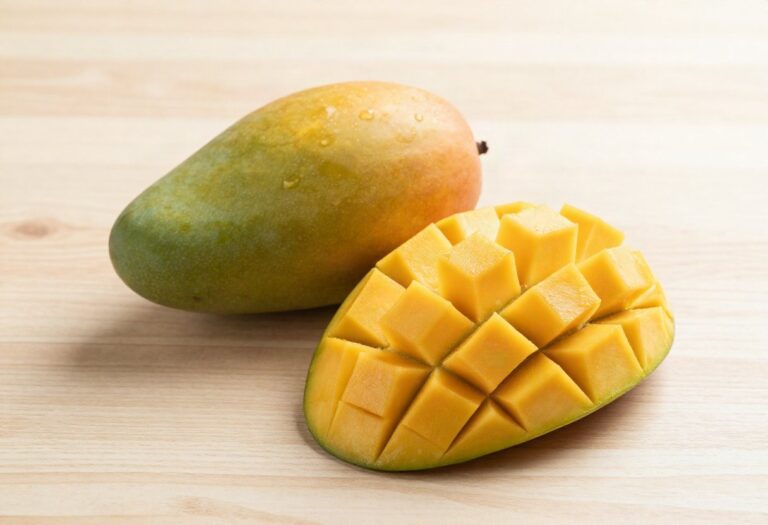
The mango is a tropical fruit with soft, juicy, fragrant flesh, originally from South Asia and now grown in many warm regions. There are many varieties, from the more fibrous to the creamiest, such as the famous Alphonso or Kent. With around 71.1 kcal per 100 g, it mainly provides carbohydrate (14.3 g), plenty of water and fibre, with very little fat. Its orange colour gives away its richness in provitamin A and vitamin C. Sweet and indulgent, mango fits naturally into a balanced diet, as a dessert, a snack or in sweet and savoury dishes, as long as you keep an eye on its sugar content.
Macronutrient breakdown
Nutrition table per 100 g
| Calories | 71 kcal |
| Kilojoules | 302 kJ |
| Protein | 0,7 g |
| Carbohydrate | 14,3 g |
| Fat | 0,3 g |
| Fibre | 1,6 g |
Micronutrients per 100 g
All measured nutrients, ranked by share of the daily reference intake.
- Vitamin C25 mg31 %
- Vitamin E2,05 mg17 %
- Vitamin A72 µg9 %
- Potassium150 mg8 %
- Vitamin B60,1 mg7 %
- Copper0,07 mg7 %
- Vitamin B30,72 mg5 %
- Manganese0,07 mg4 %
- Vitamin B9dietary folate equivalents70,2 µg
See the other 8 nutrients
- Vitamin B50,18 mg3 %
- Magnesium11 mg3 %
- Phosphorus12 mg2 %
- Calcium12 mg2 %
- Vitamin K11,12 µg1 %
- Total omega-30,03 g1 %
- Zinc0,11 mg1 %
- Iron0,09 mg1 %
Anses Ciqual 2025. Source: Anses, 2025, Ciqual food composition table
Tips
You can enjoy mango in all sorts of ways. Choose one that gives slightly under your finger and smells fragrant near the stalk: that’s the sign it is perfectly ripe. To cut it without waste, run your knife along the flat stone, score the flesh into a grid and turn the skin inside out to get neat cubes. A reasonable portion is around half a mango (100 to 150 g), enough to enjoy its flavour without overloading your daily sugar intake.
- Key nutrients: rich in vitamin C, provitamin A (beta-carotene) and fibre, mango contributes a useful amount of natural antioxidants.
- Glycaemic index: moderate to high depending on ripeness. Pair it with a source of protein or healthy fats (natural yoghurt, nuts) to soften its effect on blood sugar.
- Seasonality: available for much of the year depending on the country of origin, with a peak in the winter months for imported varieties.
In the kitchen, mango is delicious raw, in a fruit salad, in a smoothie or in a spicy chutney to go with meat and fish. You can also add it to a tartare, a fresh salsa with coriander and lime, or dry it in strips. For more fruity variety, try other tropical treasures such as pineapple or papaya, and explore the whole fruit family to create colourful plates.
Exercise tip: thanks to its easily absorbed carbohydrate, mango makes an excellent snack before exercise or for recovery, for example blended into a smoothie with a banana and a little protein powder. It helps replenish glycogen after an intense session while providing water and micronutrients. For more on food and training, take a look at the essentials of fitness nutrition.
Watching your weight: delicious as it is, mango is sweeter than many fruits. If you are watching your weight, keep portions measured and choose fresh fruit over candied, dried or tinned-in-syrup versions, which are much more concentrated in sugar. Keep a ripe mango in the fridge for a few days and leave a firmer one to ripen at room temperature. Eaten wisely, it remains a tasty, refreshing part of your balanced diet.
If you have diabetes: a third of a mango, about 120 g, makes one portion of fruit. The figures are in our guide to mango and diabetes.