Group · Fruit
Blueberries
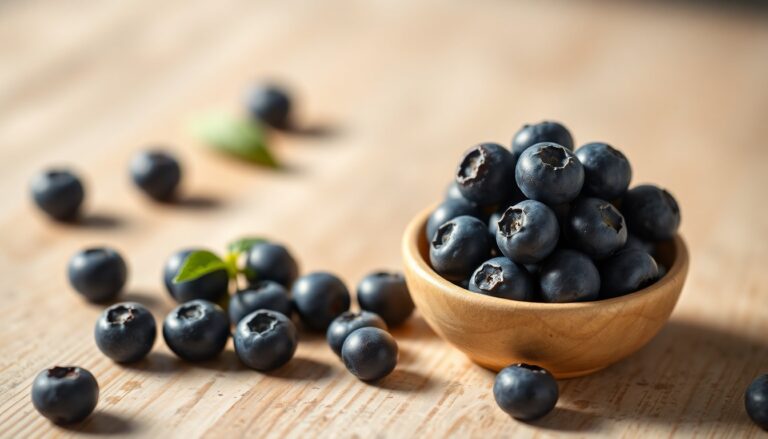
The blueberry is a small blue-purple berry with sweet, slightly tart flesh, a symbol of woodland and mountain landscapes. There is the wild bilberry, small and intensely flavoured, and the cultivated blueberry, larger and milder. You can eat it fresh, frozen, dried or as jam, and it fits naturally into a balanced diet. With around 57.7 kcal per 100 g, little fat and a good amount of fibre, it is a light yet indulgent fruit. The blueberry is best known for its pigments (anthocyanins), which give it its deep colour. Versatile, it works as well at breakfast as it does for dessert or as a snack.
Macronutrient breakdown
Nutrition table per 100 g
| Calories | 58 kcal |
| Kilojoules | 244 kJ |
| Protein | 0,9 g |
| Carbohydrate | 10,6 g |
| Fat | 0,4 g |
| Fibre | 2,4 g |
Micronutrients per 100 g
All measured nutrients, ranked by share of the daily reference intake.
- Vitamin K119,3 µg26 %
- Manganese0,34 mg17 %
- Vitamin C9,7 mg12 %
- Copper0,06 mg6 %
- Vitamin E0,57 mg5 %
- Potassium77 mg4 %
- Vitamin B60,05 mg4 %
- Vitamin B10,04 mg3 %
- Vitamin B9dietary folate equivalents6 µg
See the other 10 nutrients
- Vitamin B20,04 mg3 %
- Vitamin B30,42 mg3 %
- Iron0,28 mg2 %
- Vitamin B50,12 mg2 %
- Phosphorus12 mg2 %
- Magnesium6 mg2 %
- Zinc0,16 mg2 %
- Calcium6 mg1 %
- Vitamin A2,67 µg0 %
- Iodine0,5 µg0 %
Anses Ciqual 2025. Source: Anses, 2025, Ciqual food composition table
Tips
To enjoy the benefits of blueberries, a portion of around 100 to 150 g (a generous handful) is enough to bring flavour, fibre and freshness without loading up on calories. You can eat them plain, stirred into natural yoghurt or quark, sprinkled over oat porridge, or blended into a smoothie. Raw, they best keep their vitamin C and pigments; if you cook them into a compote or coulis, go for gentle cooking to limit nutrient losses.
Nutrition facts and profile: blueberries have a moderate carbohydrate content (10.6 g/100 g), little protein and almost no fat. Their glycaemic index is reasonable, and their 2.4 g of fibre per 100 g helps you feel full and supports digestive comfort. They are among the fruits rich in anthocyanins, antioxidant compounds that also colour blackcurrants and blackberries.
- Seasonality: peak season is summer, from June to September depending on whether they are wild or cultivated.
- Storage: keep them in the fridge for a few days, without washing them first; they freeze very well and are easy to find frozen all year round.
- In the kitchen: muffins, clafoutis, pancakes, jams, coulis for quark, or simply raw.
If you exercise: blueberries make a handy snack before or after a workout. Their carbohydrate provides readily available energy, while their fibre and water support hydration. For recovery, pair them with a source of protein (Greek yoghurt, skyr, or a protein snack) to combine carbohydrate and amino acids. They also go very well in a bowl of red berries with raspberries and strawberries for more variety in flavour and nutrients.
Watching your weight: thanks to their low calorie density, blueberries fit easily into a weight-loss or rebalancing plan. Be careful, though, with processed versions: jams, syrups and sweetened dried blueberries contain more added sugar. To discover other berries and tasty fruit, explore the fruit family and compare what they provide. Eaten fresh and without added sugar, blueberries remain one of the most worthwhile berries to include every day: light, tasty and easy to pair.
If you have diabetes: red berries are among the fruits lowest in carbohydrate. Portions and glycaemic index are in our guide to strawberries and diabetes.