Group · Dairy
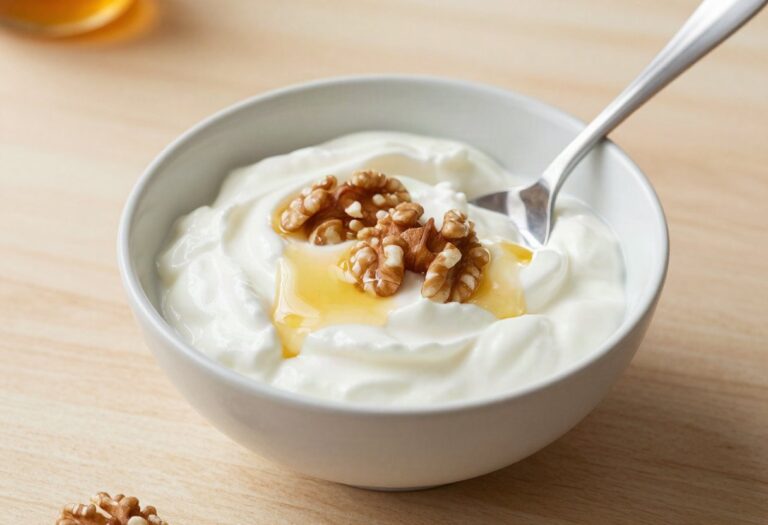
Greek yoghurt
Greek-style yoghurt and Greek yoghurt are not the same product, and that confusion is the main reason this page exists. Greek-style yoghurt, measured here, is a yoghurt enriched with cream. Authentic Greek yoghurt, on the other hand, is simply strained: the whey is removed, which concentrates the protein.
In terms of nutrition facts, Greek-style yoghurt has 103 kcal per 100 g, with 8.16 g of fat, of which 5.26 g is saturated, and only 2.96 g of protein. It provides 116 mg of calcium per 100 g. A strained Greek yoghurt, by contrast, has around 9 to 10 g of protein with much less fat.
Macronutrient breakdown
Nutrition table per 100 g
| Calories | 103 kcal |
| Kilojoules | 428 kJ |
| Protein | 3 g |
| Carbohydrate | 3,8 g |
| Fat | 8,2 g |
| Fibre | 0,1 g |
Micronutrients per 100 g
All measured nutrients, ranked by share of the daily reference intake.
- Calcium116 mg15 %
- Iodine20,7 µg14 %
- Vitamin B20,18 mg13 %
- Phosphorus82,6 mg12 %
- Potassium143 mg7 %
- Vitamin B50,34 mg6 %
- Vitamin B120,13 µg5 %
- Magnesium10,1 mg3 %
- Vitamin B9dietary folate equivalents6,95 µg
See the other 5 nutrients
- Vitamin B60,03 mg2 %
- Vitamin B10,02 mg2 %
- Total omega-30,04 g1 %
- Omega-3 ALA0,03 g1 %
- Omega-6 LA0,12 g1 %
Anses Ciqual 2025. Source: Anses, 2025, Ciqual food composition table
Tips
Read the label, not the name. That is the only advice that matters here. « Greek-style » signals added cream; « Greek » or « strained » signals that the whey has been removed. The nutrition table settles it in two seconds: if protein is around 3 g, it is a cream yoghurt; around 9 g, it is a strained yoghurt.
For feeling full, you want the second one. 2.96 g of protein for 103 kcal is the profile of a dairy dessert. Quark provides more than twice the protein for fewer calories.
It still has its uses. Its high fat content gives it a creaminess no low-fat yoghurt can match: it makes a great substitute for crème fraîche in a cold sauce, a tzatziki or a marinade, with three to four times less fat than full-fat cream.
It (almost) doesn’t split when heated. Its fat content makes it more stable than a low-fat yoghurt in a hot sauce, as long as you add it off the heat and never let it boil.
Fruit versions change everything. They typically add around ten grams of sugar per 100 g compared with the plain product. Plain yoghurt with fresh red berries is still unbeatable.
Sources
Average nutritional values per 100 g, for guidance only (may vary between brands and recipes).