Group · Dairy
Egg
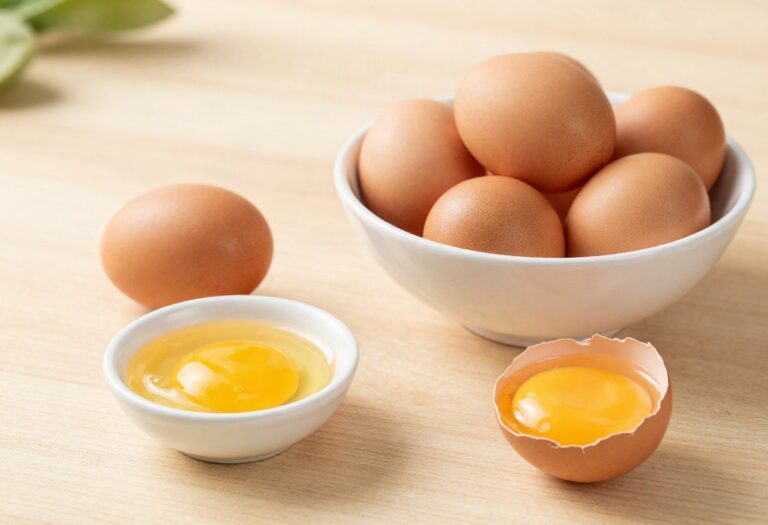
The egg is one of the most complete and versatile foods in our diet. Mostly laid by hens, eggs come in several sizes and categories (free-range, organic, premium labels) depending on how the hens are reared. Made up of a protein-rich white and a yolk that concentrates the fat and many micronutrients, the egg works just as well at breakfast as in savoury or sweet dishes. With around 140 kcal per 100 g, nearly 12.8 g of protein and only 0.06 g of carbohydrates, the egg has excellent nutrition facts. Its benchmark-quality protein makes it a valuable part of a balanced diet, whether you want to vary your intake or look after your fitness.
Macronutrient breakdown
Nutrition table per 100 g
| Calories | 140 kcal |
| Kilojoules | 582 kJ |
| Protein | 12,8 g |
| Carbohydrate | 0,1 g |
| Fat | 9,9 g |
Micronutrients per 100 g
All measured nutrients, ranked by share of the daily reference intake.
- Vitamin D2 µg40 %
- Vitamin B120,89 µg36 %
- Vitamin B20,46 mg33 %
- Phosphorus198 mg28 %
- Vitamin B51,53 mg26 %
- Iodine35,3 µg24 %
- Vitamin B947 µg24 %
- DHA0,05 g21 %
See the other 16 nutrients
- Vitamin A160 µg20 %
- Omega-6 LA1,39 g14 %
- Iron1,75 mg13 %
- Vitamin B60,17 mg12 %
- Zinc1,01 mg10 %
- Calcium76,8 mg10 %
- Vitamin E1,05 mg9 %
- Potassium138 mg7 %
- Copper0,06 mg6 %
- Total omega-30,11 g4 %
- Vitamin B10,04 mg4 %
- Magnesium11 mg3 %
- Omega-3 ALA0,06 g3 %
- Manganese0,03 mg1 %
- Vitamin B30,08 mg0 %
- Vitamin K10,3 µg0 %
Anses Ciqual 2025. Source: Anses, 2025, Ciqual food composition table
Tips
The egg lends itself to every kind of preparation: soft-boiled, hard-boiled, poached, medium-boiled, fried or scrambled. Each cooking method changes its texture and digestibility. To make the most of its qualities, go for a method where the white is fully cooked but the yolk is still runny, as with a soft-boiled egg or a poached egg. A standard portion is one or two eggs (50 to 60 g each), an easy source of protein to include every day.
How to eat eggs
- At breakfast, with wholemeal bread for a filling, balanced meal.
- As a snack or in a mixed salad, with crunchy vegetables and a drizzle of oil.
- In cooking, as a binder in omelettes, quiches, gratins or sweet recipes.
Nutritionally, the egg is packed with complete protein containing all the essential amino acids. Egg yolk provides vitamins A, D, E and B vitamins, as well as choline and minerals such as iron and selenium. Egg white, which contains almost no fat, is valued for its high protein content and very low calorie count. Its glycaemic index is close to zero, which makes it a useful food when you are rebalancing your diet.
Tips for active people: thanks to its high biological value protein, the egg supports muscle building and recovery. Two eggs after training make a practical, inexpensive snack to top up your intake. Egg white alone works well during cutting phases, while whole eggs remain valuable when bulking. To find out more about your needs, read our guidelines on fitness nutrition.
Weight control: at around 70 to 80 kcal per egg, its calorie density is moderate. Watch out above all for the way it is prepared: a fried egg cooked in a lot of fat adds significantly to the calorie count. To compare its calories and nutrition facts with other foods in the dairy and eggs family, explore our dedicated food pages.
Storage: keep your eggs in the fridge, pointed end down, and respect the date shown. Only wash them just before using them. Eaten fresh and properly cooked, they keep all their qualities and benefits as part of a varied diet.
Pregnant? Undercooked eggs (soft-boiled, medium-boiled, fried with a runny yolk) are not recommended; well-cooked eggs are fine. See our guide on soft-boiled eggs during pregnancy.