Foods high in iron: ranked by real intake per portion (mg)

The short answer
Grilled black pudding comes first with 22.8 mg of iron per 100 g, or twice the recommended intake for a whole day (11 mg for a man, 16 mg for a woman with heavy periods). Next come pig’s liver at 17.9 mg and lamb’s kidney at 12.4 mg. Among plant foods, the top scores go to chickpea (gram) flour and unsweetened cocoa, at around 4.9 mg per portion. But content is only half the story: plant iron is absorbed two to three times less well.
Why this ranking is different from the others
Sorted by content per 100 g, an iron table looks like this: dried thyme 124 mg, dried basil 89.8 mg, dried mint 87.5 mg. That is accurate, it is what most lists publish, and it is useless: you put two grams of thyme in a dish, which works out at 2.5 mg of iron once a year.
The table below is therefore sorted by the iron a typical portion actually provides: 100 g for meat, 30 g for seeds, 150 g for a cooked vegetable. Dried herbs drop out on their own, and foods people really eat take their place.
The foods highest in iron, ranked
| Food | Iron / 100 g | Share of 11 mg | Share of 16 mg | Calories |
|---|---|---|---|---|
| Grilled black pudding | 22.8 mg | 207% | 142% | 246 kcal |
| Pig’s liver | 17.9 mg | 163% | 112% | 159 kcal |
| Black pudding, uncooked | 17.4 mg | 158% | 109% | 297 kcal |
| Lamb’s kidney | 12.4 mg | 113% | 78% | 131 kcal |
| Carpet shell clam (palourde) | 9.67 mg | 88% | 60% | 99 kcal |
| Octopus | 9.54 mg | 87% | 60% | 156 kcal |
| Ox kidney | 9.5 mg | 86% | 59% | 171 kcal |
| Raw clam | 7.81 mg | 71% | 49% | 80 kcal |
| Bresaola | 7.1 mg | 65% | 44% | 172 kcal |
| Ox heart | 6.7 mg | 61% | 42% | 133 kcal |
| Venison (roe deer) | 6.14 mg | 56% | 38% | 174 kcal |
| Raw abalone | 5.9 mg | 54% | 37% | 100 kcal |
| Ox liver | 5.8 mg | 53% | 36% | 165 kcal |
| Squid | 5.77 mg | 52% | 36% | 149 kcal |
Black pudding is the richest food in iron, and nobody talks about it
It beats the runner-up by 27%, for 246 kcal per 100 g, less than 15% fat beef mince. Its iron is also haem iron, the best absorbed kind. Objectively, it is the most effective answer to a low dietary iron intake, and it costs about two euros.
One caveat, and a real one: black pudding is a processed meat (charcuterie). The guidelines of the PNNS, France’s national nutrition and health programme, set the limit at 150 g of processed meat a week, all types combined. One portion of black pudding therefore uses up two thirds of the weekly allowance.
Shellfish are the quiet route
Carpet shell clam 9.67 mg, clam 7.81 mg, abalone 5.9 mg, squid 5.77 mg, and only 80 to 156 kcal. Molluscs have neither the weekly limit of processed meat nor the concentrated vitamin A of liver. A plate of clams covers 88% of a man’s reference for 99 kcal. It is the best value in the table, and it appears on almost no list.

The best plant sources
| Food | Portion | Iron provided | Share of 11 mg |
|---|---|---|---|
| Chickpea (gram) flour | 100 g | 4.86 mg | 44% |
| Unsweetened cocoa | 10 g | 4.85 mg | 44% |
| Amaranth | 60 g | 4.57 mg | 42% |
| Sesame seeds | 30 g | 4.38 mg | 40% |
| Cooked white beans (coco) | 150 g | 4.05 mg | 37% |
| Cooked green lentils | 150 g | 3.68 mg | 33% |
| Cooked spinach | 150 g | 3.21 mg | 29% |
| Dark chocolate 70% | 25 g | 2.75 mg | 25% |
| Pumpkin seeds | 30 g | 2.65 mg | 24% |
| Buckwheat flour | 100 g | 2.5 mg | 23% |
| Tofu | 100 g | 2.4 mg | 22% |
| Cooked chickpeas | 150 g | 1.95 mg | 18% |
| Sunflower seeds | 30 g | 1.47 mg | 13% |
| Cashew nuts | 30 g | 1.17 mg | 11% |
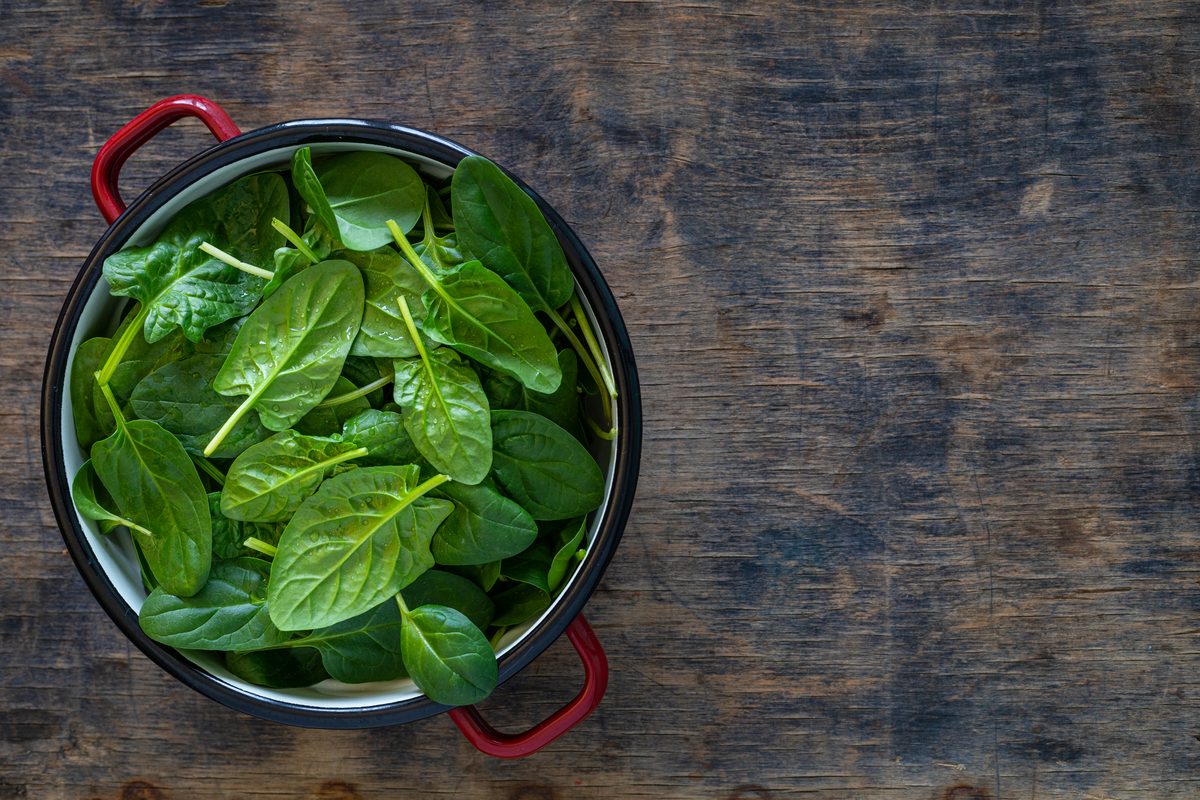
Spinach deserves a correction. It carries a reputation as an iron champion that comes from a misplaced decimal point copied for decades. The reality: 2.14 mg per 100 g cooked, or 3.21 mg for a 150 g portion. Respectable, ten times less than black pudding, and its iron is non-haem, so poorly absorbed.
Content is not absorption
This is the point rankings leave out, and it changes everything. Your body has no way of excreting iron: it regulates its stores only through absorption. What counts is not what you swallow, but what gets through.
A landmark review published in the American Journal of Clinical Nutrition puts iron bioavailability at 14 to 18% on a mixed diet and 5 to 12% on a vegetarian diet, in people with no iron stores (Hurrell & Egli, 2010, PMID 20200263).
The consequence is stark. Eleven milligrams eaten on a mixed diet give roughly 1.8 mg actually absorbed. To absorb the same amount on a vegetarian diet, you would need to eat around 21 mg, almost double the stated reference. That is why the recommendations do not read the same way depending on what is on your plate.
Two nuances the usual advice flattens
Inhibitors and enhancers matter less than you are told. Phytates, polyphenols, calcium, vitamin C, meat protein: their effect is huge in single-meal studies. But the same review notes that in studies of a varied diet, with several inhibitors and enhancers at once, the effect of each individual component becomes much more modest. The advice « drink orange juice with your lentils » is not wrong, it is overrated.
Your iron status weighs more than your menu. This is the most counter-intuitive line in the review: a person’s iron stores generally have a greater effect on absorption than the make-up of their diet. When stores are low, your body absorbs more, on its own. That is no excuse to eat badly, but it explains why two people on the same menu do not have the same ferritin.
How much iron you need a day
| Profile | Nutritional reference |
|---|---|
| Adult man | 11 mg/day |
| Adult woman, light to moderate menstrual losses | 11 mg/day |
| Adult woman, heavy menstrual losses | 16 mg/day |
The gap from 11 to 16 mg depending on how heavy periods are is the figure most often lost along the way. A woman in that situation who aims for 11 mg is really aiming for two thirds of her need.
References by age, pregnancy and menopause
The table above stops at adults. Yet needs change a lot over a lifetime, and two stages are surprising: a child aged 3 to 6 needs less iron than one aged 1 to 2, and a woman after the menopause goes back to the same level as a man.
| Profile | Average requirement | Reference (PRI) |
|---|---|---|
| Child aged 1 to 2 | 4 mg | 5 mg/day |
| Child aged 3 to 6 | 3 mg | 4 mg/day |
| Child aged 7 to 11 | 5 mg | 6 mg/day |
| Teenage boy aged 12 to 17 | 8 mg | 11 mg/day |
| Teenage girl, light to moderate or no periods | 7 mg | 11 mg/day |
| Teenage girl, heavy periods | 7 mg | 13 mg/day |
| Pregnant woman | 7 mg | 16 mg/day |
| Breastfeeding woman | 7 mg | 16 mg/day |
| Post-menopausal woman | 6 mg | 11 mg/day |
For pregnancy, Anses chose the most protective value, the one for women with heavy periods. It covers the baby’s needs, losses at delivery and rebuilding stores. EFSA (the European Food Safety Authority) does the same calculation as for a non-pregnant woman, but on one specific condition: starting pregnancy with a ferritin of at least 30 µg/L. That is the whole point of checking your stores before you conceive, not only afterwards.
Why these figures are so high compared with real needs
Your body keeps only a small part of the iron you swallow. To set these references, Anses assumes 25% absorption for haem iron and 15% for non-haem iron, rates obtained with a good-quality diet, rich in vitamin C and low in phytates, and low stores. Yet in the diets of adults in France, haem iron makes up only 10.4% of total iron, according to data from the INCA 3 study (France’s national food consumption survey) used by Anses. In children aged 7 to 10, it is 8%. In other words, almost nine milligrams in ten that you eat are « slow » iron, the kind whose absorption depends on the rest of the meal.
Who is short of iron in France?
Men, almost never. Women of childbearing age, often. That is the combined finding of the two major national studies.
What people eat. In the Anses INCA 3 study (2014-2015), adult men eat an average of 12.2 mg of iron a day, above their 11 mg reference. Adult women eat only 8.9 mg, with a median of 8.5 mg: less than the basic 11 mg, and barely more than half the 16 mg target for heavy periods. Among girls aged 11 to 17, the average is also 8.9 mg.
What blood tests show. The Esteban study by Santé publique France (the French public health agency, 2014-2016) measured ferritin in 2,472 adults. Among women of childbearing age, 20.3% had depleted stores (ferritin below 15 µg/L) and 21.5% had low stores (between 15 and 30 µg/L). Among 18 to 39 year olds, nearly one woman in four had empty stores. Iron deficiency anaemia affected 3.9% of women of childbearing age, and only 3.8% of them had received treatment during the year. Among men, depletion affected only 1.5%.
Girls are affected early: 10.4% of girls aged 6 to 17 had iron deficiency anaemia, versus 0.1% of boys. Across both sexes, only 6 children in 10 had normal stores.
Where the iron in French diets comes from. In adults, meat, fish and eggs provide 26% of iron, cereal products 20% (13% from bread alone) and fruit and vegetables 13%. Bread, quietly, weighs as much as all fruit and vegetables combined, and twice as much as vegetables alone (6.2%).
Two days, worked out
Here are two days built with the Ciqual table. The first reaches the 16 mg of a woman with heavy periods, the second shows what a well-planned vegetarian day gives.
A 16 mg day
| Meal | Food and amount | Iron |
|---|---|---|
| Breakfast | Muesli, 50 g | 1.7 mg |
| Lunch | Cooked green lentils, 200 g | 4.9 mg |
| Lunch | Raw red pepper, 100 g | 0.2 mg |
| Lunch | Wholemeal bread, 60 g | 1.2 mg |
| Snack | Pumpkin seeds, 30 g | 2.6 mg |
| Dinner | Cooked mussels, 150 g of meat | 6.0 mg |
| Dessert | Kiwi fruit, 100 g | 0.2 mg |
| Total | 16.8 mg | |
The pepper and the kiwi provide almost no iron. They are there for something else: 203 mg of vitamin C between them, placed at the meals containing the plant iron from the lentils. For dinner, light moules marinières do the job; for lunch, a red lentil and spinach dahl.
A vegetarian day
| Food and amount | Iron |
|---|---|
| Muesli, 50 g | 1.7 mg |
| Plain tofu, 150 g | 3.6 mg |
| Cooked chickpeas, 150 g | 2.0 mg |
| Wholemeal bread, 100 g | 2.0 mg |
| Pumpkin seeds, 30 g | 2.6 mg |
| Raw red pepper, 100 g, and kiwi fruit, 100 g | 0.4 mg |
| Total | 12.3 mg |
12.3 mg is above the 11 mg reference on paper. But all this iron is non-haem, and as you saw above, its absorption drops to 5 to 12% on a vegetarian diet. Without meat or shellfish, reaching 16 mg becomes very hard with normal portions. This is the profile where a ferritin test makes the most sense. A tofu and spinach saag brings two of this day’s sources together in one dish.
Iron supplements: what EFSA sets
There is no upper safety limit for iron in the strict sense. In 2024, EFSA judged the data insufficient to set one and instead set a safe level of intake: the highest dose at which you can be reasonably confident there is no adverse effect, from all sources combined.
| Age | Safe level of intake |
|---|---|
| 1 to 3 years | 10 mg/day |
| 4 to 6 years | 15 mg/day |
| 7 to 10 years | 20 mg/day |
| 11 to 14 years | 30 mg/day |
| 15 to 17 years | 35 mg/day |
| Adult, pregnancy, breastfeeding | 40 mg/day |
With food alone, this threshold is not at stake: EFSA considers the risk of overload from food negligible when the gut works normally. It concerns supplements. Digestive problems have been seen with non-haem iron preparations at 50 to 60 mg a day, especially when taken between meals. And in people with haemochromatosis or certain inherited anaemias, iron builds up in the tissues: for them, the whole reasoning is reversed. If your doctor prescribes iron, they set the dose and duration.
Frequently asked questions
Which food is highest in iron?
Grilled black pudding, with 22.8 mg per 100 g according to Ciqual 2025: twice a man’s daily reference, and haem iron, the best absorbed kind. Lists that put dried thyme first are right about content and wrong about use: you eat about two grams of it.
Which vegetable is highest in iron?
Cooked spinach tops the vegetables with 2.14 mg per 100 g, or 3.21 mg per 150 g portion. That is ten times less than black pudding, and its iron is non-haem, so less well absorbed. Its reputation comes from a misplaced decimal point copied for decades.
How can you absorb more iron?
Vitamin C at the same meal helps; tea and coffee with meals get in the way. But the effect of each factor on its own is clearly smaller on a varied diet than in single-meal studies (PMID 20200263). The most effective lever is still choosing foods with haem iron (meat, offal, shellfish), whose absorption hardly depends on the rest of the meal.
Is plant iron less well absorbed?
Yes, and the gap is large: bioavailability is estimated at 14-18% on a mixed diet versus 5-12% on a vegetarian diet (PMID 20200263). In practice, you need to eat almost twice as much to absorb the same amount. Plant sources are still useful, they simply need more volume.
How much iron does a woman need a day?
11 mg a day with light to moderate menstrual losses, 16 mg with heavy losses (Anses, 21 February 2025). It is the distinction most sources leave out, and it means a 45% higher need.
Can you eat offal without limit?
No. Liver concentrates iron but also vitamin A, which is a problem in excess, especially during pregnancy. And black pudding, despite its score, is still a processed meat: the PNNS guidelines set the limit at 150 g of processed meat a week. Shellfish have neither of these limits.
Should you take an iron supplement?
Not without a blood test. Your body cannot get rid of iron: supplementing blindly risks overload, and excess iron is not harmless. An iron panel, including ferritin, comes first.
Are eggs a good source of iron?
A modest one. A hard-boiled egg contains 1.72 mg of iron per 100 g according to Ciqual 2025, or about 1.7 mg for two eggs: 16% of the 11 mg reference. That is almost six times less than clams, weight for weight.
Do you need more iron during pregnancy?
Anses sets 16 mg a day during pregnancy and breastfeeding, versus 11 mg for a woman with moderate periods. EFSA stresses one point: this reference assumes you start pregnancy with adequate stores, meaning a ferritin of at least 30 µg/L. Antenatal check-ups make it possible to verify this.
Why are women more often short of iron than men?
Because they eat less of it and lose more. In the INCA 3 study, women eat 8.9 mg of iron a day versus 12.2 mg for men, even though their need is equal or higher. The result in the Esteban study: 20.3% of women of childbearing age have depleted stores, versus 1.5% of men.
What dose of supplemental iron is safe?
EFSA sets a safe level of intake of 40 mg a day for an adult, from all sources combined, and 10 to 35 mg depending on age for children. Above that, risk has not been shown but can no longer be ruled out. Take a supplement after a blood test and on medical advice.
Other rankings
Same method, based on the Ciqual table: foods high in magnesium, foods high in potassium, foods high in calcium, foods high in vitamin B12, foods high in vitamin C, foods high in omega-3.
Our sources
- Ciqual 2025 table (Anses), Iron column in mg/100 g, cross-checked with the site’s food pages. Portions are typical serving sizes, shown in each table.
- Anses, Références nutritionnelles en vitamines et minéraux, published 21 February 2025: 11 mg/day and 16 mg/day depending on how heavy periods are.
- Hurrell R. and Egli I., Iron bioavailability and dietary reference values, American Journal of Clinical Nutrition, 2010, PMID 20200263.
- Guidelines of the Programme national nutrition santé (PNNS) on processed meat.
- Anses, Les références nutritionnelles en vitamines et minéraux, collective expert report, request 2018-SA-0238, February 2021: tables 43 (share of haem iron from INCA 3) and 44 (references by profile).
- Anses, Étude individuelle nationale des consommations alimentaires 3 (INCA 3), collective expert report, April 2017: table 63 (iron intake by sex) and contributions of food groups.
- Santé publique France, Esteban 2014-2016, nutrition section, chapter on biological measurements: vitamins and minerals, December 2019.
- EFSA, Overview on Tolerable Upper Intake Levels as derived by the SCF and the NDA Panel, version 11, August 2025; EFSA NDA Panel, Scientific opinion on the tolerable upper intake level for iron, EFSA Journal, 2024.