Group · Fruit
Kiwi fruit
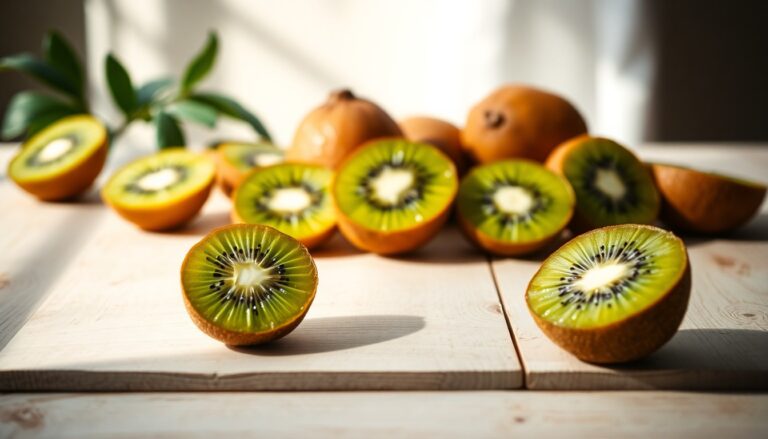
The kiwi fruit is a small fruit with fuzzy skin and green flesh (sometimes yellow or golden) dotted with tiny black seeds. Originally from China and later grown in New Zealand, it comes in several varieties, including the famous green-fleshed Hayward and the Gold kiwi, which has a milder, sweeter flavour. With only 60.9 kcal per 100 g, it fits easily into a balanced diet and suits people who exercise. Rich in vitamin C, fibre and water, the kiwi has impressive nutrition facts for such a low-calorie fruit. Fresh, sliced or in a smoothie, it brings freshness, tang and vitality to many sweet and savoury recipes.
Macronutrient breakdown
Nutrition table per 100 g
| Calories | 61 kcal |
| Kilojoules | 257 kJ |
| Protein | 0,9 g |
| Carbohydrate | 11 g |
| Fat | 0,6 g |
| Fibre | 2,4 g |
Micronutrients per 100 g
All measured nutrients, ranked by share of the daily reference intake.
- Vitamin C81,9 mg102 %
- Vitamin K116,6 µg22 %
- Copper0,15 mg15 %
- Potassium290 mg15 %
- Omega-3 ALA0,18 g9 %
- Vitamin E0,96 mg8 %
- Total omega-30,2 g8 %
- Vitamin B50,24 mg4 %
- Vitamin B9dietary folate equivalents22,2 µg
See the other 11 nutrients
- Phosphorus26 mg4 %
- Calcium29 mg4 %
- Magnesium12 mg3 %
- Vitamin B60,04 mg3 %
- Manganese0,05 mg3 %
- Vitamin B20,02 mg2 %
- Vitamin B30,23 mg1 %
- Zinc0,12 mg1 %
- Iron0,16 mg1 %
- Omega-6 LA0,07 g1 %
- Vitamin A3,17 µg0 %
Anses Ciqual 2025. Source: Anses, 2025, Ciqual food composition table
Tips
A kiwi is best eaten fully ripe, when it gives slightly under gentle pressure from your finger. You can eat it with a spoon after cutting it in half, or peel it and slice it into rounds. A portion of 1 to 2 kiwis covers a good share of your daily vitamin C needs while staying light in calories.
- At breakfast: with natural yoghurt, oat flakes or quark, for a fibre-rich meal.
- As a snack: on its own or in a homemade fruit salad, much better than tinned fruit salad, which is often sweeter.
- Savoury: diced over a fish carpaccio or in a mixed salad.
In terms of seasonality, kiwis are mainly available from November to May, which makes them a great fruit for the winter months. Their vitamin C, vitamin K, potassium and copper content, combined with 2.4 g of fibre per 100 g, makes them a useful fruit for digestive comfort and vitality. Their moderate glycaemic index and high water content make them a sensible choice for weight loss or for rebalancing your diet.
If you exercise, a kiwi is a good go-to snack before or after a workout: its natural sugars provide energy and its vitamin C contributes to antioxidant balance in the face of the oxidative stress caused by training. You can blend it into a post-workout smoothie with a banana and a source of protein, like the ideas in this article on post-workout shakes. Rich in potassium, it also helps restore fluid balance after sweating.
Good to know: kiwi contains an enzyme, actinidin, which stops gelatine from setting and makes dairy products bitter if they are mixed too far in advance. So eat it soon after mixing. For variety, alternate it with other fruit rich in vitamin C, such as oranges or strawberries.
For storage, keep your kiwis at room temperature to ripen, then in the fridge once ripe. To speed up ripening, put them next to an apple. Discover other options in the fruit family to build a colourful, varied plate all year round.
If you have diabetes: two kiwis make one portion of fruit, with a glycaemic index of 47. The figures are in our guide to kiwi fruit and diabetes.