Foods high in calcium: ranked by real portion
The short answer
Brown shrimp comes first with 1,000 mg of calcium per 100 g, more than an adult’s daily reference (950 mg). Next come tinned sardines with their bones (432 mg), kale (381 mg per portion) and hard cheeses, at around 300 mg per 30 g. But calcium only counts if it is absorbed: from spinach only 5% gets through, from kale 41%, better than milk.
The ranking, sorted by what a portion actually provides
Per 100 g, the Ciqual table puts baking powder (6,620 mg) and dried basil (2,240 mg) at the top. That is accurate and of no practical use. The ranking below works with typical portions.
| Food | Portion | Calcium | Share of 950 mg | Calories |
|---|---|---|---|---|
| Brown shrimp, cooked | 100 g | 1,000 mg | 105% | 89 kcal |
| Sardines in olive oil, tinned | 100 g | 432 mg | 45% | 224 kcal |
| Kale | 150 g | 381 mg | 40% | 52 kcal |
| Pecorino | 30 g | 348 mg | 37% | 115 kcal |
| Grana Padano | 30 g | 315 mg | 33% | 120 kcal |
| Semi-skimmed milk | 250 ml | 303 mg | 32% | 119 kcal |
| Parmesan | 30 g | 294 mg | 31% | 123 kcal |
| Emmental | 30 g | 293 mg | 31% | 112 kcal |
| Sesame seeds | 30 g | 289 mg | 30% | 182 kcal |
| Comté | 30 g | 272 mg | 29% | 124 kcal |
| Spider crab, cooked | 100 g | 230 mg | 24% | 108 kcal |
| Spinach, cooked * | 150 g | 210 mg | 22% | 29 kcal |
| Chia seeds | 30 g | 189 mg | 20% | 136 kcal |
| Watercress | 150 g | 180 mg | 19% | 23 kcal |
| Haricot beans, cooked | 150 g | 180 mg | 19% | 168 kcal |
| Plain yoghurt | 125 g | 165 mg | 17% | 91 kcal |
| Pak choi | 150 g | 158 mg | 17% | 22 kcal |
| Fromage frais | 100 g | 134 mg | 14% | 80 kcal |
| Plain tofu | 100 g | 100 mg | 11% | 147 kcal |
Hard cheeses, the densest dairy foods
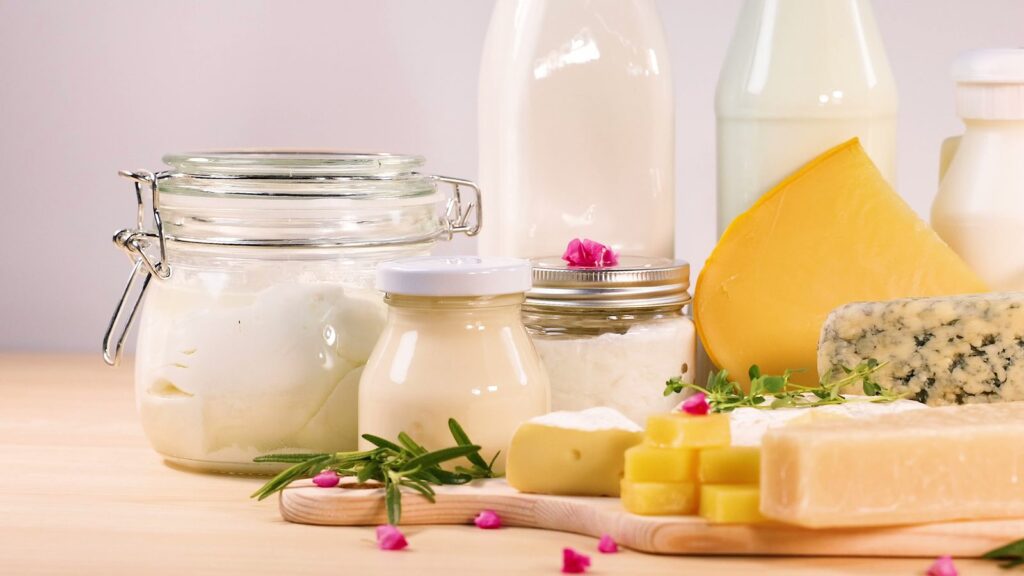
Pecorino, Grana Padano, Parmesan, Emmental and Comté provide between 272 and 348 mg per 30 g, almost a third of the reference. The trade-off is that this portion comes with 112 to 124 kcal and salt. A large glass of semi-skimmed milk does just as well, 303 mg, for 119 kcal.
Tinned sardines, thanks to their bones
It is the bones, softened by the canning process and eaten with the fish, that provide the calcium. Ciqual proves it: grilled sardines contain only 130 mg per 100 g, and boneless tinned fillets 108 mg, against 432 mg for whole sardines in olive oil.
What your body actually absorbs
Two foods that look rich in calcium on paper can give very different results in the body. Oxalates, found in large amounts in some vegetables, bind calcium and stop it getting through.
| Food | Calcium absorbed | Milk, same subjects |
|---|---|---|
| Spinach | 5.1% | 27.6% |
| Kale | 40.9% | 32.1% |
Spinach is not a source of calcium, despite its 210 mg per portion: at 5% absorption, it delivers around ten milligrams. Kale, on the other hand, which is low in oxalates, does better than milk.
What about water?
Some mineral waters are a genuine source. According to Ciqual, a litre of Hépar provides 549 mg of calcium and a litre of Contrex 468 mg, 58% and 49% of the reference, without a single calorie. A litre of Evian provides only 80 mg. It is a practical option if you do not eat dairy. Our guide to waters high in magnesium also compares their mineral content.

Calcium from water is absorbed as well as calcium from milk
You often hear that the calcium in mineral water is poorly absorbed. Tracer studies say the opposite. In a trial published in the American Journal of Clinical Nutrition in 1995, nine young women drank a water rich in calcium and sulphates, at 467 mg of calcium per litre, and then milk. Calcium absorption was 23.8% from the water and 25.0% from the milk, a non-significant difference (Couzy et al., PMID 7491887). Another study in 18 women, using a very calcium-rich Italian water, even found 47.5% absorption for the water against 43.3% for milk (Heaney and Dowell, 1994, PMID 7696826).
Both studies are small, and the second looked at a single brand. But their conclusions point the same way: if you do not eat dairy, a calcium-rich water is a source in its own right, not a second-best option. A litre at 467 mg covers about half an adult’s reference.
Plant-based drinks: fortified or not makes all the difference
This is the most common trap when you replace milk. A plant-based drink does not naturally contain the calcium of milk: only the fortified version comes close. The Ciqual table shows this for a 250 ml glass.
| Drink, 250 ml | Calcium | Share of 950 mg |
|---|---|---|
| Semi-skimmed milk | 303 mg | 32% |
| Plain soya drink, calcium-fortified | 245 mg | 26% |
| Plain chestnut drink | 193 mg | 20% |
| Sweetened almond drink, calcium-fortified | 135 mg | 14% |
| Plain soya drink, unfortified | 42 mg | 4% |
| Plain almond drink, unfortified | 30 mg | 3% |
| Plain rice drink | 13 mg | 1% |
| Plain oat drink, unfortified | 3 mg | 0.3% |
Between a fortified soya drink and an unfortified oat drink, the gap is 1 to 80. If you replace milk with a plant-based drink, the words « calcium-fortified » on the label matter more than the plant it is made from. And even fortified, an almond drink provides only half the calcium of a glass of milk.
In France, teenagers fall furthest short
The Anses INCA 3 study (2014-2015), the French national food consumption survey, compares actual intakes with the references. Adult men consume an average of 1,024 mg of calcium a day, women 840 mg, with a median of 803 mg: most women are therefore below 950 mg.
The clearest gap concerns teenagers. Boys aged 11 to 17 consume 996 mg a day, girls 859 mg, with a median of 775 mg. Yet this is the age when the reference is highest, 1,150 mg. Half of teenage girls therefore eat at best two thirds of what is recommended, just when bone mass is being built. In children under 11, the average intake is 830 mg, close to their reference of 800 mg.
Where does this calcium come from? In adults, dairy products provide 38%, 18% from cheese alone. Then come fruit and vegetables (10%), bottled water (8.4%), sandwiches, pizzas and tarts (7.9%) and hot drinks (7.2%). In children aged 1 to 10, the share from dairy rises to 58%. That shows what is at stake when a child or teenager gives up dairy without replacing it.
A 1,150 mg day for a teenager
| Meal | Food and quantity | Calcium |
|---|---|---|
| Breakfast | Bowl of semi-skimmed milk, 250 ml | 303 mg |
| Lunch | Cooked haricot beans, 150 g | 180 mg |
| Lunch | Plain yoghurt, 125 g | 171 mg |
| Afternoon snack | Almonds, 30 g | 78 mg |
| Dinner | Grated Emmental on pasta, 30 g | 293 mg |
| Dinner | Fromage frais, 100 g | 134 mg |
| Total | 1,159 mg | |
In this day, it takes four dairy products, twice the two portions of the adult reference, to meet a teenager’s needs without calcium-rich water. Swapping tap water for a calcium-rich water at meals takes the pressure off: half a litre at 467 mg per litre adds about 230 mg.
Pregnancy and breastfeeding: why the reference does not go up
As noted below, pregnancy does not raise the 950 mg reference. The explanation lies in how the body adapts. According to Anses, intestinal absorption of calcium increases during pregnancy. During breastfeeding, the calcium in breast milk comes mainly from increased bone resorption, and this loss is made up after breastfeeding ends. Several supplementation studies have shown no benefit for bone density when dietary intake was already adequate. The goal, then, is to reach the reference, not to exceed it. A mother-to-be who does not eat dairy would do well to talk to her midwife or doctor.
How much calcium a day
| Profile | Nutritional reference |
|---|---|
| Adults aged 25 and over | 950 mg/day |
| Adults aged 18 to 24 | 1,000 mg/day |
| Pregnant or breastfeeding women | 950 mg/day |
| Teenagers aged 11 to 17 | 1,150 mg/day |
| Children aged 4 to 10 | 800 mg/day |
| Children aged 1 to 3 | 450 mg/day |
Adolescence is the most demanding period, at 1,150 mg a day, because that is when most bone mass is built. Pregnancy does not raise the reference. For the role of calcium in bones, see our guide to bone health.
Two days that meet the reference, to give you a sense of scale. With dairy: a large bowl of milk (303 mg), a yoghurt (165 mg), 30 g of Emmental (293 mg) and 150 g of haricot beans (180 mg), a total of 941 mg. Without dairy: 150 g of kale (381 mg), 30 g of sesame seeds (289 mg), 150 g of haricot beans (180 mg) and 150 g of pak choi (158 mg), a total of 1,008 mg. Ideas for going without milk are in our guide to eating lactose-free.
Calcium supplements: the limit and the debate
EFSA sets the tolerable upper intake level for adults at 2,500 mg a day, including during pregnancy and breastfeeding, from all sources combined. For children and teenagers, it did not find enough data to set one. From food alone, it is hard to get close to this threshold. A supplement added to a diet already rich in dairy, however, does bring you closer to it.
Supplements also raise a cardiovascular question. A meta-analysis published in the BMJ in 2010 pooled 15 placebo-controlled trials of calcium supplements at 500 mg a day or more, without added vitamin D. Among participants whose individual data were available, 143 heart attacks occurred in the calcium group against 111 in the placebo group, a 31% higher risk (Bolland et al., PMID 20671013). The authors concluded that the role of these supplements in osteoporosis needed to be reassessed. This work looked at tablets, not at calcium from food.
Two practical consequences. First, look for calcium on your plate and in your water before looking for it in a tablet. Second, do not forget vitamin D: Anses points out that calcium absorption depends on vitamin D status. Sources of this vitamin are in our ranking of foods high in vitamin D. If you have osteoporosis or are on treatment, choosing a supplement is a matter for your doctor.
Frequently asked questions
Which food is highest in calcium?
Per portion, cooked brown shrimp, with 1,000 mg per 100 g according to Ciqual. Among everyday foods, hard cheeses such as Parmesan and tinned sardines with their bones.
Which vegetable is highest in calcium?
Kale, with 381 mg per 150 g, and well absorbed: 41%, better than milk. Spinach shows 210 mg, but only 5% of its calcium is absorbed.
Is spinach high in calcium?
On paper yes, in the body no: its oxalates block the calcium, absorbed at 5.1% against 27.6% for milk in the same study.
How can you get enough calcium without dairy?
With greens from the cabbage family (kale, pak choi), sesame seeds, haricot beans, tinned sardines and a calcium-rich water such as Hépar, 549 mg per litre. A typical day exceeds 1,000 mg.
Is milk the best source of calcium?
A good source, but not the only one: 303 mg per large glass, about 30% absorbed. Kale does better on absorption and hard cheeses on quantity.
How much calcium do you need a day?
Anses sets 950 mg a day from age 25, 1,000 mg from 18 to 24 and 1,150 mg during adolescence. The safe upper limit is 2,500 mg a day.
Do plant-based drinks contain calcium?
Only if they are fortified. A 250 ml glass of fortified soya drink provides 245 mg, almost as much as milk (303 mg). Unfortified, the same drink provides only 42 mg, and an unfortified oat drink 3 mg (Ciqual 2025).
Is the calcium in mineral water well absorbed?
Yes, as well as the calcium in milk. In a trial in young women, calcium from a water at 467 mg per litre was absorbed at 23.8%, against 25.0% for milk, with no significant difference (PMID 7491887).
Do teenagers get enough calcium?
Girls do not. In the INCA 3 study, girls aged 11 to 17 consume an average of 859 mg of calcium a day, with a median of 775 mg, against a reference of 1,150 mg. Boys are at 996 mg.
Should you take a calcium supplement?
Not by default. The EFSA safe upper limit is 2,500 mg a day, and a 2010 meta-analysis linked calcium supplements without vitamin D to a 31% higher risk of heart attack. Food and calcium-rich waters come first; a supplement is something to discuss with your doctor.
Other rankings
Same method, based on the Ciqual table: foods high in iron, foods high in magnesium, foods high in potassium, foods high in vitamin B12, foods high in vitamin C, foods high in omega-3.
Our sources
- Ciqual 2025 table (Anses), Calcium column in mg/100 g, cross-checked against the food pages on this site. Portions are shown in each table.
- Anses, Les références nutritionnelles en vitamines et minéraux, March 2021.
- Heaney R.P., Weaver C.M., Recker R.R., Calcium absorbability from spinach, Am J Clin Nutr, 1988 – PMID 3354496.
- Heaney R.P., Weaver C.M., Calcium absorption from kale, Am J Clin Nutr, 1990 – PMID 2321572.
- Couzy F. et al., Calcium bioavailability from a calcium- and sulfate-rich mineral water, compared with milk, in young adult women, American Journal of Clinical Nutrition, 1995 – PMID 7491887.
- Heaney R. P. and Dowell M. S., Absorbability of the calcium in a high-calcium mineral water, Osteoporosis International, 1994 – PMID 7696826.
- Bolland M. J. et al., Effect of calcium supplements on risk of myocardial infarction and cardiovascular events: meta-analysis, BMJ, 2010 – PMID 20671013.
- Anses, Étude individuelle nationale des consommations alimentaires 3 (INCA 3), April 2017: tables 44, 50 and 63, contributions of food groups.
- Anses, collective expert report 2018-SA-0238, February 2021: section 2.2.15 Calcium (pregnancy, breastfeeding, role of vitamin D).
- EFSA, Overview on Tolerable Upper Intake Levels as derived by the SCF and the NDA Panel, version 11, August 2025.