Group · Meat
Calf’s brains
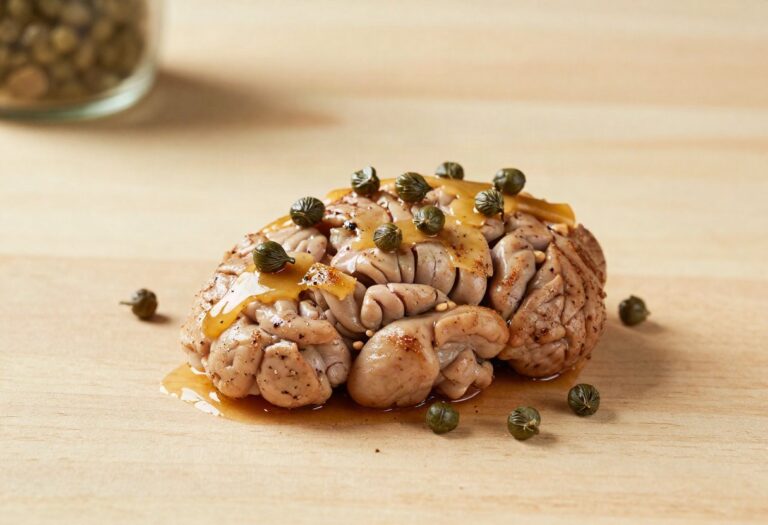
Calf’s brains are among the most delicate offal in traditional French cooking. Known for their melting texture and fine taste, they are most often prepared meunière, breaded or poached in court-bouillon. This is a prized product found at the butcher’s, and it must be very fresh. Nutritionally, calf’s brains provide around 135 kcal per 100 g, with 11.5 g of protein and 9.63 g of fat, with no carbohydrate or fibre. Rich in certain micronutrients and with a particular profile, they are best enjoyed in small amounts, as a gastronomic speciality to include now and then in a varied and balanced diet.
Macronutrient breakdown
Nutrition table per 100 g
| Calories | 135 kcal |
| Kilojoules | 562 kJ |
| Protein | 11,5 g |
| Carbohydrate | 0,6 g |
| Fat | 9,7 g |
Micronutrients per 100 g
All measured nutrients, ranked by share of the daily reference intake.
- Vitamin B129,65 µg386 %
- Phosphorus385 mg55 %
- Copper0,26 mg26 %
- Vitamin B51 mg17 %
- Vitamin C13 mg16 %
- Zinc1,61 mg16 %
- Vitamin B32,43 mg15 %
- Vitamin B20,2 mg14 %
See the other 9 nutrients
- Vitamin B60,17 mg12 %
- Iron1,67 mg12 %
- Potassium214 mg11 %
- Vitamin B10,08 mg7 %
- Magnesium16 mg4 %
- Calcium16 mg2 %
- Manganese0,04 mg2 %
- Vitamin B93 µg2 %
- Iodine1 µg1 %
Anses Ciqual 2025. Source: Anses, 2025, Ciqual food composition table
Tips
Calf’s brains are prepared by soaking in cold water to draw out the blood, then carefully removing the membranes. Cooking meunière (dusted with flour and then browned in butter) remains the most classic method, but you can also poach them in a vinegar-spiked court-bouillon before pan-frying them. Served with a squeeze of lemon, capers or a brown butter sauce, they go best with steamed vegetables to lighten the dish. Allow a reasonable portion of 80 to 100 g, which is enough given their fat content.
Nutrition facts and key points:
- Calories: 135 kcal per 100 g, a moderate energy density but driven by the fat.
- Protein: 11.5 g, complete protein that is useful for building muscle.
- Fat: 9.63 g, including some cholesterol typical of offal, hence the case for eating them in moderation.
- Carbohydrate and fibre: none, as with most meats and offal.
To vary your exploration of offal, you can try lamb’s brains, which taste similar, or products richer in iron such as calf’s liver. Sweetbreads also offer a soft texture appreciated by food lovers. You will find all the cuts and offal in the meat family.
For active people: calf’s brains provide good-quality protein useful for recovery, but their fat content makes them poorly suited to a light meal before exercise. Keep them for dinner instead, served with vegetables. If you are looking for a practical protein boost around your sessions, lean meats such as chicken breast or options like a protein snack will be better for an easily digested bite.
Weight control and storage: because of their high fat content, limit calf’s brains to an occasional food if you are watching your figure, and avoid cooking methods heavy on butter or frying. Choose gentle cooking, which preserves their delicacy. Buy them very fresh, keep them in the fridge and cook them within 24 hours of purchase. As part of a balanced meal, they remain a gastronomic pleasure to enjoy from time to time without overdoing it.