Group · Herbs & spices
Fleur de sel (sea salt flakes)
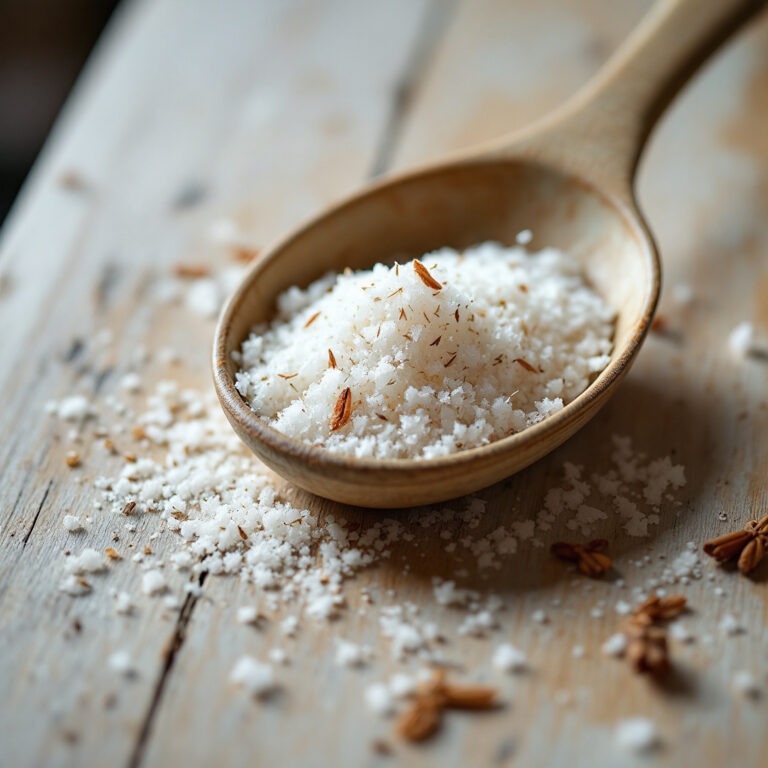
Fleur de sel is the fine crust of crystals that forms on the surface of salt pans when the wind and sun allow, harvested by hand with a wooden rake. Guérande, Noirmoutier, Camargue: the harvest is small, which explains the price. Its crunchy texture and slow dissolving are its only real difference from table salt.
In terms of nutrition facts, it provides no calories, and no protein, carbohydrate or fat. The only figure that matters is the salt: 94.3 g per 100 g. It also contains 424 mg of magnesium and 171 mg of calcium per 100 g, traces of seawater that give it its flavour, but with no nutritional significance, as explained below.
Macronutrient breakdown
Nutrition data unavailable.
Nutrition table per 100 g
Micronutrients per 100 g
All measured nutrients, ranked by share of the daily reference intake.
- Magnesium424 mg113 %
- Calcium171 mg21 %
- Potassium103 mg5 %
Anses Ciqual 2025. Source: Anses, 2025, Ciqual food composition table
Tips
The minerals in fleur de sel are a selling point, not a source of intake. 424 mg of magnesium per 100 g sounds like a lot; but at one gram per plate, that is 4 mg, or 1% of the reference intake. No mineral water, salt or spice meets a mineral requirement at the amount you actually use. Better to know that before paying the price.
It does not replace salt, it finishes the dish. Its value is texture: crystals that crunch between the teeth and do not dissolve immediately. In cooking water, it is strictly equivalent to coarse salt at a tenth of the price. Keep it for the final seasoning.
It can lower your salt consumption. A useful paradox: because the crystals dissolve slowly, your tongue perceives the saltiness more strongly. A pinch placed on the surface gives more sensation than a pinch mixed through the dish, so you end up using less overall.
The benchmark to remember. Anses (the French health agency) recommends not exceeding about 5 g of salt a day, from all sources. Two thirds of that total comes from processed foods (bread, cured meats, cheese), not from the salt shaker. That is where a change will show.
Not iodised: worth knowing. Fleur de sel is neither iodised nor fluoridated, unlike ordinary table salt. If it is your only salt, your iodine has to come from elsewhere: fish, seafood, dairy products, or the seaweeds in the Vegetables family.
Sources
Average nutritional values per 100 g, provided for guidance only (spices and condiments are eaten in small amounts; values vary by brand and preparation).