Cranberry pills for UTI: do they work? Benefits, dose and side effects
The short answer
Do cranberry pills work for UTIs? For prevention, modestly, and mainly in women with recurrent infections. The largest review, a 2023 Cochrane analysis of 50 trials and 8,857 people, found that cranberry products cut the risk of a new urinary tract infection by about a quarter in women with recurrent UTIs, and also helped children and people prone to UTIs after medical procedures. They did not help pregnant women or elderly people in care homes. Cranberry does not treat an active UTI: no trial shows that. EU health claims for cranberry have not been accepted, and cranberry can boost the effect of warfarin.
This article is for information and does not replace medical advice. Fever, back pain, blood in the urine, pregnancy or urinary symptoms in a man: see a doctor promptly.
What do cranberry pills do?
Cranberry (Vaccinium macrocarpon) is a tart North American berry, related to the blueberry. Its key compounds are A-type proanthocyanidins (PACs), polyphenols that stop some E. coli bacteria, the main cause of bladder infections, from sticking to the bladder wall. Cranberry is not an antibiotic: it does not kill bacteria, it makes it harder for them to settle. That is why it is studied for prevention, not treatment.
Watch the sugar: dried cranberries are usually sweetened (see sweetened dried cranberries), and so are many juice cocktails. See how much sugar a day.
Cranberry for UTI: what the evidence shows
Williams et al. pooled 50 randomised trials (8,857 people) of cranberry juice, capsules or tablets. Overall, the risk of a symptomatic, culture-confirmed UTI fell by 30% (26 trials, 6,211 people, moderate certainty evidence).
| Group | Effect on UTI risk |
|---|---|
| Women with recurrent UTIs (8 trials, 1,555 women) | 26% lower (RR 0.74) |
| Children (5 trials, 504) | 54% lower (RR 0.46) |
| People prone to UTIs after an intervention, such as a catheter (6 trials, 1,434) | 53% lower (RR 0.47) |
| Elderly people in care (3 trials) | Little or no effect (RR 0.93) |
| Pregnant women (3 trials) | Little or no effect (RR 1.06) |
| Neurogenic bladder, incomplete emptying (3 trials) | Little or no effect (RR 0.97) |
Compared with preventive antibiotics, cranberry may perform about the same (2 trials, 385 people, low certainty). Results vary widely between trials and products.
- Cranberry juice for UTI: in 373 women with a recent UTI, one 240 ml (8 oz) glass a day for 24 weeks reduced diagnosed episodes (39 vs 67 on placebo); one UTI was prevented for every 3.2 woman-years of use (Maki et al., 2016). Time to a culture-positive UTI did not change.
- Cranberry powder capsules: in 182 women with recurrent UTIs, 500 mg of whole-fruit powder a day for 6 months lowered the share of women with a UTI (10.8% vs 25.8%), even though the powder held only 0.56% PACs (Vostalova et al., 2015).
Can cranberry treat a UTI? A second Cochrane review (Jepson et al., 2023) found no adequate trials. An active infection needs medical care.
How much PAC? And what regulators say
- In a study of 32 volunteers (Howell et al., 2010), urine blocked E. coli adhesion more as the PAC dose rose, most clearly at 72 mg of PACs a day. This was a lab test on urine, not a count of infections prevented.
- The 2023 Cochrane review found no difference in UTI risk between low, moderate and high PAC doses (very low certainty).
- PACs are measured with different methods, so the same number on two labels may not mean the same thing.
In short, no PAC dose is validated. In the EU, health claims for cranberry supplements and urinary health have not been accepted: in 2014 the European Food Safety Authority (EFSA) reviewed a cranberry extract (Pacran) and found no cause-and-effect relationship. The European Medicines Agency, meanwhile, recognises cranberry juice since 2022 as a traditional herbal medicine to prevent recurrent uncomplicated UTIs in women, once a doctor has ruled out serious causes, at 30 ml of pure juice a day. That status rests on long-standing use and covers juice only.
Cranberry pills side effects and what to avoid
Warfarin: the EMA advises against combining cranberry with warfarin and with tacrolimus (an anti-rejection drug). The data are mixed: in 12 healthy men, two weeks of cranberry raised the INR response by 30% (Mohammed Abdul et al., 2008), while in 30 patients on warfarin, 240 ml of juice a day had no clinically important effect (Ansell et al., 2009). On a blood thinner, ask your doctor first.
| Situation | EMA position |
|---|---|
| Warfarin, tacrolimus | Do not combine |
| History of kidney stones | Caution: cranberry concentrate is high in oxalate |
| Kidney disease with recurrent UTIs | Medical supervision |
| Pregnancy and breastfeeding | Not recommended (no safety data) |
| Men, and under 18 | Not recommended without medical advice |
Tolerance is generally good: the Cochrane review found probably no more digestive side effects than placebo (10 trials, 2,166 people).
How to take cranberry
- Who: mainly women with recurrent UTIs, after seeing a doctor.
- Which form: pure juice (30 ml a day per the EMA), juice drinks (240 ml in Maki’s trial) or capsules; Cochrane cannot say one form beats another.
- Morning or night? No trial compares timing. What matters is taking it every day for months: many trials last 6 months.
- Good habits: drink enough (see how much water to drink a day) and do not hold in urine.
Recurrent UTIs sometimes go with an imbalanced vaginal flora: our best probiotic for vaginal flora comparison covers the strains studied, and our guide to probiotics and gut microbiota explains their role. For everyday polyphenols, try blueberries.
Nutrition•pro: organic cranberry capsules
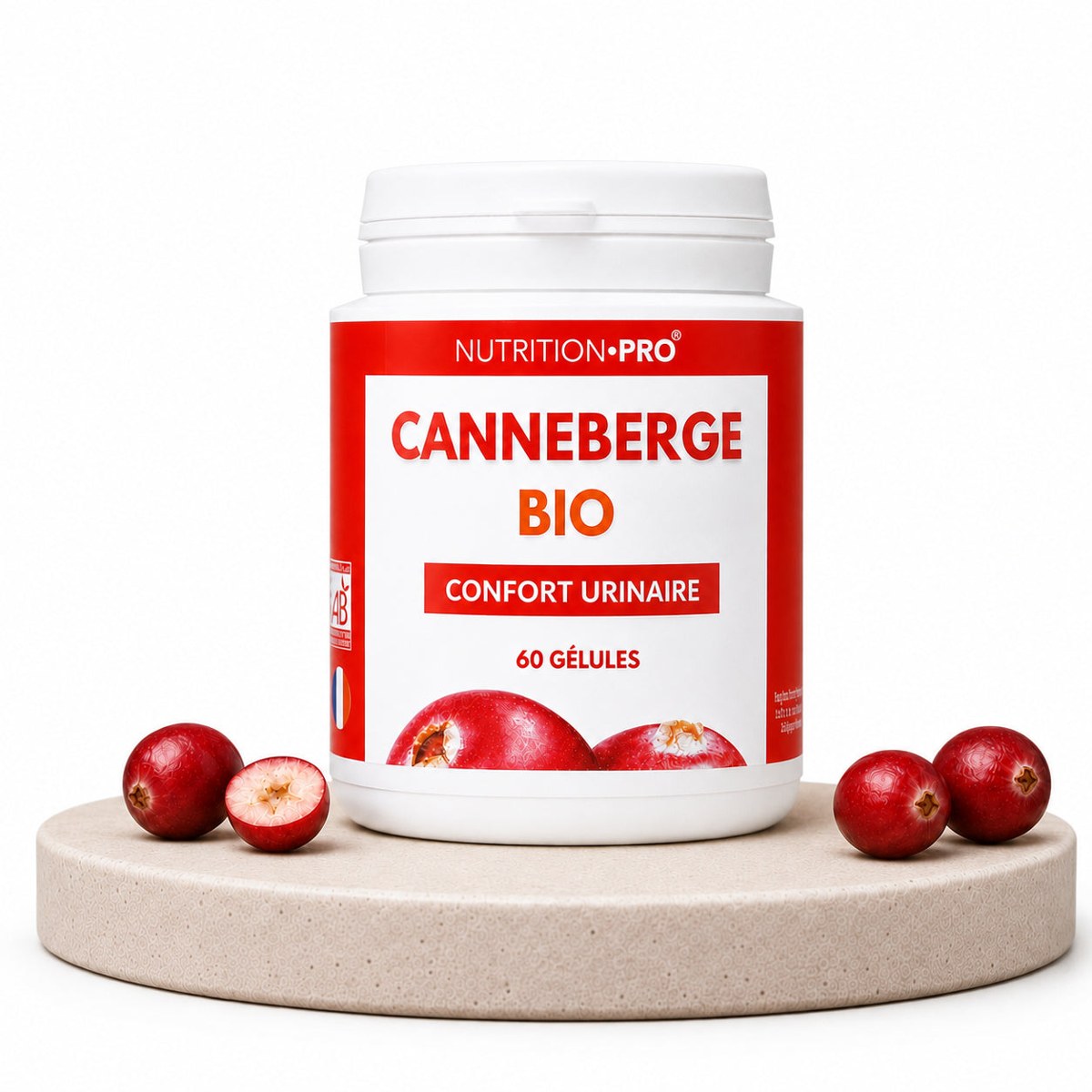
Nutrition•pro is a French brand based in Paris. Its organic Cranberry keeps to the essentials: an extract of Vaccinium macrocarpon fruit, the species used in the trials, organically grown and free of added sugar, unlike most juices.
- 1 g of organic cranberry extract per daily serving of 2 capsules;
- single ingredient, vegetable capsule (HPMC);
- 2 capsules a day with meals and a large glass of water;
- 60 capsules, a 1-month supply;
- €29.99 per jar (price checked on 22/11/2026), about €1.00 a day.
How does the dose compare? 1 g of extract is twice the 500 mg of whole-fruit powder that reduced recurrences in Vostalova’s trial, but an extract and a powder do not compare gram for gram, and the PAC content is not stated, so the product cannot be placed against the 36 or 72 mg PAC doses discussed in studies. If that figure matters to you, ask the brand. The capsule format avoids the sugar of juice, a real plus for daily use over months. Same cautions as above: no warfarin or tacrolimus without medical advice, care with kidney stones, and no self-treatment in pregnancy or in men.
Promo code: SEOCONSULTINGSL for 10% off your order, €26.99 per jar, about €0.90 a day (as of 22/11/2026).
See Nutrition•pro organic Cranberry →
Partner link: we earn a commission if you order through this link, at no extra cost to you.
Frequently asked questions
What are cranberry pills good for?
Lowering the risk of repeat UTIs, best shown in women with recurrent infections, children and people after certain procedures. They do not treat an active infection.
Does cranberry juice help a UTI?
It may help prevent the next one (240 ml a day reduced episodes in one trial), but no trial shows it cures an infection you already have.
What should you avoid when taking cranberry pills?
Warfarin and tacrolimus, per the EMA. Take care with a history of kidney stones, and do not use them to delay seeing a doctor.
Can you take cranberry pills while pregnant?
Trials in pregnant women showed no benefit, and the EMA does not recommend it for lack of safety data. A UTI in pregnancy needs medical treatment.
Do cranberry pills have side effects?
Few: digestive effects were probably no more common than with placebo in the Cochrane review. The main risk is the interaction with warfarin.
Sources
- Williams G. et al. Cranberries for preventing urinary tract infections. Cochrane Database Syst Rev, 2023; 4: CD001321. PubMed 37068952
- Jepson R.G. et al. Cranberries for treating urinary tract infections. Cochrane Database Syst Rev, 2023; 12: CD001322. PubMed 38096261
- EMA, HMPC. European Union herbal monograph on Vaccinium macrocarpon Aiton, fructus. EMA/HMPC/49135/2017, 23 November 2022. ema.europa.eu
- Howell A.B. et al. Dosage effect on uropathogenic Escherichia coli anti-adhesion activity in urine following consumption of cranberry powder standardized for proanthocyanidin content. BMC Infect Dis, 2010; 10: 94. PubMed 20398248
- Vostalova J. et al. Are high proanthocyanidins key to cranberry efficacy in the prevention of recurrent urinary tract infection? Phytother Res, 2015; 29(10): 1559-67. PubMed 26268913
- Maki K.C. et al. Consumption of a cranberry juice beverage lowered the number of clinical urinary tract infection episodes in women with a recent history of urinary tract infection. Am J Clin Nutr, 2016; 103(6): 1434-42. PubMed 27251185
- Mohammed Abdul M.I. et al. Pharmacodynamic interaction of warfarin with cranberry but not with garlic in healthy subjects. Br J Pharmacol, 2008; 154(8): 1691-700. PubMed 18516070
- Ansell J. et al. The absence of an interaction between warfarin and cranberry juice: a randomized, double-blind trial. J Clin Pharmacol, 2009; 49(7): 824-30. PubMed 19553405
- EFSA, NDA Panel. Scientific Opinion on the substantiation of a health claim related to Pacran and defence against bacterial pathogens in the lower urinary tract. EFSA Journal, 2014. doi.org/10.2903/j.efsa.2014.3656