The short answer
A water filter jug mainly improves the taste of tap water, by retaining chlorine. It does not make unsafe water safe, and Anses (the French food safety agency) has noted that it can release silver, sodium or potassium and degrade the microbiological quality of the water if it is used badly. On budget, the jug is paid for once, the cartridge is paid for every month: from 0.041 to 0.066 EUR per litre filtered depending on the packs, against 0.025 EUR for a tap filter. And anti-limescale cartridges remove some of the calcium and magnesium from the water.
What a jug really costs
The jug costs 25 to 60 EUR; what matters is the cartridge, to be replaced every four weeks or every 100 to 150 litres. The right indicator is therefore the cost per litre filtered.
| System and refill | Stated capacity | Price | Cost per litre filtered | One year, 2 litres a day |
|---|---|---|---|---|
| Brita A 1000, under-sink filter | 4,000 l or 6 months | 49.99 EUR | 0.012 EUR | 100 EUR, two filters |
| Brita ON TAP V, tap filter, 3 refills | 600 l or 4 months each | 44.99 EUR | 0.025 EUR | 45 EUR |
| Brita ON TAP V, 1 refill | 600 l or 4 months | 19.99 EUR | 0.033 EUR | 60 EUR |
| Brita MAXTRA PRO, 12 cartridges | 150 l or 4 weeks each | 73.90 EUR | 0.041 EUR | 80 EUR |
| BWT Magnesium Mineralized Water, 3 cartridges | 100 to 150 l or 4 weeks each | 19.90 EUR | 0.044 to 0.066 EUR | 86 EUR |
| Brita P 1000, under-sink filter | 1,200 l or 12 months | 59.99 EUR | 0.050 EUR | 60 EUR |
| Brita MAXTRA PRO, 6 cartridges | 150 l or 4 weeks each | 49.90 EUR | 0.055 EUR | 108 EUR |
The time limit matters more than the capacity. At 2 litres a day, a jug cartridge filters 56 litres in four weeks, far from its 150 litres, but must be changed all the same. The real cost per litre is therefore almost three times that in the table: about 0.11 EUR with the pack of 12 MAXTRA PRO. Tap and under-sink filters, which last several months, fare better.
What a jug does, and does not do
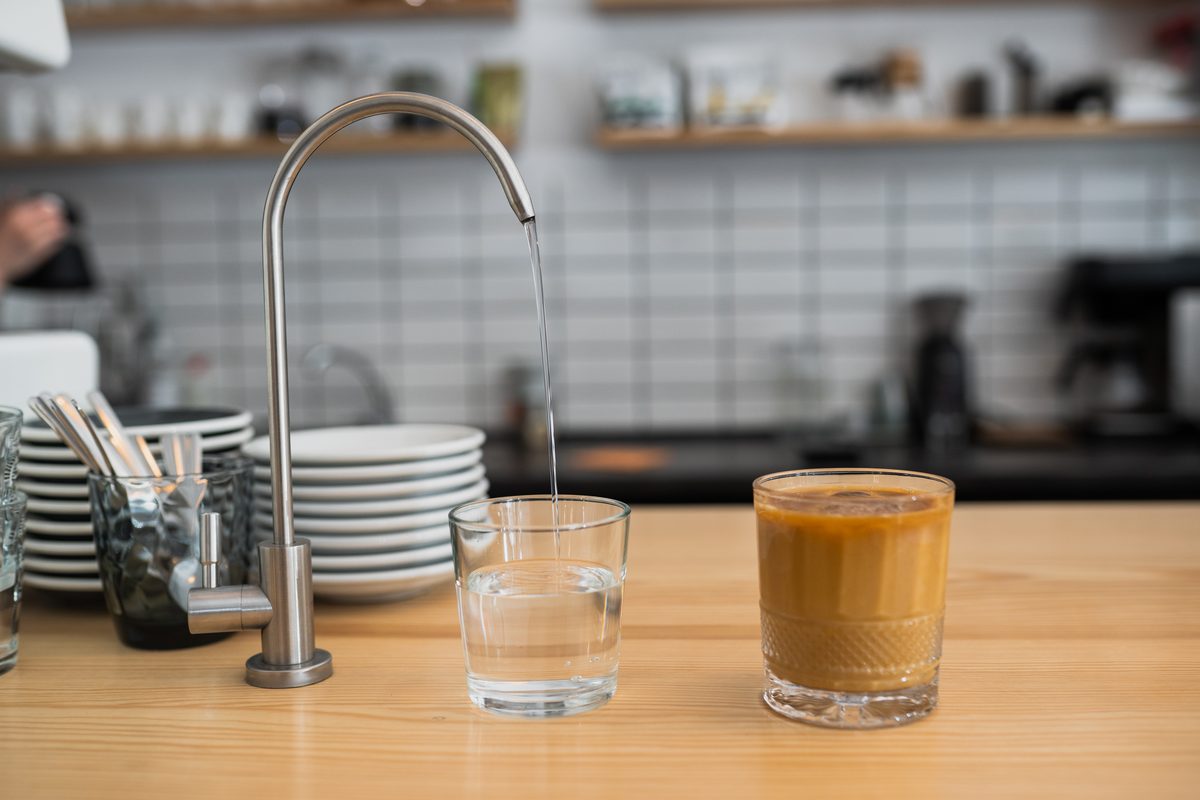
It improves taste, mainly by retaining chlorine
The activated carbon in the cartridges retains chlorine and some of the compounds that give tap water a taste. That is the main benefit, and the easiest to notice. Brands also claim a reduction in certain metals such as lead and copper, certain pesticides, drug residues or PFAS; Anses considers that these claims should be verified by standardised tests and that the reduction rates should appear on the packaging.
It does not make unsafe water safe
Anses insists: filter jugs are intended only for tap water that is already safe to drink. In France, this water is one of the most closely monitored foods. If your water has a real problem, for example lead pipes in an old building, the action has to be taken at the source.
Used badly, it can degrade the water
In its opinion of 19 October 2016, Anses notes that filtration can cause a drop in pH, a release of silver, sodium, potassium or ammonium, and a deterioration in the microbiological quality of the water during all or part of the life of the cartridge. Silver is used to limit bacterial growth in the activated carbon. Hence the basic rules: follow the instructions, change the cartridge on time, keep the jug in the fridge and drink the filtered water quickly. Anses also warns against cartridges sold online that do not always comply with European regulations.
The point that matters for nutrition: minerals
Anti-limescale cartridges remove some of the calcium and magnesium. Limescale is made precisely of calcium and magnesium carbonates: reducing « carbonate hardness », as the MAXTRA PRO EXPERT ANTI-TARTRE cartridge advertises, means reducing these two minerals. Brita writes that essential minerals are « preserved depending on the filtration used ». If you count on your water for part of your magnesium, an anti-limescale cartridge goes in the wrong direction.
« Magnesium » cartridges do not say how much they add. BWT sells cartridges that enrich the water with magnesium, and others with zinc and magnesium, but does not publish the amount per litre. It is therefore impossible to compare them with a magnesium-rich mineral water, whose label gives the exact content. Our ranking of magnesium-rich waters gives these contents, and our magnesium comparison shows what a supplement costs.
Our verdict
If the taste of chlorine bothers you, a jug does the job, provided you change the cartridge every four weeks and keep it cool. To limit the cost, the Brita ON TAP V tap filter works out about half the price over a year compared with a jug, 45 EUR against 80 to 108 EUR. Avoid anti-limescale cartridges if your water is your source of calcium and magnesium, and set aside « enriched » water claims until the content is published. And if your tap water simply tastes fine, you need nothing: our guide on how much water to drink gives the benchmarks.
Our sources
- Official websites brita.fr and bwt.com, consulted on 24/09/2026: prices, capacities and cartridge claims.
- Anses, opinion of 19 October 2016 on the assessment of the safety and efficacy of filter jugs, referral no. 2015-SA-0083.