Group · Meat
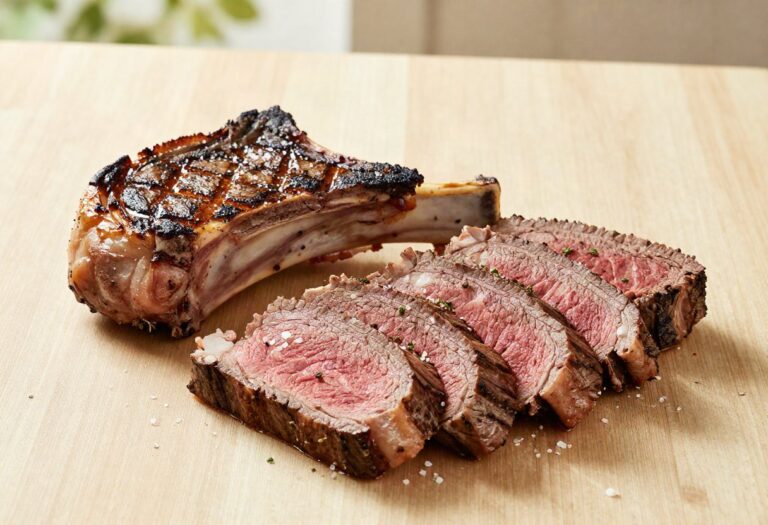
Côte de bœuf (rib of beef)
Côte de bœuf is a bone-in cut taken from the forerib, thick and marbled. It is this marbling, the fat running through the muscle, that gives it its tenderness and its nutritional values.
On the nutrition side, it provides 251 kcal per 100 g raw, with 19.6 g of fat, 18.7 g of protein and no carbohydrate. It provides 2.8 mg of haem iron.
Macronutrient breakdown
Nutrition table per 100 g
| Calories | 251 kcal |
| Kilojoules | 1040 kJ |
| Protein | 18,7 g |
| Fat | 19,6 g |
Micronutrients per 100 g
All measured nutrients, ranked by share of the daily reference intake.
- Vitamin B121,4 µg56 %
- Vitamin B60,42 mg30 %
- Vitamin B34,5 mg28 %
- Phosphorus188 mg27 %
- Iron2,8 mg20 %
- Potassium355 mg18 %
- Vitamin B20,17 mg12 %
- Vitamin B10,08 mg7 %
See the other 4 nutrients
- Magnesium18 mg5 %
- Vitamin B96,9 µg3 %
- Iodine2,4 µg2 %
- Calcium11 mg1 %
Anses Ciqual 2025. Source: Anses, 2025, Ciqual food composition table
Tips
The stated weight includes the bone. A 1.2 kg rib gives about 900 g of meat. This is worth knowing when estimating portions: a 1.2 kg rib comfortably feeds four people.
Marbling is not a flaw. Of the 19.6 g of fat, less than half is saturated. Some of the fat melts during cooking and stays in the pan: what reaches the plate is less fatty than the raw cut.
The iron. 2.8 mg of haem iron per 100 g, in a form far better absorbed than plant iron. This is the real nutritional value of this cut, beyond the pleasure.
Frequency. French guidelines put meat other than poultry at around 500 g a week. A shared rib counts as a special meal, not a habit.