Group · Cereals & grains
Chestnut flour
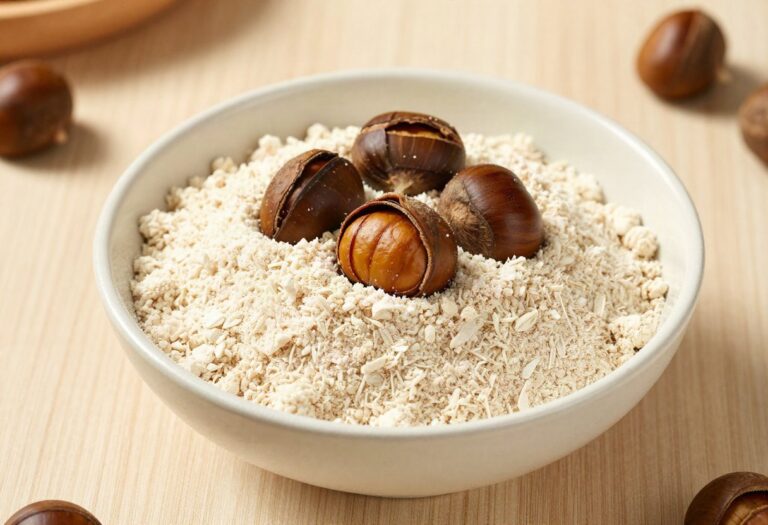
Chestnut flour is made from dried, ground chestnuts. It is not a cereal: it is a nut fruit, which explains its sweet taste and its complete absence of gluten. It is traditional in Corsica, the Ardèche and Tuscany.
In terms of nutrition facts: 362 kcal per 100 g, with 70.4 g of carbohydrates, 12.6 g of fibre, the record among flours, and 6.1 g of protein. It provides 67.9 mg of magnesium, 61.6 mg of calcium and 2.1 mg of vitamin B3 per 100 g.
Macronutrient breakdown
Nutrition table per 100 g
| Calories | 362 kcal |
| Kilojoules | 1530 kJ |
| Protein | 6,1 g |
| Carbohydrate | 70,4 g |
| Fat | 3,5 g |
| Fibre | 12,6 g |
Micronutrients per 100 g
All measured nutrients, ranked by share of the daily reference intake.
- Manganese3,2 mg160 %
- Copper0,5 mg50 %
- Vitamin B60,58 mg41 %
- Vitamin B51,53 mg26 %
- Vitamin C16 mg20 %
- Magnesium67,9 mg18 %
- Vitamin B32,1 mg13 %
- Zinc1,1 mg11 %
- Vitamin B9dietary folate equivalents215 µg
See the other 3 nutrients
- Omega-6 LA1,03 g10 %
- Calcium61,6 mg8 %
- Omega-3 ALA0,12 g6 %
Anses Ciqual 2025. Source: Anses, 2025, Ciqual food composition table
Tips
12.6 g of fibre: no flour does better. Twice as much as barley flour, and incomparable with white wheat flour.
It is naturally sweet. Its 70.4 g of carbohydrates include a large share of simple sugars: a chestnut recipe needs much less added sugar, often half.
Gluten-free, so no structure. It does not rise and does not hold together alone: cut it to a quarter or a third in a dough, or use it in preparations that do not need to rise, such as Tuscan castagnaccio.
Only 6.1 g of protein. That is the weak point compared with cereal flours, which have twice as much. It is a fruit, not a grain.
It goes rancid quickly. Its fat makes it fragile: six months at most, in a closed jar in a cool place. After that, it takes on a recognisable bitter taste.