Group · Cereals & grains
Millet
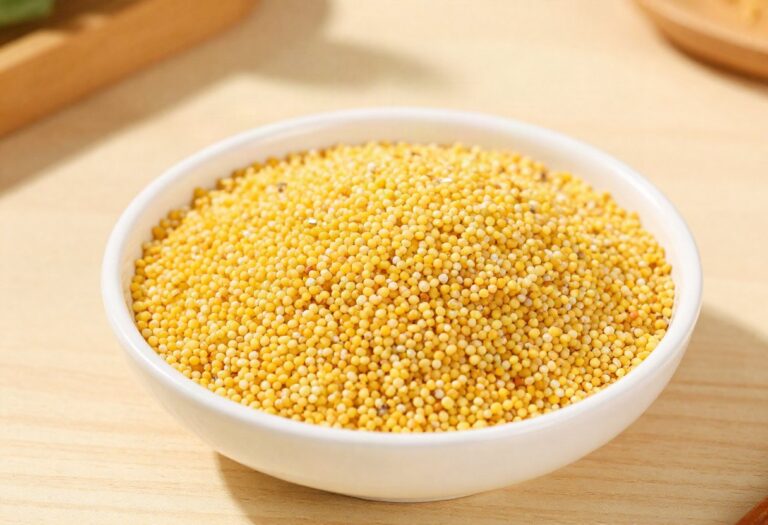
Millet, known in French as mil or millet, covers several small round-grained cereals grown since the Neolithic in Africa and Asia. It is the staple cereal of the Sahel, where it withstands drought better than any other.
In terms of nutrition facts, cooked without salt: 116 kcal per 100 g, with 22.4 g of carbohydrates, 3.76 g of protein and 1.3 g of fibre. It provides 44 mg of magnesium, 100 mg of phosphorus, 1.33 mg of vitamin B3 and 0.91 mg of zinc per 100 g.
Macronutrient breakdown
Nutrition table per 100 g
| Calories | 116 kcal |
| Kilojoules | 492 kJ |
| Protein | 3,8 g |
| Carbohydrate | 22,4 g |
| Fat | 1 g |
| Fibre | 1,3 g |
Micronutrients per 100 g
All measured nutrients, ranked by share of the daily reference intake.
- Copper0,16 mg16 %
- Phosphorus100 mg14 %
- Manganese0,27 mg14 %
- Magnesium44 mg12 %
- Vitamin B10,11 mg10 %
- Zinc0,91 mg9 %
- Vitamin B31,33 mg8 %
- Vitamin B60,11 mg8 %
- Vitamin B9dietary folate equivalents19 µg
See the other 8 nutrients
- Vitamin B20,08 mg6 %
- Iron0,63 mg5 %
- Potassium62 mg3 %
- Vitamin B50,17 mg3 %
- Vitamin K10,3 µg0 %
- Calcium3 mg0 %
- Vitamin E0,02 mg0 %
- Vitamin A0,17 µg0 %
Anses Ciqual 2025. Source: Anses, 2025, Ciqual food composition table
Tips
It is gluten-free. That is one of its main strengths in Europe: a true cereal that can be used on a coeliac diet, unlike wheat, barley or rye.
116 kcal cooked is low. Millet absorbs a lot of water: on the plate, it is noticeably less dense than rice or semolina. A generous portion is still reasonable.
44 mg of magnesium per 100 g cooked. A good score for a cooked cereal, close to the level of quinoa.
Toast it before cooking. Two minutes dry in the pan, until it smells fragrant: this completely changes its taste, which is otherwise often found bland.
It suits everything. As grains like rice, as a breakfast porridge, or as a patty. Its neutral flavour makes it a base, as long as you season it boldly.