Group · Dairy
Pecorino
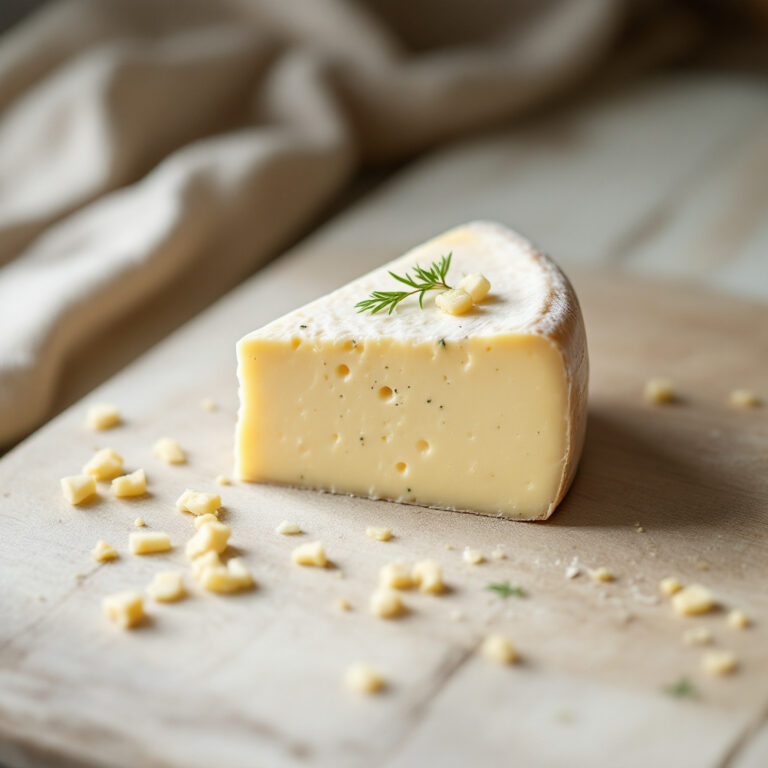
Pecorino is a family of Italian sheep’s milk cheeses (pecora means sheep), the best known of which is pecorino romano. Dry, granular and very salty, it is grated rather than sliced, and it is the essential ingredient of cacio e pepe pasta and the Roman carbonara.
On nutrition facts: 383 kcal per 100 g, with 31 g of fat of which 22 g saturated fatty acids, and 25 g of protein. Two figures stand out: 1,160 mg of calcium per 100 g (145% of the reference intake) and 5.3 g of salt, one of the highest of all cheeses.
Macronutrient breakdown
Nutrition table per 100 g
| Calories | 383 kcal |
| Kilojoules | 1590 kJ |
| Protein | 25 g |
| Carbohydrate | 1 g |
| Fat | 31 g |
Micronutrients per 100 g
All measured nutrients, ranked by share of the daily reference intake.
- Calcium1160 mg145 %
- Phosphorus675 mg96 %
- Zinc3,5 mg35 %
- Vitamin B20,47 mg34 %
- Vitamin A139 µg17 %
- Iron1,4 mg10 %
- Vitamin D0,5 µg10 %
- Vitamin B60,09 mg6 %
See the other 4 nutrients
- Potassium94 mg5 %
- Vitamin B97 µg4 %
- Vitamin B10,03 mg3 %
- Vitamin B30,2 mg1 %
Anses Ciqual 2025. Source: Anses, 2025, Ciqual food composition table
Tips
5.3 g of salt, but you grate 10 g. That is the right scale: a portion of pasta gets 10 to 15 g, which is about 0.6 g of salt. That is not negligible, but it is very far from the raw figure. A pecorino dish never needs salting otherwise.
Do not salt the pasta water. That is the Roman rule, and it is right: between the salted water and the cheese, a cacio e pepe becomes inedible. See salt for daily reference points.
Its calcium is genuinely useful. 1,160 mg per 100 g: 20 g of pecorino provide nearly 30% of the reference intake. Hard cooked-pressed cheeses are, along with Beaufort, the foods with the most calcium in the whole database.
It keeps for a very long time. Its low water content, 32.2 g per 100 g, makes it barely perishable: a well-wrapped piece lasts weeks in the fridge. Grate it as needed, never in advance.
Sheep, not cow. This matters if you have a cow’s milk protein allergy: pecorino contains none, but sheep proteins often cross-react with those of the cow. It is therefore not a safe exemption without medical advice.
Sources
Average nutrition values per 100 g, given for guidance (spices and condiments are eaten in small amounts; values vary by brand and preparation).