Group · Sweet foods
Petit beurre
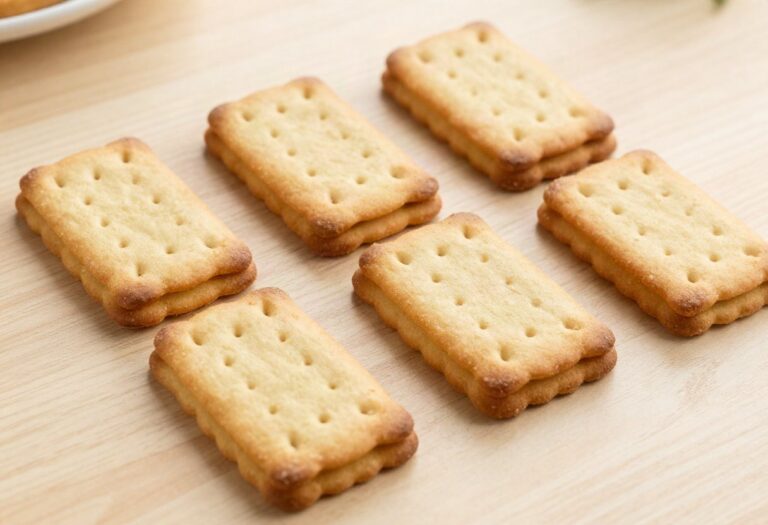
The petit beurre is a great classic of French biscuit-making, recognisable by its rectangular shape with four notched corners and scalloped edges. Made from wheat flour, sugar, butter and sometimes eggs, this dry biscuit has accompanied coffee, tea and teatime for generations. It is available plain, but also in chocolate-coated or chocolate chip versions. In terms of nutrition facts, the petit beurre provides around 450 kcal per 100 g, with 73.4 g of carbohydrate, 13.3 g of fat and 7.78 g of protein. It is a handy, affordable treat, to be enjoyed in moderation as part of a varied and balanced diet.
Macronutrient breakdown
Nutrition table per 100 g
| Calories | 450 kcal |
| Kilojoules | 1890 kJ |
| Protein | 7,8 g |
| Carbohydrate | 73,4 g |
| Fat | 13,3 g |
| Fibre | 2,6 g |
Micronutrients per 100 g
All measured nutrients, ranked by share of the daily reference intake.
- Manganese0,5 mg25 %
- Phosphorus100 mg14 %
- Copper0,12 mg12 %
- Vitamin B919,1 µg10 %
- Vitamin B50,48 mg8 %
- Potassium150 mg8 %
- Vitamin B10,08 mg7 %
- Iron0,82 mg6 %
See the other 11 nutrients
- Omega-6 LA0,53 g5 %
- Zinc0,52 mg5 %
- Magnesium18 mg5 %
- Vitamin E0,53 mg4 %
- Calcium34 mg4 %
- Vitamin B120,09 µg4 %
- Total omega-30,09 g4 %
- Omega-3 ALA0,07 g4 %
- Vitamin B20,04 mg3 %
- Vitamin B60,03 mg2 %
- Vitamin K11,09 µg1 %
Anses Ciqual 2025. Source: Anses, 2025, Ciqual food composition table
Tips
The petit beurre has many practical advantages: it keeps for a long time in its airtight tin, is easy to carry and has endless culinary uses. But its calorie density remains high, around 450 kcal per 100 g, and a single biscuit rarely weighs more than 8 g. A reasonable portion is around 2 to 4 biscuits, the equivalent of a small snack.
How to eat petit beurre?
- At teatime, with a piece of fresh fruit and a dairy product for a more filling, better-balanced snack.
- As the base for a cheesecake or tart case, crumbled with a little melted butter.
- Dunked in a coffee, a tea or a hot chocolate, for a childhood treat.
- With a compote with no added sugar, to limit your sugar intake.
Nutritionally, the petit beurre is mainly made up of carbohydrate (nearly 73.4 g per 100 g) from the flour and sugar, which gives it a fairly high glycaemic index. Its 2.54 g of fibre is modest, unlike an oat biscuit, which is better for fullness. If you are looking for a festive alternative, shortbread or gingerbread offer other tasty profiles within the sugary foods family.
Tip for active people: thanks to its quickly available carbohydrate, the petit beurre can help out as a snack before moderate exercise, or contribute to replenishing glycogen stores after training. Pair it with a source of protein (yoghurt, fromage blanc, a shake) to support recovery. For snacks better suited to performance, take a look at our protein snack ideas, which are better balanced in protein and fibre.
Weight control: dry biscuits are easy to nibble without noticing. The winning habit is to take out your portion in advance rather than eating straight from the packet. Also watch out for chocolate-coated versions, which are higher in fat and sugar. The petit beurre is not a food to ban: eaten in moderation and chosen among your treats, it has its place. To compare its calories with other sweet treats, see our food calorie table.