Group · Meat
Duck rillettes
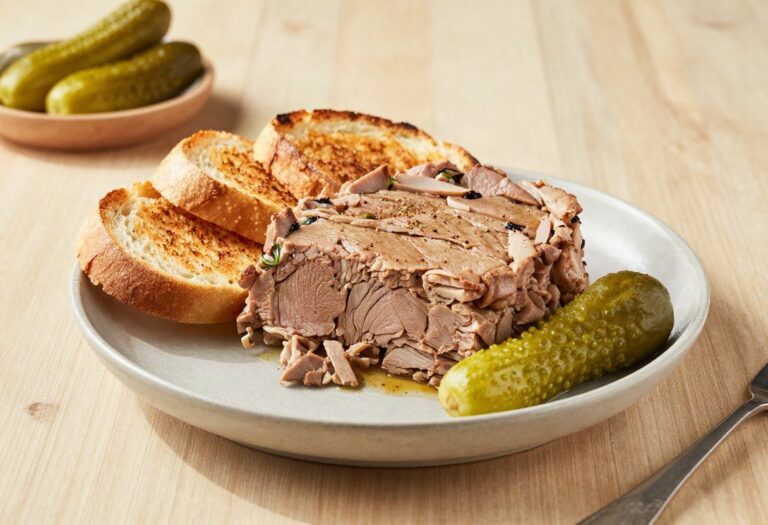
Duck rillettes are duck meat slowly cooked in its own fat then shredded. Duck fat changes things compared with pork: it is mostly monounsaturated, like olive oil.
As for nutrition facts: 377 kcal per 100 g, with 34.6 g of fat including 11.2 g of saturated fat, and 15.3 g of protein. They provide 1.76 µg of vitamin B12, 1.6 mg of iron and 200 mg of phosphorus per 100 g, with 1.25 g of salt.
Macronutrient breakdown
Nutrition table per 100 g
| Calories | 377 kcal |
| Kilojoules | 1560 kJ |
| Protein | 15,3 g |
| Carbohydrate | 1,1 g |
| Fat | 34,6 g |
Micronutrients per 100 g
All measured nutrients, ranked by share of the daily reference intake.
- Vitamin B121,76 µg70 %
- Omega-6 LA4,23 g42 %
- Phosphorus200 mg29 %
- Zinc2,5 mg25 %
- Vitamin B33,05 mg19 %
- Calcium140 mg18 %
- Omega-3 ALA0,31 g16 %
- Total omega-30,33 g13 %
See the other 11 nutrients
- Vitamin B50,69 mg12 %
- Iron1,6 mg11 %
- Potassium210 mg11 %
- Copper0,1 mg10 %
- DHA0,02 g8 %
- Vitamin B915 µg8 %
- Vitamin B60,09 mg6 %
- Magnesium19 mg5 %
- Vitamin E0,6 mg5 %
- Vitamin B20,07 mg5 %
- Manganese0,08 mg4 %
Anses Ciqual 2025. Source: Anses, 2025, Ciqual food composition table
Tips
The fat profile is better than that of pork. 11.2 g of saturated fat out of 34.6 g of fat, against 14.8 g out of 37.6 g for rillettes du Mans. The difference is real without being spectacular.
A 30 g slice on bread is worth 113 kcal. That is the unit to calculate with: the 377 kcal per 100 g only describe the pot.
1.25 g of salt is moderate for this part of the shop. The fat does the preserving, not the salt. A slice provides 0.38 g.
They count towards the processed meat guideline. 150 g a week, all products combined, according to the Programme national nutrition santé.
Serve them at room temperature. Cold, the fat is set and the flavour is muted. Twenty minutes out of the fridge is enough: this is the rule for all confit products.