Group · Fish
John Dory
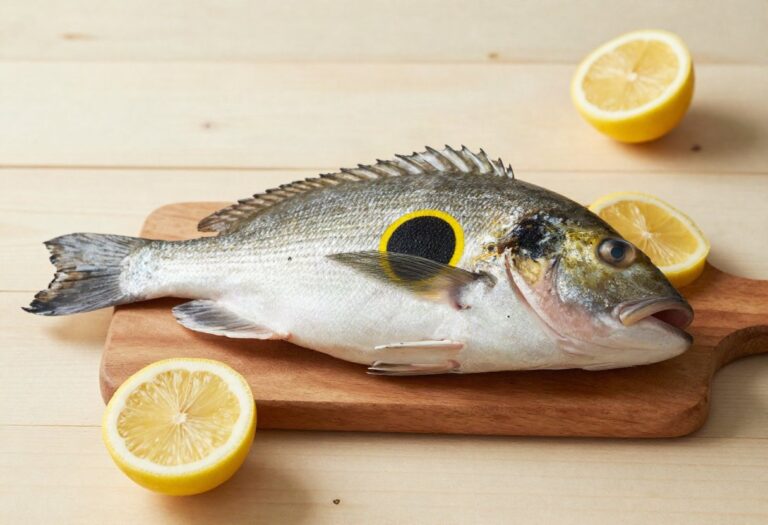
The John Dory (known in French as Saint-Pierre) is a deep-bodied, flattened fish, recognisable by the dark spot on its flank, said in legend to be the mark of Saint Peter’s thumb. Its fine white flesh is one of the most sought after in French gastronomy.
In terms of nutrition facts, raw: 86.7 kcal per 100 g, with 19.9 g of protein and 0.8 g of fat. It provides 3.6 mg of iron, 307 mg of potassium, 180 mg of phosphorus and 20 µg of iodine per 100 g, with 0.17 g of salt.
Macronutrient breakdown
Nutrition table per 100 g
| Calories | 87 kcal |
| Kilojoules | 368 kJ |
| Protein | 19,9 g |
| Fat | 0,8 g |
Micronutrients per 100 g
All measured nutrients, ranked by share of the daily reference intake.
- DHA0,17 g68 %
- Vitamin B60,95 mg68 %
- Copper0,27 mg27 %
- Iron3,6 mg26 %
- Phosphorus180 mg26 %
- Potassium307 mg15 %
- Iodine20 µg13 %
- Zinc0,95 mg10 %
See the other 6 nutrients
- EPA0,02 g8 %
- Total omega-30,19 g8 %
- Magnesium22,5 mg6 %
- Manganese0,1 mg5 %
- Calcium31,5 mg4 %
- Omega-3 ALA0 g0 %
Anses Ciqual 2025. Source: Anses, 2025, Ciqual food composition table
Tips
3.6 mg of iron: very high for a white fish. A quarter of the reference intake per 100 g, and it is haem iron, absorbed three to four times better than plant iron.
19.9 g of protein for 0.8 g of fat. The profile of the lean white fish par excellence, on a par with pouting.
Its yield is very low. A big head and large flat bones mean a whole John Dory gives barely 35% flesh. Allow 500 g whole weight per person, which explains its price.
It cooks in a few minutes. The fillets are thin: three minutes per side in a frying pan, or eight minutes whole in the oven. Its delicate flesh cannot tolerate any overcooking.
It needs almost nothing. A drizzle of olive oil, some lemon, a little fleur de sel. At this price, a heavy sauce would be a waste.