Group · Fruit
Elderberries
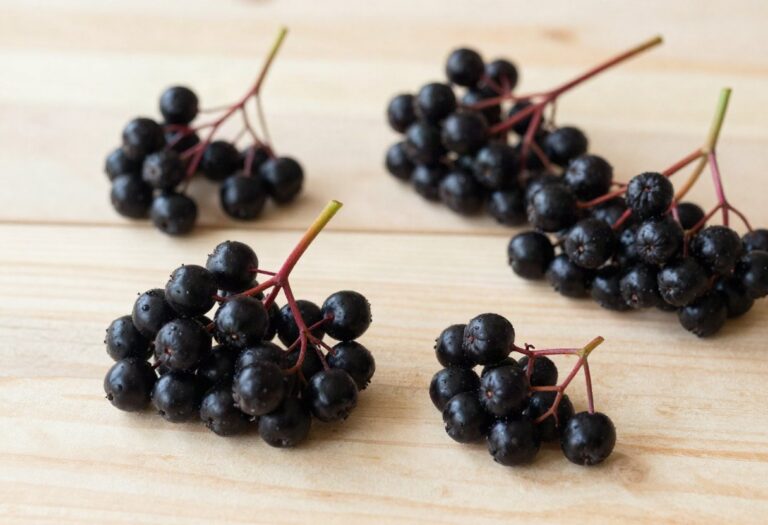
The black elder produces small purple berries in clusters, harvested at the end of summer. Be careful: they must never be eaten raw. They contain a cyanogenic glycoside that causes nausea and vomiting, and only cooking destroys it.
In terms of nutrition facts: 73 kcal per 100 g, with 7 g of fibre, a remarkable level for a fruit, 18.4 g of carbohydrate, 0.66 g of protein and 0.5 g of fat. They provide 36 mg of vitamin C, 280 mg of potassium, 38 mg of calcium and 1.6 mg of iron per 100 g.
Macronutrient breakdown
Nutrition table per 100 g
| Calories | 73 kcal |
| Kilojoules | 305 kJ |
| Protein | 0,7 g |
| Carbohydrate | 18,4 g |
| Fat | 0,5 g |
| Fibre | 7 g |
Micronutrients per 100 g
All measured nutrients, ranked by share of the daily reference intake.
- Vitamin C36 mg45 %
- Vitamin B60,23 mg16 %
- Potassium280 mg14 %
- Iron1,6 mg11 %
- Vitamin B10,07 mg6 %
- Copper0,06 mg6 %
- Phosphorus39 mg6 %
- Calcium38 mg5 %
See the other 10 nutrients
- Vitamin B20,06 mg4 %
- Omega-3 ALA0,09 g4 %
- Vitamin A30 µg4 %
- Vitamin B30,5 mg3 %
- Vitamin B96 µg3 %
- Vitamin B50,14 mg2 %
- Omega-6 LA0,16 g2 %
- Magnesium5 mg1 %
- Zinc0,11 mg1 %
- Selenium0,6 µg1 %
USDA FoodData Central (SR Legacy)
Tips
Cooking is not optional. This is the most important point on this page: raw, elderberries make you ill. Cooked in jelly, syrup or jam, they cause no problem.
Do not confuse them with dwarf elder. This herbaceous species, which grows in clumps rather than as a shrub, is clearly toxic even when cooked. The edible black elder is a woody shrub whose berries hang downwards.
7 g of fibre per 100 g: few fruits do better. But elderberry is eaten processed, as jelly or syrup, where added sugar largely dominates and the fibre is partly filtered out.
Its claims against colds remain weak. A few trials suggest an effect on the duration of flu symptoms, but the studies are small and often funded by manufacturers. It is not a treatment.
The flowers are a different product. The white spring flower heads are used for elderflower cordial, which is not toxic at all. Flowers and berries are not harvested in the same season or used for the same purpose.