Group · Fats & oils
Salted butter
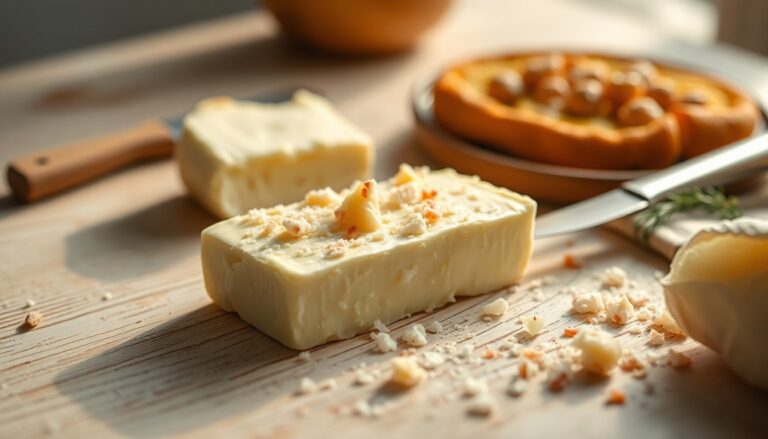
Salted butter is a dairy fat made by churning cream, with salt added (often around 2 to 3%). An emblematic speciality of Brittany, it comes as lightly salted and salted butter, both mellow and bold, sometimes with crunchy crystals of Guérande salt. Rich in fat (80.8 g per 100 g) and providing around 732 kcal per 100 g, it is an indulgent product to use in moderation. A source of vitamin A and saturated fatty acids, it goes as well with toast as it does in cooking. Used wisely, it has its place in a varied, balanced diet, as long as you keep an eye on portions.
Macronutrient breakdown
Nutrition table per 100 g
| Calories | 732 kcal |
| Kilojoules | 3010 kJ |
| Protein | 0,5 g |
| Carbohydrate | 0,7 g |
| Fat | 80,8 g |
Micronutrients per 100 g
All measured nutrients, ranked by share of the daily reference intake.
- Omega-3 ALA0,4 g20 %
- Total omega-30,45 g18 %
- EPA0,04 g16 %
- Vitamin E1,77 mg15 %
- Omega-6 LA1,16 g12 %
- Vitamin K16,11 µg8 %
- Phosphorus24 mg3 %
- Vitamin B120,08 µg3 %
See the other 6 nutrients
- Calcium24 mg3 %
- Magnesium7,4 mg2 %
- Potassium35 mg2 %
- Zinc0,17 mg2 %
- Iron0,23 mg2 %
- Vitamin B50,05 mg1 %
Anses Ciqual 2025. Source: Anses, 2025, Ciqual food composition table
Tips
Salted butter is best enjoyed raw or at the end of cooking, to preserve its aroma and stop it burning above roughly 130 °C. A sensible portion is around 10 g, about a knob on a slice of toast. On fresh bread, with radishes, on a steamed potato or to finish a sauce, it brings out all its character. Take it out of the fridge a little beforehand so it is soft and easy to spread.
- Storage: in the fridge, well wrapped so it does not pick up odours; the salt acts as a natural preservative.
- Cooking: ideal for salted butter caramel, crêpes or gently pan-fried fish. For a gentler way of cooking, take inspiration from the principles of gentle cooking.
- Pairings: caramel, buckwheat, dark chocolate, seafood or steamed vegetables.
In terms of nutrition facts, salted butter is almost entirely fat, with a high proportion of saturated fatty acids and very little carbohydrate or protein. Its glycaemic index is zero. It provides vitamin A, vitamin D and vitamin E, as well as salt, which you need to take into account if you are watching your sodium intake. Its high calorie density calls for moderation, especially if you are watching your weight.
If you are looking for a lighter version, reduced-fat butter contains less fat, while unsalted butter remains an alternative with no added salt. For cooking at higher temperatures, olive oil or another vegetable fat can take over. You can compare all these options in the fats and oils family.
For active people: salted butter provides dense energy, useful for meeting high calorie needs when building mass, and best included in small amounts in complete meals. However, it has no place in a snack around exercise, where easily absorbed carbohydrates and protein are the priority. For weight loss, it is better kept as a finishing touch, with the frequency limited. Remember that a fat, however tasty, is still high in calories: it is the overall balance of the plate that counts, as a good balanced diet reminds us.