Group · Fruit
Guigne cherries
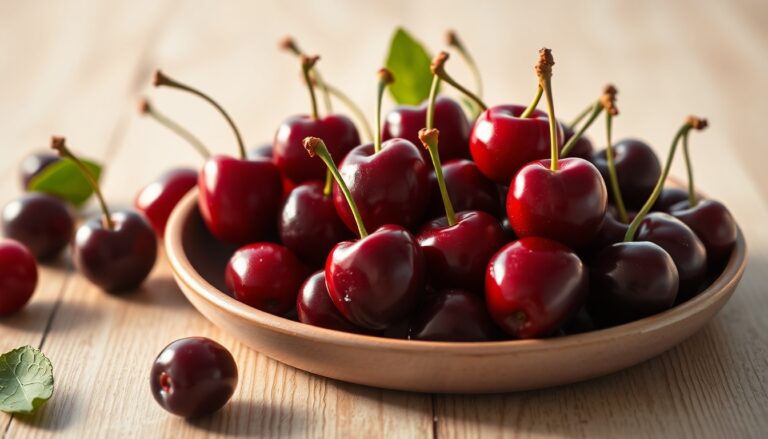
The guigne cherry is one of the most popular sweet cherries at the start of summer. Small, firm and plump, its flesh ranges from light red to deep purple depending on the variety, with a sweet, juicy flavour. It is told apart from the bigarreau by its more tender flesh and generous juice. In terms of nutritional values, it provides around 53.7 kcal per 100 g, with 13 g of carbohydrate, 1.6 g of fibre and very little fat. A source of vitamin C and natural antioxidant compounds, it fits easily into a balanced diet. The seasonal fruit par excellence, the guigne cherry is best enjoyed fresh and plain once the fine weather arrives.
Macronutrient breakdown
Nutrition table per 100 g
| Calories | 54 kcal |
| Kilojoules | 227 kJ |
| Protein | 0,9 g |
| Carbohydrate | 13 g |
| Fat | 0,2 g |
| Fibre | 1,6 g |
Micronutrients per 100 g
All measured nutrients, ranked by share of the daily reference intake.
- Potassium190 mg10 %
- Copper0,08 mg8 %
- Vitamin C4,09 mg5 %
- Manganese0,06 mg3 %
- Vitamin B60,04 mg3 %
- Phosphorus19 mg3 %
- Vitamin A20,2 µg3 %
- Magnesium8,8 mg2 %
- Vitamin B9dietary folate equivalents6,75 µg
See the other 6 nutrients
- Vitamin B50,14 mg2 %
- Calcium9,9 mg1 %
- Iron0,17 mg1 %
- Total omega-30,03 g1 %
- Vitamin B20,01 mg1 %
- Zinc0,06 mg1 %
Anses Ciqual 2025. Source: Anses, 2025, Ciqual food composition table
Tips
The guigne cherry is above all eaten fresh, washed just before eating and kept in the fridge in its original packaging to preserve its firmness. A sensible portion is around 100 to 150 g, a good handful. At 53.7 calories per 100 g, it stays a fruit moderate in sugars, ideal as a snack, at breakfast with a plain yoghurt, or as a low-calorie dessert.
- Seasonality: guignes appear from late May to July, the time to enjoy their freshness and good prices.
- Key nutrients: vitamin C, potassium, gentle fibre (1.6 g) and polyphenols that give it its intense colour.
- Glycaemic index: moderate, especially if you eat it whole rather than as juice, where there is less fibre.
In the kitchen, the guigne cherry suits clafoutis, compotes, jams and coulis. You can also stone and freeze it to enjoy out of season, or combine it with other summer fruits. For variety, pair it with strawberries or blueberries in a colourful fruit salad packed with antioxidants.
For active people, the guigne cherry is a useful ally: its natural carbohydrates provide quickly available energy, perfect as a snack before a light session or to replenish stores after exercise. Some athletes like sweet cherries in the recovery phase. Remember to pair it with a source of protein, for example fromage blanc or one of these protein snacks, for a complete, filling bite. It also fits very well into an overall approach to nutrition for fitness.
For weight control, the guigne remains a sensible fruit, but its sweetness can tempt you to nibble without counting. Stay attentive to quantities, especially in the form of candied or syrup cherries, which are far sweeter and higher in calories. Always favour fresh fruit, whose fibre supports fullness. You will find other spring and summer fruits in the fruit family, and you can compare its nutrients with other foods using the calorie table. Well integrated, the guigne cherry brings freshness, pleasure and nutritional benefits to your days.