Wellness careers: physical, mental and emotional
Dreaming of a career in wellness, but put off by the range of career paths, required skills and possible statuses (self-employed or employee)? This growing sector meets rising demand for natural approaches, stress management and a better work-life balance. Discover the key professions (nutritionist, sophrologist, life coach), what sets them apart, the essential training, and promising specialisms such as corporate wellbeing or work with older people. Learn how to reconcile passion with economic reality, with practical advice to get started or move on in a career that fits your values and society’s needs.
- What is a wellness career?
- The main wellness careers by category
- What skills and training do you need for a wellness career?
- Becoming a wellness practitioner: getting started and making a living
- Trends and specialisms: the wellness careers that are recruiting in 2026
- Finding your path: a career with meaning above all
What is a wellness career?
Wellness careers cover professions focused on improving people’s overall quality of life, beyond traditional medical care.
They bring in complementary approaches to strengthen physical health, emotional wellbeing and mental balance.
The sector is seeing strong growth, with a forecast increase of 12% by 2026, driven by a growing need for personalised solutions to modern challenges such as stress, burnout and the issues raised by remote working.
Wellness professionals work in three main areas:
- Physical wellbeing: nutritionist (balanced diet advice), physiotherapist (functional rehabilitation), sports coach (personalised support with physical activity)
- Mental and emotional wellbeing: psychologist (mental health), life coach (personal development), sophrologist (relaxation and self-confidence techniques)
- Holistic approaches: naturopath (natural methods), energy healing practitioner (harmonising energy flows), Bach flower consultant (natural solutions for emotions)
The sector offers a wide variety of career paths: 65% of practitioners are self-employed, often alongside other activities.
Key skills include active listening, empathy and certified training recognised by professional bodies. This flexibility appeals to professionals who want to combine autonomy with a positive impact on people’s overall health.
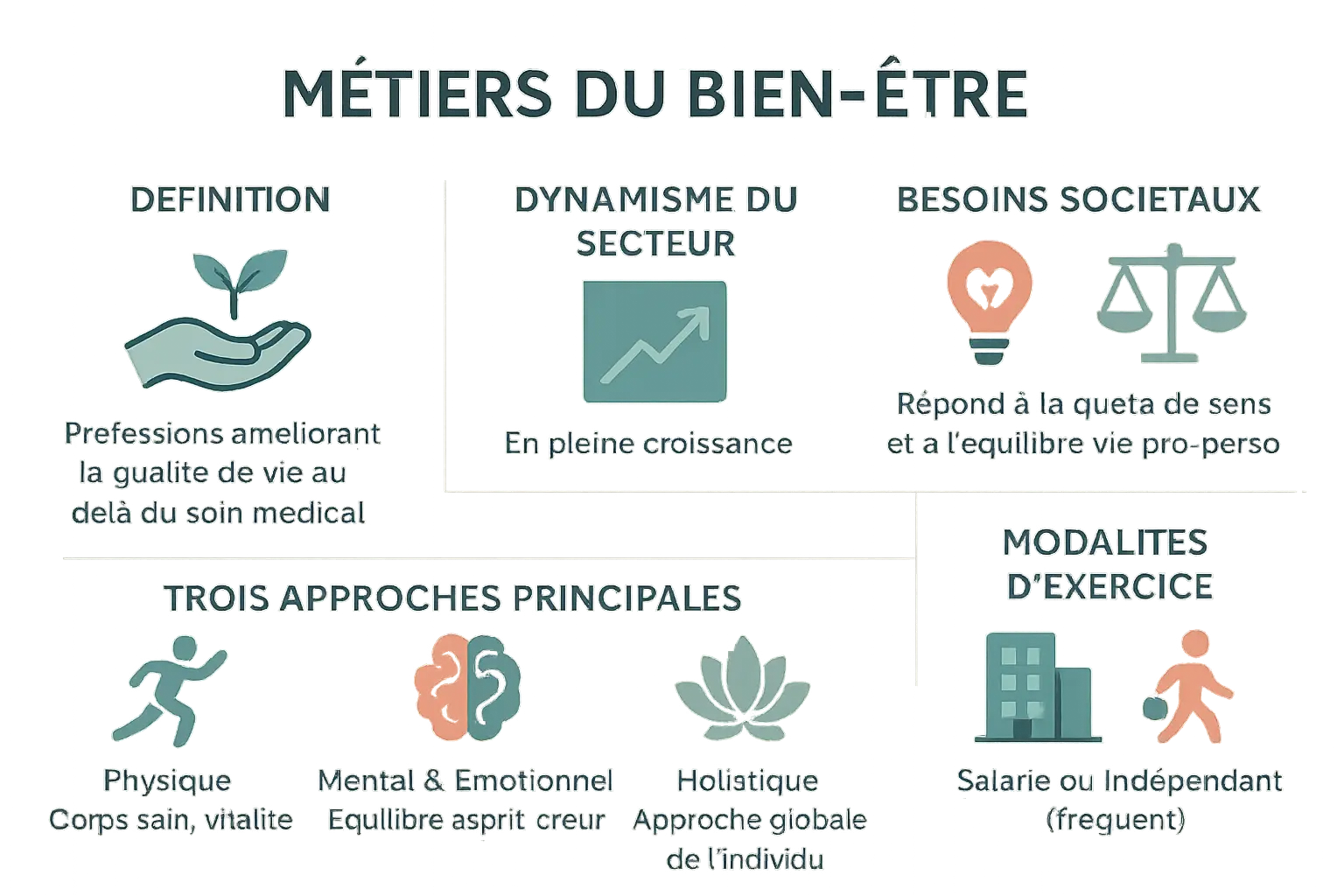
Overview of the main wellness careers by category
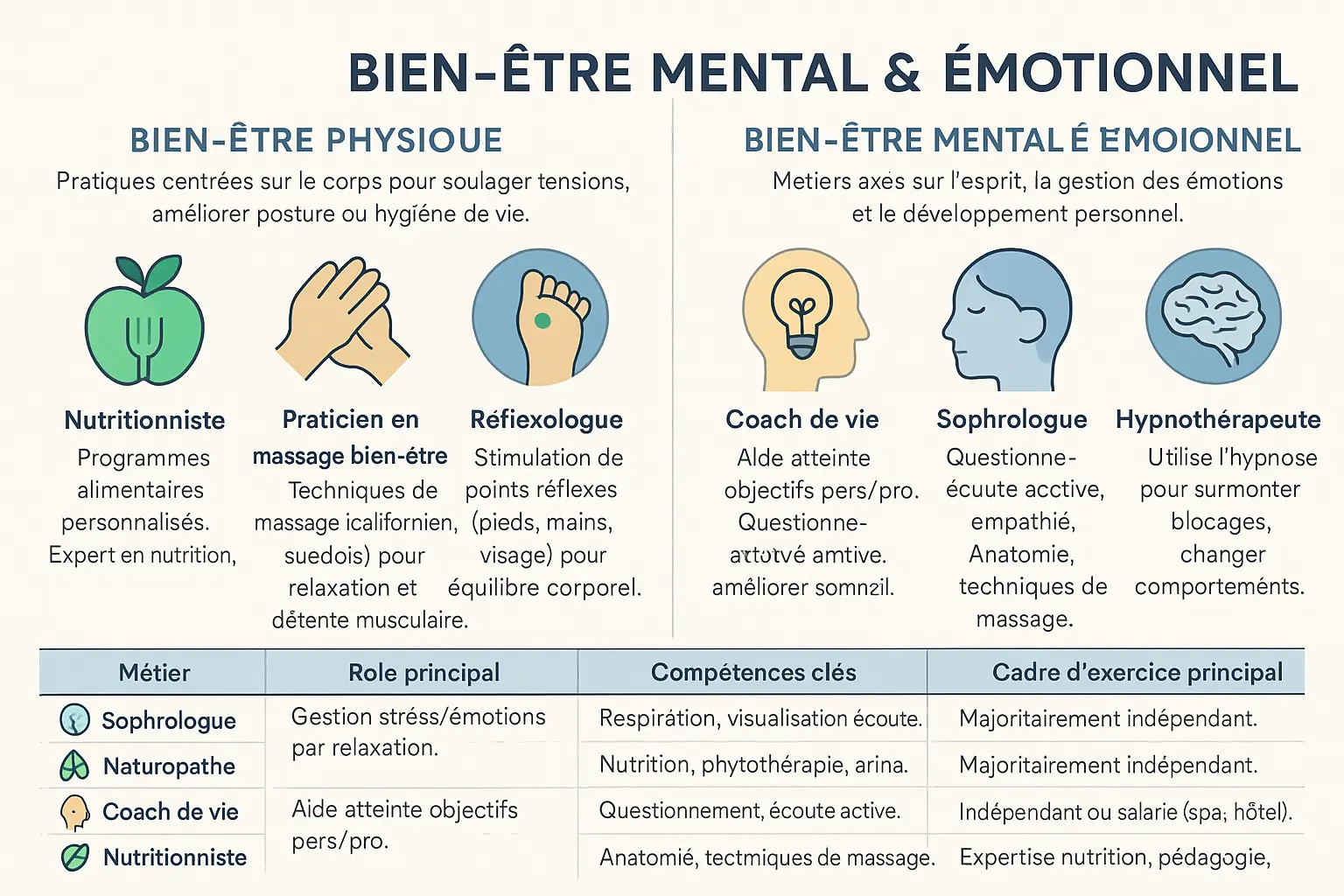
Careers focused on physical wellbeing
Physical wellness careers aim to improve bodily health through non-medical methods. They help to reduce tension, improve lifestyle habits or boost vitality. In 2026, these professions are seeing growing demand, linked to interest in preventive and natural care.
The nutritionist is a food expert. They design personalised programmes for goals such as weight loss, managing allergies or improving energy. Their skills in biochemistry and food science allow them to support people with tailored advice. They can work in wellness centres, in companies or in private practice.
The wellness massage practitioner uses techniques such as Swedish, Californian or Ayurvedic massage. They release muscle tension and promote relaxation, without any therapeutic aim. The career appeals for its hands-on, immediate nature. Spas, hotels and fitness centres regularly recruit in this field.
The reflexologist stimulates reflex points on the feet, hands or face. The practice aims to restore the body’s energy balance, as a complement to an overall approach. Reflexology courses, often validated by certified bodies, attract professionals who want to move towards gentle methods.
Careers dedicated to mental and emotional wellbeing
Mental and emotional wellness careers target psychological balance. They help people manage stress, overcome obstacles or develop their potential. In 2026, these professions are booming, particularly in companies and preventive health centres.
The life coach supports people to achieve personal or professional goals. They use active listening and questioning to guide without imposing. For example, they can help someone get through a career transition, manage the balance between private and working life, or improve self-esteem. This career requires a recognised certification, such as those issued by the ICF (International Coaching Federation).
The sophrologist offers breathing exercises, muscle relaxation and positive visualisation. These tools manage anxiety, improve sleep or prepare people for important events such as an exam or a speech. Companies are increasingly bringing in sophrologists to reduce stress at work.
The hypnotherapist uses an altered state of consciousness to access inner resources. This helps to change behaviours, overcome trauma or build self-confidence. Hypnosis training, often validated by university diplomas, attracts trained professionals, with a focus on ethical methods.
Comparison table of wellness careers
| Career | Main role | Key skills | Main working arrangement |
|---|---|---|---|
| Sophrologist | Managing stress and emotions through relaxation | Command of breathing and visualisation techniques, active listening | Mostly self-employed |
| Naturopath | Supporting health balance through natural methods | Knowledge of nutrition, herbal medicine, aromatherapy | Mostly self-employed |
| Life coach | Helping people reach personal or professional goals | Questioning, active listening, empathy, non-judgement | Mostly self-employed |
| Wellness massage practitioner | Body relaxation and unwinding through manual techniques | Knowledge of anatomy, command of massage techniques | Self-employed or employee (spa, hotel) |
| Nutritionist | Advice on dietary balance for health and wellbeing | Expertise in nutrition science, teaching ability | Employee (hospital, company) or self-employed |
The table above summarises the careers and what sets them apart. In 2026, the physical and mental wellness sectors offer growing opportunities, particularly for nutritionists, life coaches and sophrologists. This momentum comes from growing awareness of overall health. Recruiters are looking for people who can bring in comprehensive approaches, combining technical skills with kindness.
What skills and training do you need for a wellness career?
Essential personal qualities
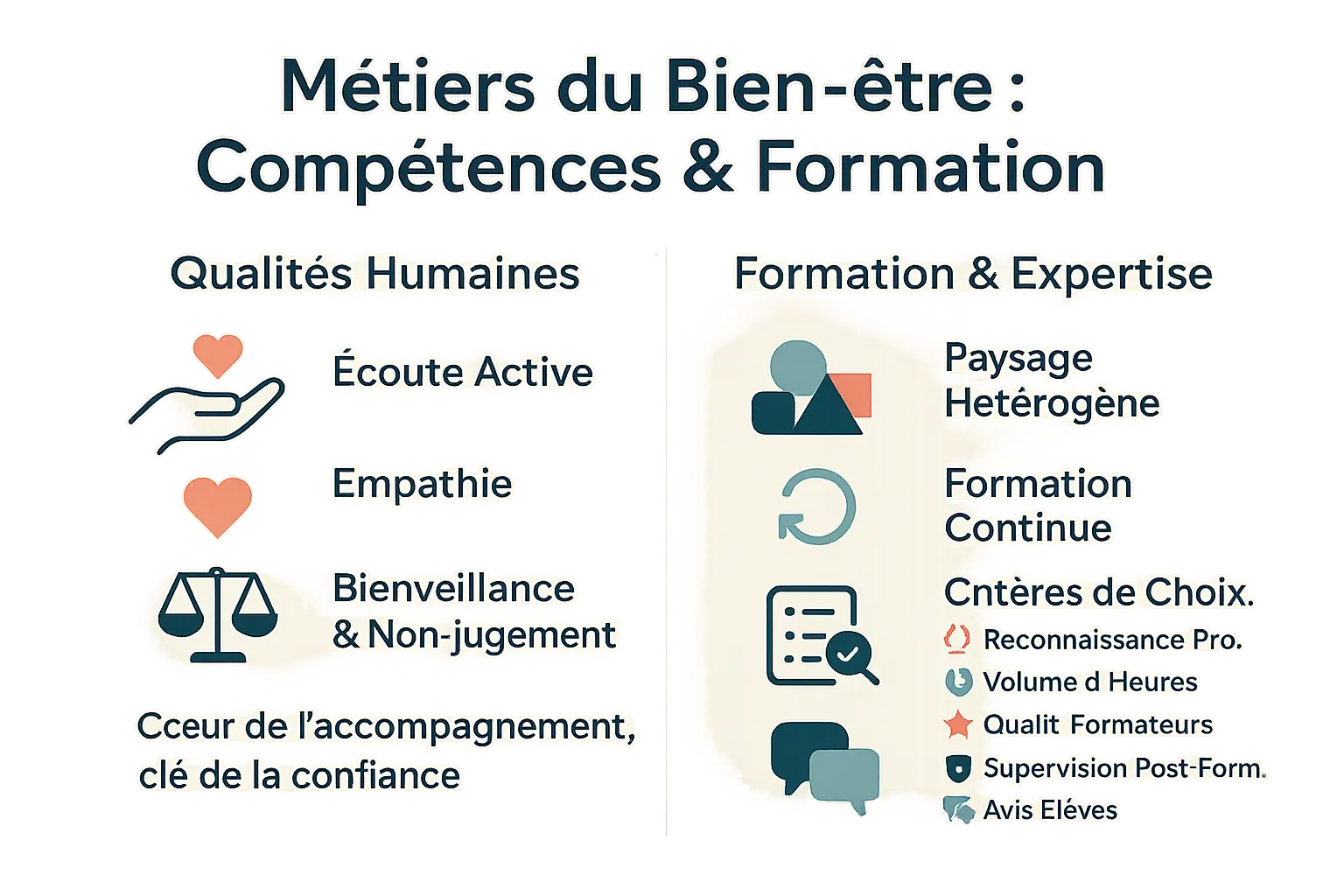
Wellness careers demand far more than technical knowledge. Professionals need to develop active listening that picks up on needs without judgement. This skill creates a safe space where clients feel genuinely heard, whether with a nutritionist or a life coach. An emotional wellbeing adviser, for example, must spot obstacles without letting their own beliefs interfere.
« Empathy and listening are not just skills, but the very heart of support. They are the key to creating a space of trust where wellbeing can flourish. »
Kindness and non-judgement complete this foundation. These qualities help build a relationship of trust, essential for guiding each person according to their unique needs. Without these fundamentals, even the most refined techniques remain ineffective. These skills apply to every career, whether sophrologist or social economy adviser.
Training: certifications and recognised diplomas
The wellness sector combines regulated professions with unofficial training. Choosing a school takes rigorous analysis to make sure your path is credible. In 2026, recruiters are looking for certified profiles in nutrition, personal coaching or stress management, with a preference for diplomas backed by practical placements.
- Favour training recognised by federations such as the Fédération Française des Thérapeutes (FFT) or the Union des Métiers de la Santé Naturelle (UMSN)
- Assess the number of hours: 200 to 600 hours minimum depending on the specialism, with both theoretical and practical learning
- Check the teachers’ qualifications: experienced practitioners holding recognised diplomas
- Make sure there is post-training follow-up with regular updates so you can keep up with changes in the sector
- Read reviews from former students to judge the quality of the teaching and the career opportunities offered
Continuing training is a major pillar for adapting to changes in the sector. In 2026, recruiters will value specialisms in physical, mental and emotional wellbeing, with skills in emotion management and non-violent communication. Careers in strong demand include health prevention advisers and supportive parenting coaches, where the human element remains at the heart of the professional approach.
Becoming a wellness practitioner: getting started and making a living
Self-employed status: a favoured route
Self-employed status, often as a micro-entrepreneur (the simplified French sole-trader regime), appeals to wellness practitioners. It gives autonomy over how you organise your work and your methods, but means managing clients, administration and variable income. This choice is explained by the flexibility it allows, ideal for careers such as nutritionist or life coach, where personalised support is central.
Taking an entrepreneurial approach is essential: mastering communication, keeping rigorous accounts and building a network. The key steps are:
- Define your project (nutrition, life coaching, yoga) by identifying a niche, such as intuitive eating or post-lockdown coaching.
- Draw up a business plan to assess costs (training, equipment), fees and profitability, including marketing strategies.
- Choose a suitable status (micro-entrepreneur to simplify paperwork, with a turnover ceiling of €72,600 a year).
- Create a website and use social media (Instagram, LinkedIn) to share testimonials or short tips.
- Build a client base through word of mouth, local partnerships (wellness fairs) or specialist platforms (Keldiah, Malt).
Pay and income prospects
Income varies with specialism, location and experience. A session costs between €50 and €100, but monthly income depends on the number of clients (e.g. 20 to 30 sessions a month). Experts in urban areas, or with professional recognition (e.g. a nutritionist certified by AFNOR, the French standards body), generate more stable income, often above €2,000 a month after 2-3 years in practice.
Making a living from a wellness career is a marathon, not a sprint. Patience, perseverance and good management matter as much as mastering your practice.
To secure your income, it is advisable to diversify your services (online workshops, discussion groups) and to train in business management. For example, a nutritionist can sell PDF programmes or run webinars, while a life coach can work with companies on group sessions. Seasonal fluctuations (clients deserting in summer) or economic ones call for constant adaptation, such as adjusting fees or stepping up communication on seasonal offers.
Trends and specialisms: the wellness careers that are recruiting in 2026
Specialisms with a future
The wellness sector is evolving fast, shaped by growing societal concerns. In 2026, certain niches are particularly attractive to companies and individuals. For example, corporate wellbeing is gaining importance. According to current trends, 70% of French companies plan to step up their action against stress at work. This opens up opportunities for experts in stress management or burnout prevention.
Longer life expectancy creates a greater need for professionals suited to older people. Practitioners specialising in gentle physical activity or cognitive workshops to maintain independence will be in high demand. At the same time, young people’s wellbeing is attracting more and more interest. Methods to improve concentration or manage emotions in pupils could become a pillar of schools.
An innovative field also stands out: animal-assisted therapy. Using animals in rehabilitation or emotional support programmes is winning over new audiences. This crossover between emotion and nature attracts a variety of players, from mental health to special needs education.
Professions with strong recruitment potential
In 2026, some careers should see increased demand:
- Professional coach: specialising in career development or leadership in companies, to help employees thrive in their jobs.
- Sophrologist: focused on reducing stress and preventing work-related risks, in collaboration with HR.
- Wellness practitioner for older people: working in care homes (EHPAD in France) or at home to improve older people’s quality of life.
- Naturopath: meeting growing demand for holistic and natural approaches to health.
These careers adapt to contemporary challenges, whether work-life balance or an ageing population. Skills in communication, active listening and teaching will be key to succeeding in these fields.
Finding your path: a career with meaning above all
Wellness careers, such as nutritionist, life coach or sophrologist, demand key human skills: active listening, empathy and personalised support, united by a common goal: improving quality of life. In 2026, these growing professions respond to a rising demand for people’s overall balance.
Solid training remains essential to acquire technical skills and professional ethics. Yet this career choice remains above all a personal commitment. These careers attract those who want to combine passion with social contribution, in a sector in strong demand.
Drawn to caring support and real impact? In 2026, the sector is recruiting for needs linked to overall wellbeing. These careers let you turn your motivation into concrete action.
Choosing a wellness career means deciding to align your working life with your deepest values, to help, in your own way, build a more peaceful world.
Before committing, ask yourself: what kind of relationship do you want to build with your clients? What balance between the technical and the emotional? Your answer will guide your career choice.
Booming wellness careers meet physical, mental and emotional needs. Varied, they demand kindness, expertise and passion. Choosing this path means combining personal meaning with positive impact. « Choosing a wellness career means deciding to align your working life with your deepest values, to help, in your own way, build a more peaceful world. »
FAQ
What types of careers are there in the wellness sector?
The wellness sector covers professions focused on improving people’s quality of life. There are three main categories: careers linked to physical wellbeing (nutritionist, massage practitioner, reflexologist), those dedicated to mental and emotional wellbeing (life coach, sophrologist, hypnotherapist), and holistic approaches combining both dimensions. These professionals often work for themselves, although some are employed in settings such as spas or companies.
Which wellness professions are most in demand?
Careers in strong demand include professional coaches specialising in companies, sophrologists focused on stress management, practitioners working with older people, and naturopaths. These specialisms respond to societal trends such as burnout prevention or the ageing population. In 2026, these fields should see significant growth, particularly in emotional education for young people and natural approaches to health.
Which career brings the most personal satisfaction?
Wellness careers are often associated with a strong sense of fulfilment, especially those that let you help others towards greater serenity. Coaches, sophrologists and holistic care practitioners frequently report satisfaction linked to the concrete impact of their work. However, the feeling of joy also depends on being aligned with your personal values: choosing a career that resonates with your own aspirations is essential.
Which career is considered the most zen?
Professions centred on relaxation and stress reduction, such as sophrologist or wellness massage practitioner, are often seen as the most zen. They involve gentle methods (breathing, positive visualisation, muscle relaxation) and often a calm working environment. These careers attract people looking for a balance between their working life and their own personal fulfilment.
Which careers are linked to the highest levels of job happiness?
Surveys indicate that careers where autonomy, creativity and human impact are valued generate more happiness. In wellness, this includes life coaches, holistic therapists and nutrition advisers. Their independence, the variety of tasks and the chance to adapt their practice to their personal convictions partly explain this satisfaction.
What are the seven areas of wellbeing at work?
Wellbeing at work rests on seven pillars: physical health, mental health, work-life balance, personal fulfilment, social relationships, professional achievement and financial security. Companies are investing more and more in these areas through specialists (sophrologists, coaches) to prevent burnout and improve quality of life at work.
Which wellness careers pay the best?
Income varies with specialism, experience and status (employee or self-employed). Naturopaths, professional coaches working with companies and sophrologists specialising in psychosocial risks are among the best paid. When self-employed, sessions can be charged at between €50 and €100, with monthly income depending on the number of clients. Financial success does, however, require rigorous management and an effective communication strategy.
Which wellness careers are actively recruiting?
The sectors with shortages are those linked to corporate wellbeing, support for older people and natural approaches to health. Coaches specialising in leadership, practitioners working in care homes and naturopaths are meeting growing demand. These careers recruit both in employee structures and through collaboration with self-employed practitioners, particularly for one-off interventions or tailor-made programmes.
Which careers are the most enjoyable to do?
The careers judged most enjoyable share common features: autonomy, variety of tasks and direct impact on clients. Massage practitioners, sophrologists and nutrition advisers often cite the satisfaction of seeing their clients progress as a key motivator. These professions also appeal for the chance to work at your own pace, especially when self-employed.
💼 Careers & guidance: interested in this field professionally? Discover our career profiles: naturopath, sophrologist.