Group · Fish
Arctic char
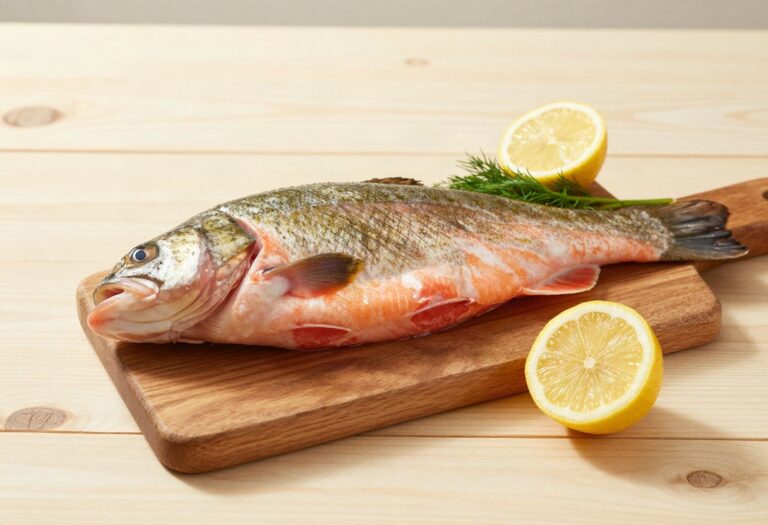
The Arctic char (known in French as omble chevalier) is a salmonid of deep, cold Alpine lakes, a cousin of trout and salmon. Its pink, fine, delicate flesh makes it one of the most prized fish in Savoyard cooking, and one of the most expensive.
In terms of nutrition facts, raw: 103 kcal per 100 g, with 19.8 g of protein and 2.7 g of fat. It provides 9 µg of vitamin D, 370 mg of potassium, 260 mg of phosphorus and 16 µg of selenium per 100 g, with 0.14 g of salt.
Macronutrient breakdown
Nutrition table per 100 g
| Calories | 103 kcal |
| Kilojoules | 436 kJ |
| Protein | 19,8 g |
| Fat | 2,7 g |
Micronutrients per 100 g
All measured nutrients, ranked by share of the daily reference intake.
- Vitamin D9 µg180 %
- Phosphorus260 mg37 %
- Selenium16 µg29 %
- Vitamin B60,37 mg26 %
- Potassium370 mg19 %
- Vitamin B10,16 mg15 %
- Magnesium30 mg8 %
- Zinc0,67 mg7 %
See the other 3 nutrients
- Vitamin B20,09 mg6 %
- Iron0,49 mg4 %
- Calcium8,8 mg1 %
Anses Ciqual 2025. Source: Anses, 2025, Ciqual food composition table
Tips
9 µg of vitamin D: nearly double the reference intake. A salmonid-level score, reached for only 103 kcal, against 205 for cooked salmon. It is its best selling point.
19.8 g of protein for 2.7 g of fat. Much leaner than a farmed trout, whose feed is richer.
Its flesh is very fragile: cook it minimally. Steam it for six minutes, or fry it for two minutes per side. Beyond that it dries out and loses its melting texture, which is its whole appeal.
It does not tolerate heavy sauces. A little lemon, some dill, a touch of cream at most. A butter sauce completely overwhelms its delicacy.
Wild or farmed. Wild char from Lake Geneva or Lac du Bourget is rare and expensive; farmed fish, more common, is a little fattier. Both are of good quality, and the origin is shown on the label.