Group · Fats & oils
Argan oil
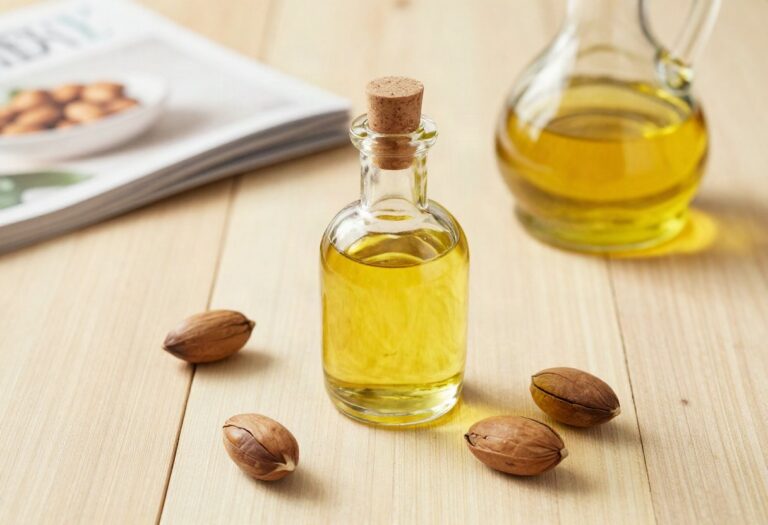
Argan oil is extracted from the kernel of the argan tree, which is native to south-west Morocco. There are two kinds: the edible one, made from roasted kernels and tasting of hazelnut, and the cosmetic one, which is not roasted. They are not interchangeable.
In terms of nutrition facts: 889 kcal per 100 g, with 98.7 g of fat: 44.8 g of monounsaturated, 33.3 g of polyunsaturated and 17.6 g of saturated. It provides 3.6 mg of vitamin E per 100 g.
Macronutrient breakdown
Nutrition table per 100 g
| Calories | 889 kcal |
| Kilojoules | 3650 kJ |
| Fat | 98,7 g |
Micronutrients per 100 g
All measured nutrients, ranked by share of the daily reference intake.
- Omega-6 LA33 g330 %
- Vitamin E3,6 mg30 %
- Omega-3 ALA0,13 g7 %
Anses Ciqual 2025. Source: Anses, 2025, Ciqual food composition table
Tips
Like all oils, it comes to 90 kcal a spoonful. That is the only useful figure: no oil has fewer calories than another. What sets them apart is their fatty acid profile.
Do not heat it. Its smoke point is low and roasting its kernels has already developed its aromas: with heat, it loses them all. It is a dressing oil, and nothing else.
44.8 g of monounsaturated: a profile close to olive. Olive oil is still better documented for heart health, and costs ten times less.
Its price comes from how it is made. It takes about thirty kilos of fruit and several hours of cracking by hand to make one litre. Look for a certified women’s cooperative, as the industry matters socially in the region.
Food or cosmetic: read the label. The cosmetic oil is not roasted, does not have the flavour you expect and is not meant to be eaten.