Group · Meat
Bayonne ham
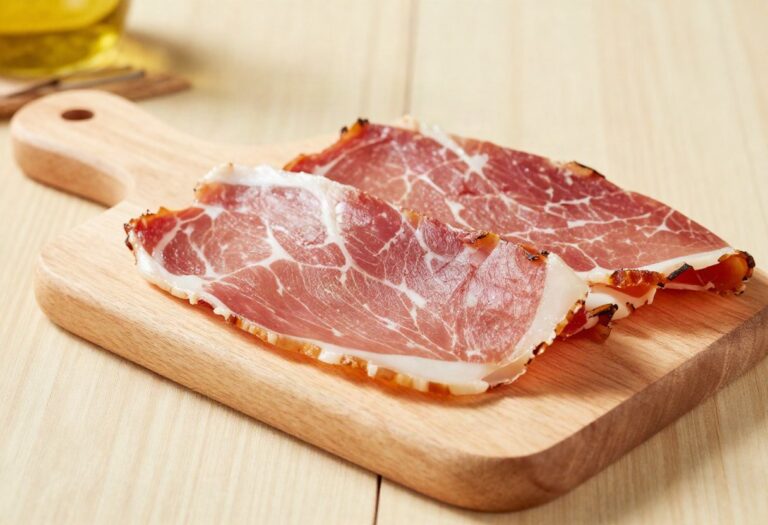
Bayonne ham is a PGI raw ham from south-west France, salted with salt from Salies-de-Béarn then dried for at least seven months. The name comes from the port from which it was shipped, not from where it is produced.
As for nutrition facts: 243 kcal per 100 g for 28 g of protein and 12.6 g of fat including 4.93 g of saturated fat. It provides 554 mg of potassium per 100 g. But it contains 5.75 g of salt, one of the highest in the whole database.
Macronutrient breakdown
Nutrition table per 100 g
| Calories | 243 kcal |
| Kilojoules | 1020 kJ |
| Protein | 28 g |
| Carbohydrate | 4,6 g |
| Fat | 12,6 g |
Micronutrients per 100 g
All measured nutrients, ranked by share of the daily reference intake.
- Potassium554 mg28 %
- Vitamin C13 mg16 %
- Omega-6 LA1,27 g13 %
- Omega-3 ALA0,08 g4 %
- EPA0 g1 %
Anses Ciqual 2025. Source: Anses, 2025, Ciqual food composition table
Tips
5.75 g of salt: three slices are enough to weigh on you. 45 g provides 2.6 g of salt, more than half the daily guideline. Dry salting is the very technique of the product: it cannot be separated from it. See salt.
28 g of protein for 243 kcal. The ratio is very good, better than a standard raw ham. On this measure, it is a lean product.
It counts towards the processed meat guideline. 150 g a week, all products combined, according to the Programme national nutrition santé.
Toxoplasmosis: the restriction to know about. It is not cooked, and drying does not systematically destroy the parasite. Not recommended for pregnant women who are not immune, unless previously frozen at -18°C.
Melon, fig, Espelette pepper. The traditional pairings are not just decoration: the sugar in the fruit offsets the salt, and that is what makes the product pleasant in small amounts.