Group · Dairy
Époisses
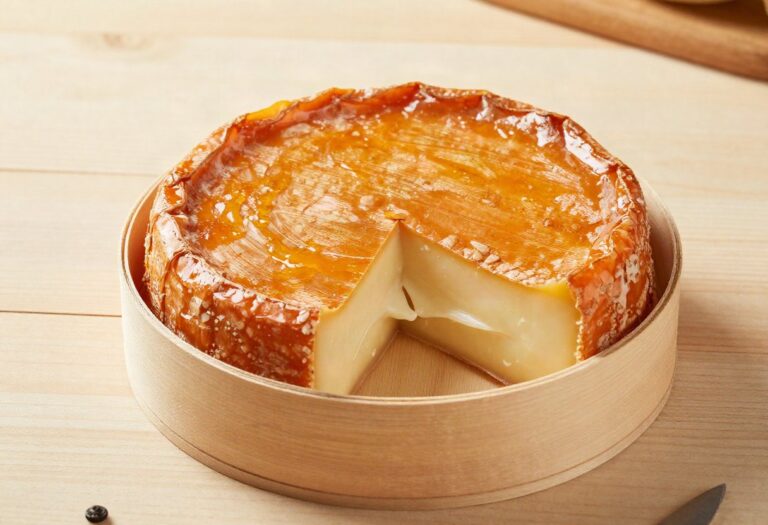
Époisses is a Burgundy cheese with a washed rind, PDO, rubbed with Burgundy marc throughout its maturing. This repeated washing gives it its glossy orange rind and an aroma reputed to be one of the strongest in France.
In terms of nutrition facts: 286 kcal per 100 g, with 24 g of fat of which 17 g is saturated, and 17.3 g of protein. It provides 220 mg of phosphorus, 120 mg of calcium, 1.7 µg of vitamin B12 and 21 µg of iodine per 100 g. One point to watch: 1.77 g of salt.
Macronutrient breakdown
Nutrition table per 100 g
| Calories | 286 kcal |
| Kilojoules | 1180 kJ |
| Protein | 17,3 g |
| Fat | 24 g |
Micronutrients per 100 g
All measured nutrients, ranked by share of the daily reference intake.
- Vitamin B21,24 mg89 %
- Vitamin B121,7 µg68 %
- Phosphorus220 mg31 %
- Vitamin B51,1 mg18 %
- Calcium120 mg15 %
- Iodine21 µg14 %
- Vitamin B60,18 mg13 %
- Potassium140 mg7 %
See the other 11 nutrients
- Omega-3 ALA0,13 g7 %
- Vitamin E0,64 mg5 %
- Zinc0,5 mg5 %
- Omega-6 LA0,43 g4 %
- Vitamin B30,57 mg4 %
- Magnesium10 mg3 %
- Vitamin K11,73 µg2 %
- Copper0,02 mg2 %
- Vitamin B10,02 mg2 %
- Iron0,21 mg2 %
- Manganese0,01 mg1 %
Anses Ciqual 2025. Source: Anses, 2025, Ciqual food composition table
Tips
A whole Époisses weighs 250 g. That is 715 kcal: a sharing cheese for four to six, served with a spoon when well matured.
1.77 g of salt per 100 g. Salt is essential for washing the rind and keeping the flora under control. A 40 g portion provides 0.71 g, or 14% of the daily guideline: see salt.
Little calcium: 120 mg per 100 g. Like all very moist soft cheeses, it concentrates minerals poorly. For calcium, a Tomme does five times better.
Eat it with a spoon, with bread. There is no need to spread it: at full ripeness, the paste runs. A plain country loaf shows it off better than a bread made with cereals.
Raw milk. The PDO requires it. Not recommended for pregnant women or people with weakened immune systems.