Group · Bread
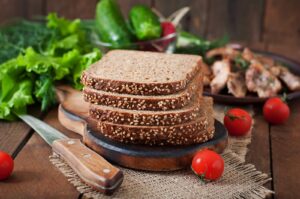
Multigrain bread
Multigrain bread is a bread enriched with seeds and a variety of flours (wheat, rye, oats, flax, sunflower, sesame, millet…) that give it a dense texture and a tasty flavour. More filling than ordinary white bread, it comes as a block loaf, a round loaf or sliced for the toaster. With around 269 kcal per 100 g, it provides 10.5 g of protein, 46.9 g of carbohydrate and above all 5.2 g of fibre, nutritional values that suit a balanced diet well. A source of complex carbohydrates and minerals, it has its place at breakfast as well as at lunch. It is a versatile choice, popular with active people and with those who watch their figure but love good bread.

Macronutrient breakdown
Nutrition table per 100 g
| Calories | 269 kcal |
| Kilojoules | 1140 kJ |
| Protein | 10,5 g |
| Carbohydrate | 46,9 g |
| Fat | 3,2 g |
| Fibre | 5,2 g |
Micronutrients per 100 g
All measured nutrients, ranked by share of the daily reference intake.
- Manganese0,78 mg39 %
- Copper0,25 mg25 %
- Omega-3 ALA0,47 g24 %
- Phosphorus150 mg21 %
- Total omega-30,49 g20 %
- Vitamin B930,5 µg15 %
- Magnesium53 mg14 %
- Omega-6 LA1,24 g12 %
See the other 10 nutrients
- Potassium230 mg12 %
- Iron1,6 mg11 %
- Zinc1,1 mg11 %
- Vitamin B10,1 mg9 %
- Vitamin B50,43 mg7 %
- Vitamin E0,85 mg7 %
- Calcium40 mg5 %
- Vitamin B30,71 mg4 %
- Vitamin B60,06 mg4 %
- Vitamin A1,21 µg0 %
Anses Ciqual 2025. Source: Anses, 2025, Ciqual food composition table
Tips
To enjoy the benefits of multigrain bread, stick to a reasonable portion of 40 to 60 g per meal, or one to two slices. Its richness in fibre (5.2 g per 100 g) supports fullness and slows the absorption of carbohydrates, which means a glycaemic index that is often more moderate than that of a classic baguette. For comparison, you can take a look at baguette or discover other wholegrain breads in the bread family.
How to eat it? It works with savoury and sweet toppings alike:
- at breakfast, lightly toasted with a little fresh cheese, peanut butter or a drizzle of honey;
- at lunch, as an open sandwich topped with egg, avocado, salmon or hummus;
- alongside a soup or a mixed salad.
The seeds it contains (flax, sunflower, sesame, pumpkin) provide unsaturated fatty acids, magnesium, zinc and B vitamins. To vary your pleasures and nutritional profiles, alternate with wholemeal bread or sourdough bread, which some people find easier to digest.
Tip for active people: its complex carbohydrates make it a good source of energy before exercise, ideally two to three hours before a session. After training, pair it with a source of protein (egg, chicken breast, fromage blanc) to support muscle recovery. A slice of multigrain bread with fresh cheese can make a simple, effective snack; to go further, explore our protein snack ideas.
Weight control: at 269 kcal per 100 g, multigrain bread is still fairly high in calories because of the seeds. If you are trying to lose weight, watch the quantities and especially the toppings, which are often richer than the bread itself. Choose low-fat spreads and lean protein. Making this bread part of a proper balanced diet helps you manage portions over time.
Storage: keep it in a clean cloth or a fabric bag at room temperature for two to three days. You can also slice and freeze it, then put it straight in the toaster. As for seasonality, bread is eaten all year round, and each baker has their own blend of grains, making it a food with plenty of varieties and flavours.
If you have diabetes: the glycaemic index of breads ranges from 53 to 95 depending on the flour and grains. See the comparison in our guide which bread for people with diabetes.