Group · Fish
Hoki
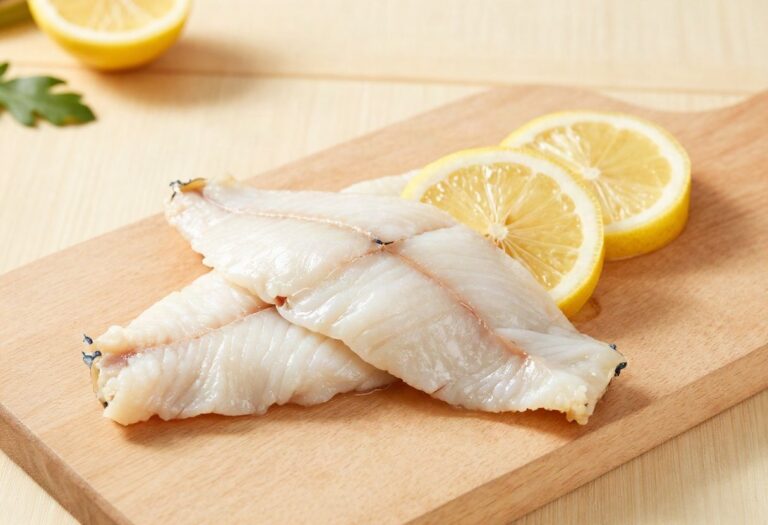
The hoki, or New Zealand blue grenadier, is a fish of southern waters widely used by industry: it is the fish found in a large share of breaded fillets and frozen products.
In terms of nutrition facts, raw: 92.3 kcal per 100 g, with 17.8 g of protein and 2.36 g of fat. It provides 345 mg of potassium, 167 mg of phosphorus, 27.8 µg of selenium and 2.49 µg of vitamin D per 100 g, with 0.18 g of salt.
Macronutrient breakdown
Nutrition table per 100 g
| Calories | 92 kcal |
| Kilojoules | 389 kJ |
| Protein | 17,8 g |
| Fat | 2,4 g |
Micronutrients per 100 g
All measured nutrients, ranked by share of the daily reference intake.
- DHA0,17 g68 %
- Selenium27,8 µg51 %
- Vitamin D2,49 µg50 %
- Vitamin B121,11 µg44 %
- EPA0,07 g29 %
- Phosphorus167 mg24 %
- Potassium345 mg17 %
- Vitamin B31,67 mg10 %
See the other 13 nutrients
- Total omega-30,25 g10 %
- Iodine13,5 µg9 %
- Vitamin B50,52 mg9 %
- Vitamin B60,12 mg9 %
- Magnesium28,2 mg8 %
- Vitamin B10,05 mg4 %
- Vitamin E0,47 mg4 %
- Vitamin B20,05 mg3 %
- Zinc0,26 mg3 %
- Iron0,23 mg2 %
- Calcium6,46 mg1 %
- Omega-3 ALA0,01 g0 %
- Omega-6 LA0,03 g0 %
Anses Ciqual 2025. Source: Anses, 2025, Ciqual food composition table
Tips
The fish is not the problem, the breadcrumb coating is. 92.3 kcal per 100 g raw; a breaded, fried fillet can show three times as much. This is the decisive point for this product, which you almost always meet in processed form.
Its fishery is one of the best certified in the world. The New Zealand hoki fishery has been certified sustainable since 2001, which is rare for a species fished on this scale.
17.8 g of protein for 92 kcal. A classic lean white fish profile, comparable to cod, which it often replaces in industry.
Its flesh is very fragile. Like all deep-sea fish, it falls apart under strong heat. Steam it or cook it in a parcel, do not grill it.
It comes from a very long way away. New Zealand means frozen transport over a considerable distance. This is a factor to weigh against a European white fish such as pouting or dab.