Group · Fruit
Morello cherries
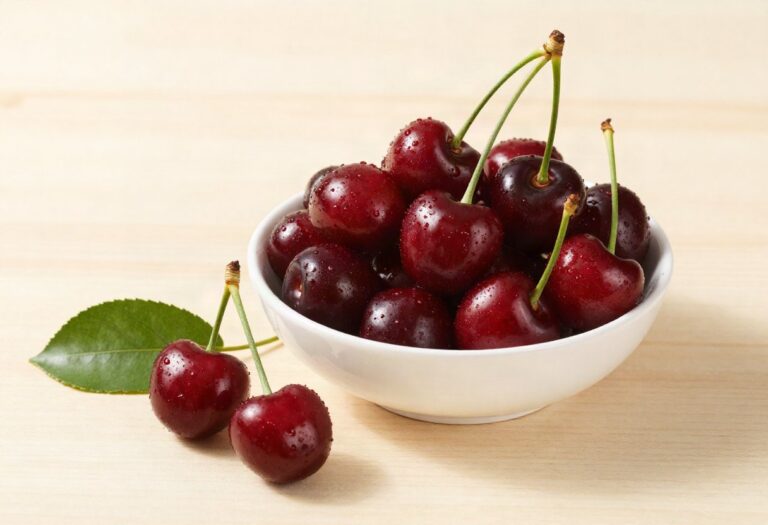
The griotte (morello cherry) is a sour cherry with soft flesh and dark juice, of a different species from the sweet cherry. Too tart to eat raw for most people, it is the cherry of jams, clafoutis and kirsch.
In terms of nutrition facts, raw: only 50 kcal per 100 g, with 12.18 g of carbohydrates including 8.49 g of sugars, 1.6 g of fibre and 1 g of protein. It provides 770 µg of beta-carotene, 173 mg of potassium and 10 mg of vitamin C per 100 g.
Macronutrient breakdown
Nutrition table per 100 g
| Calories | 50 kcal |
| Kilojoules | 209 kJ |
| Protein | 1 g |
| Carbohydrate | 12,2 g |
| Fat | 0,3 g |
| Fibre | 1,6 g |
Micronutrients per 100 g
All measured nutrients, ranked by share of the daily reference intake.
- Vitamin C10 mg13 %
- Copper0,1 mg10 %
- Potassium173 mg9 %
- Vitamin A64 µg8 %
- Manganese0,11 mg6 %
- Vitamin B98 µg4 %
- Vitamin B60,04 mg3 %
- Vitamin B20,04 mg3 %
See the other 12 nutrients
- Vitamin K12,1 µg3 %
- Vitamin B10,03 mg3 %
- Vitamin B30,4 mg3 %
- Magnesium9 mg2 %
- Vitamin B50,14 mg2 %
- Iron0,32 mg2 %
- Omega-3 ALA0,04 g2 %
- Phosphorus15 mg2 %
- Calcium16 mg2 %
- Zinc0,1 mg1 %
- Vitamin E0,07 mg1 %
- Omega-6 LA0,05 g0 %
USDA FoodData Central (SR Legacy)
Tips
It is noticeably less sweet than the sweet cherry. 8.49 g of sugars per 100 g, against far more for a bigarreau. That explains its tartness, and makes it a better choice if you watch your blood sugar, as long as you do not drown it in sugar.
770 µg of beta-carotene: much more than a sweet cherry. Its dark red flesh is the visible signature.
In a clafoutis, keep the stones in. This is the Limousin tradition, and it has a basis: the stone gives off an almond aroma during cooking. Warn your guests.
Morello juice and sports recovery. Several trials suggest an effect on muscle soreness after intense exercise, attributed to anthocyanins. The protocols use the equivalent of 300 ml of concentrated juice: a handful of fruits will not have this effect.
It freezes very well. Stoned and spread out on a tray, it keeps its texture and colour for several months, and its season lasts only three weeks.