Group · Dairy
Munster
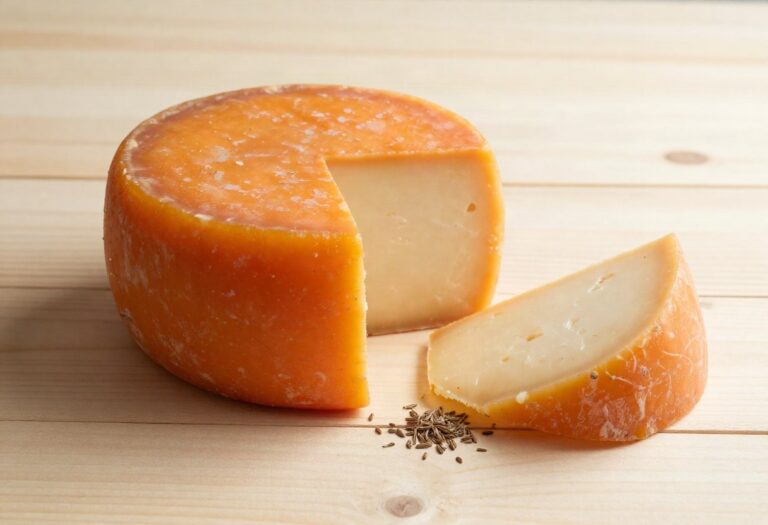
Munster is a soft, washed-rind cheese from Alsace and Lorraine, where it has protected designation of origin status. Recognisable by its orange rind and powerful smell, it develops a creamy, melting paste with a pronounced flavour. It comes in different forms: the large munster, the small munster, or the cumin munster, flavoured with the seed. Within the dairy products family, it provides good-quality protein and calcium. With around 324 kcal per 100 g, however, it is a rich cheese, to be enjoyed in moderation as part of a varied, balanced diet.
Macronutrient breakdown
Nutrition table per 100 g
| Calories | 324 kcal |
| Kilojoules | 1350 kJ |
| Protein | 20 g |
| Carbohydrate | 0,7 g |
| Fat | 26,8 g |
| Fibre | 0,2 g |
Micronutrients per 100 g
All measured nutrients, ranked by share of the daily reference intake.
- Phosphorus468 mg67 %
- Vitamin B121,47 µg59 %
- Calcium350 mg44 %
- Vitamin A298 µg37 %
- Zinc2,81 mg28 %
- Vitamin B20,32 mg23 %
- Iodine30,4 µg20 %
- Vitamin D0,6 µg12 %
See the other 15 nutrients
- Selenium4,32 µg8 %
- Magnesium27 mg7 %
- Omega-3 ALA0,14 g7 %
- Potassium134 mg7 %
- Vitamin B912 µg6 %
- Omega-6 LA0,43 g4 %
- Vitamin B60,06 mg4 %
- Vitamin K12,5 µg3 %
- Vitamin B50,19 mg3 %
- Copper0,03 mg3 %
- Iron0,41 mg3 %
- Vitamin E0,26 mg2 %
- Vitamin B10,01 mg1 %
- Vitamin B30,1 mg1 %
- Manganese0,01 mg0 %
Anses Ciqual 2025. Source: Anses, 2025, Ciqual food composition table
Tips
Munster is best eaten properly matured, at room temperature, to bring out its full aroma. A sensible portion of 30 g is plenty to enjoy its nutrition facts without adding too many calories. You can serve it at the end of a meal, on a piece of country bread, or add it to hot dishes such as an Alsatian tartiflette, a tart or potatoes au gratin.
- Calories and composition: 324 kcal per 100 g, 20 g of protein, 26.8 g of fat and only 0.7 g of carbohydrate. Its density in fat calls for moderation, especially if you are watching your weight.
- Key nutrients: a useful source of calcium, phosphorus, vitamins B2 and B12, and complete protein. The absence of fibre and sugars makes it a food with a very low glycaemic index.
- Tasty pairings: it goes well with a little cumin, dried fruit, or a green salad to lighten the whole.
For storage, keep munster in the vegetable drawer of the fridge, wrapped in its original paper to preserve its moisture, and take it out 30 minutes before eating. Its robust aroma intensifies with maturing, which is perfectly normal.
If you enjoy soft cheeses, you can vary your choices with a milder Camembert or a melting Reblochon. To discover other dairy options, explore the whole dairy products family.
For active people: munster provides protein that helps maintain muscle, but its richness in fat makes it a poor choice just before exercise, as it is slow to digest. Keep it instead for a recovery meal, in a measured amount, and round out your intake with lighter sources such as 0% fat fromage blanc. If you are looking for high-protein snacks that are easier to digest after training, our protein snack ideas may inspire you.
Weight control: because of its calorie density, munster deserves only an occasional place in a weight-loss plan. Weigh your portion, avoid eating several cheeses in the same meal and choose a light accompaniment. Well incorporated, it brings enjoyment and flavour benefits without unbalancing your plate. To compare intakes easily, see our food calorie table.