Group · Vegetables
Muscat squash
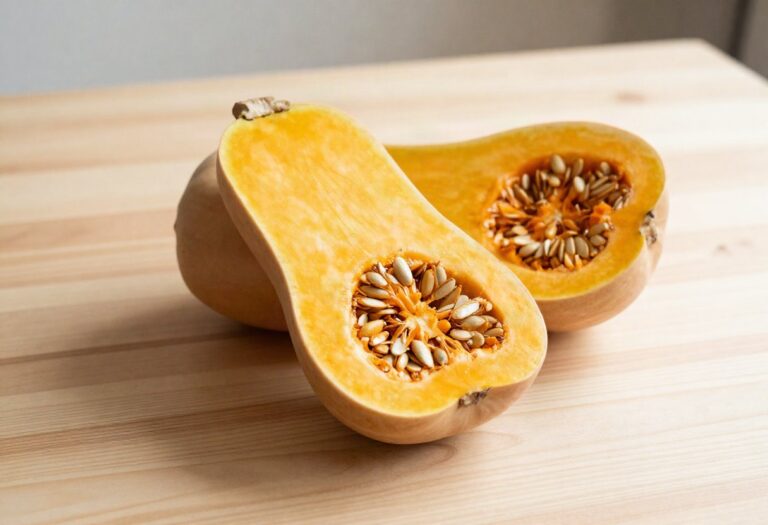
The muscat squash, or Muscade de Provence, is a large ribbed squash with dark orange flesh, most often sold by the slice. Its French name comes from its slightly musky scent, more pronounced than that of other squashes.
In terms of nutrition facts, raw flesh without the skin provides 23.5 kcal per 100 g, with 4.6 g of carbohydrate, 1 g of fibre and 0.55 g of protein. It provides 235 mg of potassium, 18.3 mg of calcium and 4.6 mg of vitamin C per 100 g, with 93.3 g of water.
Macronutrient breakdown
Nutrition table per 100 g
| Calories | 24 kcal |
| Kilojoules | 99 kJ |
| Protein | 0,6 g |
| Carbohydrate | 4,6 g |
| Fat | 0,1 g |
| Fibre | 1 g |
Micronutrients per 100 g
All measured nutrients, ranked by share of the daily reference intake.
- Potassium235 mg12 %
- Vitamin C4,6 mg6 %
- Iron0,43 mg3 %
- Phosphorus18,3 mg3 %
- Calcium18,3 mg2 %
- Magnesium6,25 mg2 %
- Vitamin B10,01 mg1 %
- Iodine0,5 µg0 %
Anses Ciqual 2025. Source: Anses, 2025, Ciqual food composition table
Tips
23.5 kcal: it is one of the lightest squashes. Its water content, 93.3 g per 100 g, explains everything. It fills the plate for almost nothing.
Its orange flesh signals carotenoids. Pair it with a little fat, such as a tablespoon of olive oil, to improve absorption, as with pumpkin.
Roasted rather than boiled. Being so watery, it gets washed out in water. In the oven, the water evaporates and the sugars caramelise: the flavour concentrates without adding anything.
If you buy it by the slice, check the cut. It should be moist and shiny, not dry or dull. A slice left on display for several days loses a lot.
It keeps all winter if whole. Like all hard-skinned squashes, in a cool, dry place. That is what makes it a cold-season vegetable.