Group · Vegetables
Spring onion
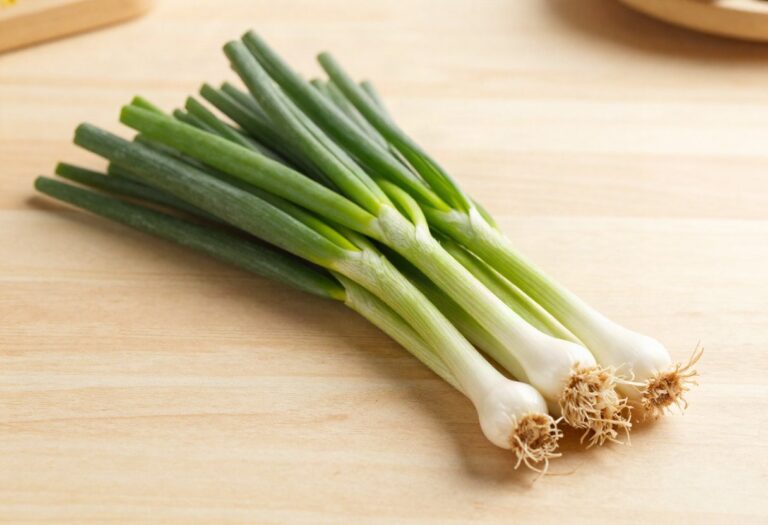
The spring onion is an onion harvested before it is mature, sold in bunches with its green tops. It is milder and less pungent than a dry onion, and its stems are eaten like chives.
In terms of nutrition facts, fried without fat, it provides 28 kcal per 100 g, with 3.56 g of carbohydrate, 3.1 g of fibre and 1.13 g of protein. It provides 260 mg of potassium, 55 mg of calcium and 137 µg of beta-carotene per 100 g.
Macronutrient breakdown
Nutrition table per 100 g
| Calories | 28 kcal |
| Kilojoules | 117 kJ |
| Protein | 1,2 g |
| Carbohydrate | 3,6 g |
| Fat | 0,3 g |
| Fibre | 3,1 g |
Micronutrients per 100 g
All measured nutrients, ranked by share of the daily reference intake.
- Manganese0,36 mg18 %
- Potassium260 mg13 %
- Vitamin C7,38 mg9 %
- Calcium55 mg7 %
- Iron0,85 mg6 %
- Vitamin K14,03 µg5 %
- Vitamin B60,07 mg5 %
- Phosphorus26 mg4 %
- Vitamin B9dietary folate equivalents40,5 µg
See the other 8 nutrients
- Copper0,03 mg3 %
- Magnesium11 mg3 %
- Vitamin B30,41 mg3 %
- Vitamin B50,14 mg2 %
- Zinc0,21 mg2 %
- Vitamin A11,4 µg1 %
- Omega-3 ALA0,02 g1 %
- Omega-6 LA0,08 g1 %
Anses Ciqual 2025. Source: Anses, 2025, Ciqual food composition table
Tips
Do not throw away the green tops. This is the most common mistake: the green part is snipped like chives and provides the carotenoids that the white bulb lacks. Two vegetables in one bunch.
3.1 g of fibre for 28 kcal: a very good ratio. Onion fibre is partly fructans, prebiotics that feed the gut microbiota.
The same fructans are a problem on a low-FODMAP diet. Onion is one of the foods least well tolerated with irritable bowel syndrome. The green tops are better tolerated than the bulb.
Raw, it is clearly milder than a dry onion. Sliced into a salad or over fish, it adds crunch without being aggressive. That is its advantage over the red onion.
It does not keep like a dry onion. A week in the fridge, tops included. With no dry outer skin, it has no protection.