Group · Vegetables
Pak choi
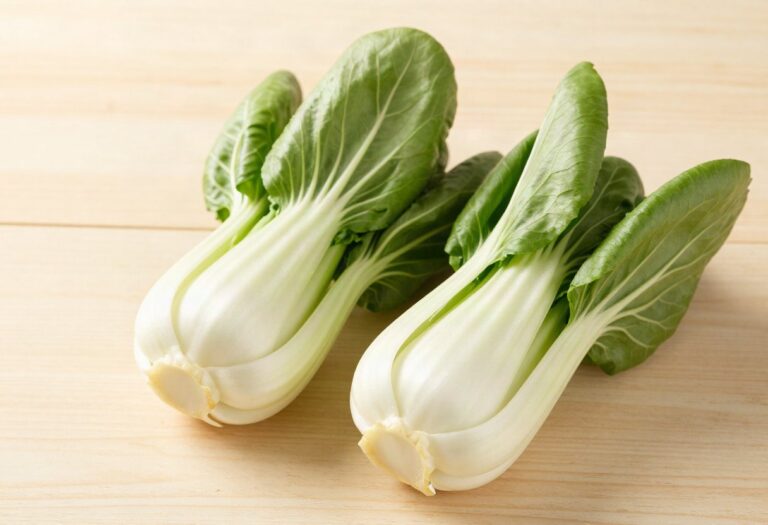
Pak choi is a Chinese cabbage with crunchy white stalks and large dark green leaves, which does not form a head. Unlike Chinese leaf, it stays firm when cooked and suits the wok, steaming and broth.
On the nutrition side, raw pak choi provides 14.6 kcal per 100 g, with 1.5 g of protein and 1 g of fibre. It is remarkably well supplied for such a light vegetable: 45 mg of vitamin C (56% of the reference intake), 105 mg of calcium, 45.5 µg of vitamin K1 and 2,680 µg of beta-carotene per 100 g.
Macronutrient breakdown
Nutrition table per 100 g
| Calories | 15 kcal |
| Kilojoules | 61 kJ |
| Protein | 1,5 g |
| Carbohydrate | 1,2 g |
| Fat | 0,2 g |
| Fibre | 1 g |
Micronutrients per 100 g
All measured nutrients, ranked by share of the daily reference intake.
- Vitamin K145,5 µg61 %
- Vitamin C45 mg56 %
- Vitamin A223 µg28 %
- Vitamin B60,19 mg14 %
- Calcium105 mg13 %
- Potassium252 mg13 %
- Manganese0,16 mg8 %
- Iron0,8 mg6 %
- Vitamin B9dietary folate equivalents66 µg
See the other 11 nutrients
- Phosphorus37 mg5 %
- Magnesium19 mg5 %
- Vitamin B20,07 mg5 %
- Vitamin B10,04 mg4 %
- Vitamin B30,5 mg3 %
- Omega-3 ALA0,05 g3 %
- Copper0,02 mg2 %
- Zinc0,19 mg2 %
- Vitamin B50,09 mg1 %
- Vitamin E0,09 mg1 %
- Omega-6 LA0,04 g0 %
Anses Ciqual 2025. Source: Anses, 2025, Ciqual food composition table
Tips
105 mg of calcium for 15 kcal. That is what sets it apart as a vegetable. Cruciferous vegetables provide well-absorbed calcium, unlike spinach, whose oxalates block much of the absorption. A useful point if you limit dairy products.
Separate the stalks from the leaves. The stalks need three to four minutes, the leaves less than one. Thrown into the wok together, you get either raw stalks or leaves cooked to mush. Stalks first, leaves at the end.
Vitamin C does not survive boiling water. 45 mg per 100 g raw, much less after ten minutes of boiling. Steaming, stir-frying, or a broth eaten along with the vegetable: all three preserve most of it.
It needs almost nothing. A splash of tamari, garlic, ginger and a teaspoon of oil are enough for a whole bunch. It is a vegetable that stands on its own, as long as you sear it over a high heat.
Baby leaves can be eaten raw. Finely sliced in a salad, they add a peppery crunch and keep all their vitamin C. A little-known use in the UK, common in Asia.
Sources
Average nutrition values per 100 g, given as a guide only (they may vary by brand and preparation).