Group · Condiments & sauces
Vegetable stock
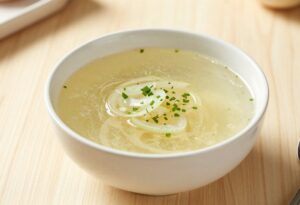
Vegetable stock is the most versatile base in cooking: it serves as the cooking liquid for grains, as the base for soups and risottos, and as a substitute for fat when sweating vegetables. Cube, powder or homemade, the use is the same, the make-up is not.
On nutrition facts, made up, it shows 4.78 kcal per 100 g, with 0.51 g of carbohydrate, 0.34 g of protein and 0.16 g of fat. In other words, a practically empty liquid, which is exactly its appeal. The only figure to look at is the salt: 0.61 g per 100 g.

Macronutrient breakdown
Nutrition table per 100 g
| Calories | 5 kcal |
| Kilojoules | 20 kJ |
| Protein | 0,4 g |
| Carbohydrate | 0,6 g |
| Fat | 0,2 g |
Micronutrients per 100 g
All measured nutrients, ranked by share of the daily reference intake.
- Vitamin B10,11 mg10 %
- Iron0,1 mg1 %
- Vitamin B20,01 mg1 %
- Vitamin B30,1 mg1 %
- Magnesium2 mg1 %
- Manganese0,01 mg1 %
- Vitamin B91 µg1 %
- Potassium8 mg0 %
See the other 2 nutrients
- Calcium1 mg0 %
- Vitamin A0,17 µg0 %
Anses Ciqual 2025. Source: Anses, 2025, Ciqual food composition table
Tips
It replaces oil for sweating vegetables. This is its most useful use, and the most underrated. Two spoonfuls of stock in a hot pan sweat an onion as well as a spoonful of oil, for 1 kcal instead of 90. Over everyday cooking, the difference becomes considerable.
Salt is the only real issue. 0.61 g per 100 g seems modest, but a soup easily contains 700 ml: that comes to more than 4 g of salt, almost the whole daily reference. « Reduced salt » versions halve this figure.
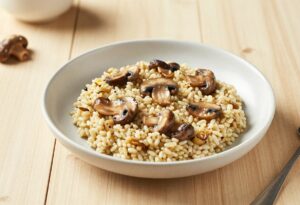
It adds flavour to starchy foods at no cost. Cooking rice, quinoa or couscous in stock rather than water completely changes the result, without adding a calorie or any fat.
At home, it can be made with peelings. Carrot tops, leek greens and mushroom stalks, frozen as you go and then simmered for forty minutes. No added salt, no waste, and a flavour that bears no comparison with a cube.
Read the ingredients list. Many cubes contain palm oil, sugar and flavour enhancers on top of the salt. A dehydrated vegetable powder without additives is available in health food shops, and can be measured out more precisely.
Sources
Average nutrition values per 100 g, given for guidance (may vary by brand and preparation).