Group · Fruit
Reinette du Canada apple
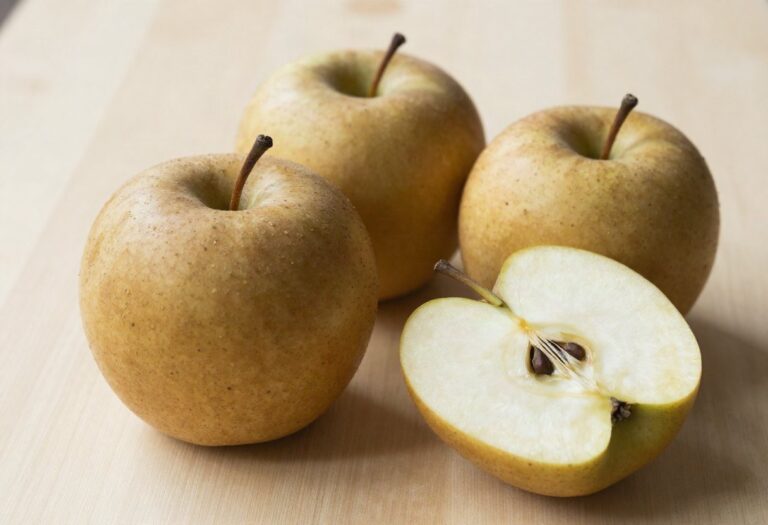
The reinette du Canada is an old variety with rough, grey skin, unappealing to look at and remarkable to taste. Its buttery, slightly tart flesh makes it the traditional cooking apple of French cuisine.
In terms of nutrition facts, raw flesh without skin: 51.1 kcal per 100 g, with 11.6 g of carbohydrates including 11 g of sugars and 1.6 g of fibre. It provides 154 mg of potassium, the best score of the apples in this batch, and 4 mg of vitamin C per 100 g.
Macronutrient breakdown
Nutrition table per 100 g
| Calories | 51 kcal |
| Kilojoules | 216 kJ |
| Protein | 0,4 g |
| Carbohydrate | 11,6 g |
| Fat | 0,1 g |
| Fibre | 1,6 g |
Micronutrients per 100 g
All measured nutrients, ranked by share of the daily reference intake.
- Potassium154 mg8 %
- Vitamin C4 mg5 %
- Vitamin B60,06 mg4 %
- Copper0,04 mg4 %
- Vitamin B10,03 mg3 %
- Manganese0,03 mg2 %
- Vitamin B20,02 mg1 %
- Phosphorus8,61 mg1 %
- Vitamin B9dietary folate equivalents1 µg
See the other 7 nutrients
- Magnesium3,76 mg1 %
- Iron0,14 mg1 %
- Zinc0,09 mg1 %
- Iodine1,12 µg1 %
- Vitamin B30,1 mg1 %
- Calcium3,59 mg0 %
- Selenium0,05 µg0 %
Anses Ciqual 2025. Source: Anses, 2025, Ciqual food composition table
Tips
4 mg of vitamin C: three times a Gala. That is not much in absolute terms, but the gap between varieties is real, and old varieties are often better supplied.
It is the cooking apple par excellence. Its flesh turns into a melting purée without releasing water: exactly what you want for a compote or a turnover. In a tart it collapses; for slices that hold, choose a Granny.
Its rough skin is normal. This surface russeting is characteristic of reinettes and signals no defect. It is edible, although many people peel it.
It improves in storage. Picked in October, it gains in aroma after a few weeks of keeping, unlike modern varieties, which are at their best at harvest.
It is becoming rare. Its dull appearance works against it in supermarkets. You mostly find it from producers and at markets, from autumn to spring.