Group · Nuts & seeds
Roasted almonds
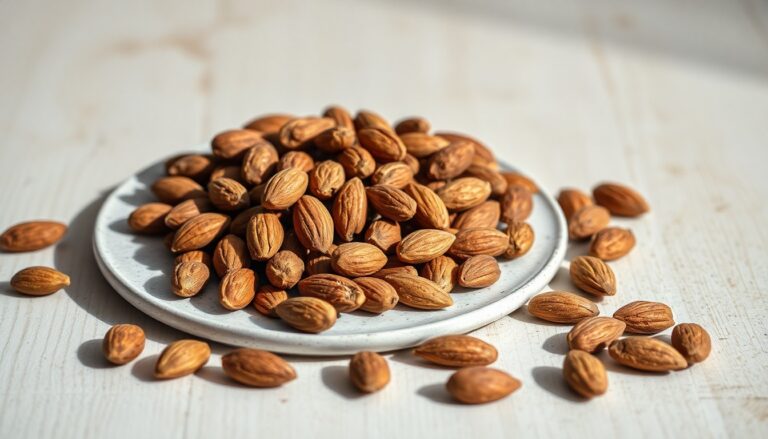
Roasted almonds are almonds that have been baked in the oven or toasted in a pan, which develops their aromas and their characteristic crunch. This roasting intensifies the flavour while keeping most of their nutritional richness. They are sold plain, salted, flaked or whole, and fit equally well into sweet and savoury recipes. Essential members of the nut family, they are dense in plant protein, healthy fats, fibre and minerals. At around 647 kcal per 100 g, they are an energy-rich food, best enjoyed in small amounts. Easy to carry around, roasted almonds make a filling snack, popular with food lovers who care about a balanced diet.
Macronutrient breakdown
Nutrition table per 100 g
| Calories | 647 kcal |
| Kilojoules | 2680 kJ |
| Protein | 24,1 g |
| Carbohydrate | 12,2 g |
| Fat | 53,9 g |
| Fibre | 8,5 g |
Micronutrients per 100 g
All measured nutrients, ranked by share of the daily reference intake.
- Vitamin E23,9 mg199 %
- Omega-6 LA12,9 g129 %
- Manganese2,23 mg112 %
- Copper1,1 mg110 %
- Vitamin B21,2 mg86 %
- Magnesium279 mg74 %
- Phosphorus471 mg67 %
- Potassium713 mg36 %
- Vitamin B9dietary folate equivalents55 µg
See the other 9 nutrients
- Calcium268 mg34 %
- Zinc3,31 mg33 %
- Iron3,73 mg27 %
- Vitamin B33,64 mg23 %
- Vitamin B60,14 mg10 %
- Vitamin B10,08 mg7 %
- Vitamin B50,32 mg5 %
- Omega-3 ALA0,01 g0 %
- Vitamin A0,08 µg0 %
Anses Ciqual 2025. Source: Anses, 2025, Ciqual food composition table
Tips
To enjoy the benefits of roasted almonds without weighing down your calorie count, aim for a portion of around 20 to 30 g, a small handful. This amount provides protein, fibre and unsaturated fatty acids while staying reasonable. The nutrition facts show 607 kcal, 24.1 g of protein, 12.2 g of carbohydrate, 53.9 g of fat and 8.46 g of fibre per 100 g: a high energy density that calls for moderation.
How to eat them? At breakfast on a yoghurt or porridge, as a topping for salads, in your slow-cooked dishes or simply plain as a snack. Roasted flaked almonds elevate fish, vegetables and desserts. Choose plain rather than salted versions to limit sodium, especially if you are watching your blood pressure. For storage, keep them in an airtight container, away from light and heat, as the fats can go rancid.
- Key nutrients: antioxidant vitamin E, magnesium, calcium, manganese, potassium and fibre that promotes fullness.
- Glycaemic index: low, thanks to their richness in fat and protein.
- Weight-loss asset: their filling effect helps space out snacking, as long as you stick to the portions.
For active people, roasted almonds are a handy snack before an endurance session or for recovery, paired with a piece of fruit to combine carbohydrate and protein. They complement a protein snack well or can be added to a homemade bar. For a targeted protein boost after the session, you can pair them with a post-training shaker. Remember to drink enough too, as their fibre content deserves it.
You can vary things within the same family by alternating with hazelnuts or cashews, each bringing its own minerals and flavours. To explore other nuts and seeds, see the Nuts & Seeds family page. And if you want to compare the energy density of different snacks, the food calorie table will help you put together snacks suited to your goals.
In short, roasted almonds combine indulgence, plant protein and healthy fats. Include them in moderation in a balanced, varied diet.