Group · Fruit
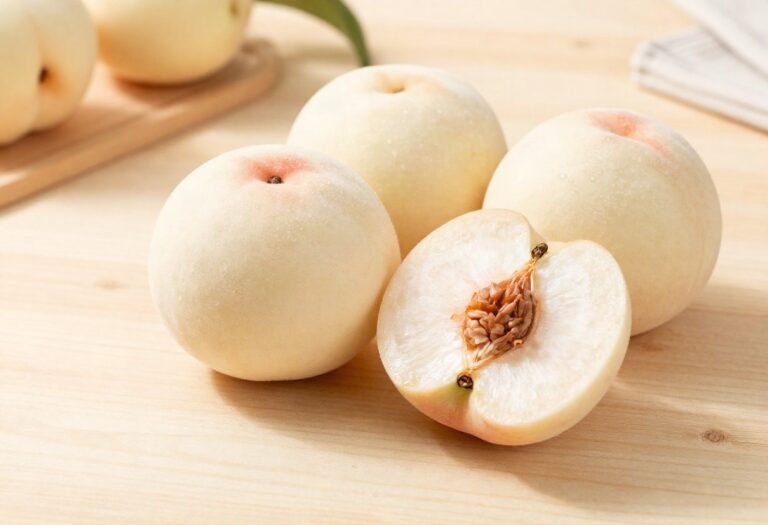
White peach
The white peach is distinguished from the yellow by its pale flesh, which is finer, more fragrant and more fragile. It keeps less well, which is why you mostly find it from local producers and in peak season.
In terms of nutrition facts, raw flesh and skin: 44.3 kcal per 100 g, with 9.48 g of carbohydrates including 8.7 g of sugars and 2.1 g of fibre. It provides 180 mg of potassium and 3.85 mg of vitamin C per 100 g, and contains 87.6 g of water.
Macronutrient breakdown
Nutrition table per 100 g
| Calories | 44 kcal |
| Kilojoules | 187 kJ |
| Protein | 0,7 g |
| Carbohydrate | 9,5 g |
| Fibre | 2,1 g |
Micronutrients per 100 g
All measured nutrients, ranked by share of the daily reference intake.
- Potassium180 mg9 %
- Copper0,06 mg6 %
- Vitamin C3,85 mg5 %
- Vitamin B50,18 mg3 %
- Phosphorus18 mg3 %
- Manganese0,05 mg3 %
- Magnesium7,1 mg2 %
- Vitamin E0,19 mg2 %
- Vitamin B9dietary folate equivalents7,92 µg
See the other 5 nutrients
- Vitamin B30,2 mg1 %
- Zinc0,11 mg1 %
- Iron0,11 mg1 %
- Calcium4,1 mg1 %
- Vitamin A0,21 µg0 %
Anses Ciqual 2025. Source: Anses, 2025, Ciqual food composition table
Tips
44.3 kcal: it is a very light fruit. A 150 g portion provides 66 kcal and 3.2 g of fibre. The ratio is excellent.
White or yellow: the difference is real. The yellow is richer in carotenoids, the white more fragrant and more acidic. It is not only a matter of colour.
Do not put it in the fridge before it is ripe. Cold halts ripening and makes the flesh mealy. Keep it at room temperature until it gives under your finger, then chill it if needed.
Eat the skin. It holds some of the fibre and polyphenols. Its fuzz bothers some people: a rub with a tea towel is enough to remove it.
Its season is short: June to September. Out of season, what you find comes from South America, picked unripe, and has little left of the fruit described here.