Group · Fruit
Williams pear
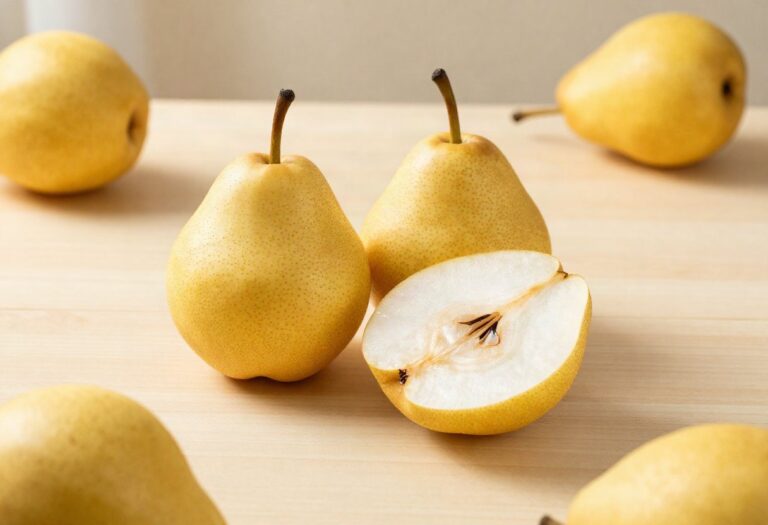
The Williams pear is a summer variety with yellow skin and very fragrant flesh, grown since the late 18th century in England. It is the pear of tinned fruit in syrup and of the eau-de-vie that bears its name.
In terms of nutrition facts, raw flesh without skin: 50.2 kcal per 100 g, with 11.5 g of carbohydrates including 9.4 g of sugars and 3.1 g of fibre. It provides 120 mg of potassium and 2.57 mg of vitamin C per 100 g.
Macronutrient breakdown
Nutrition table per 100 g
| Calories | 50 kcal |
| Kilojoules | 211 kJ |
| Protein | 0,3 g |
| Carbohydrate | 11,5 g |
| Fibre | 3,1 g |
Micronutrients per 100 g
All measured nutrients, ranked by share of the daily reference intake.
- Potassium120 mg6 %
- Copper0,05 mg5 %
- Vitamin C2,57 mg3 %
- Magnesium5,3 mg1 %
- Phosphorus9,8 mg1 %
- Manganese0,02 mg1 %
- Vitamin B50,06 mg1 %
- Zinc0,09 mg1 %
- Vitamin B9dietary folate equivalents18,4 µg
See the other 3 nutrients
- Calcium6,1 mg1 %
- Iron0,07 mg1 %
- Vitamin A0,21 µg0 %
Anses Ciqual 2025. Source: Anses, 2025, Ciqual food composition table
Tips
3.1 g of fibre, flesh alone: pears beat apples. A Gala apple provides 1.9 g. That is the pear’s main nutritional argument, and it holds for every variety.
It ripens after picking, and very fast. That is the difficulty with Williams: between « too hard » and « mealy », the window is two or three days. Test the neck near the stalk, not the belly.
Its sorbitol explains its laxative effect. This polyol is also the reason pears are poorly tolerated on a low-FODMAP diet.
Poached, it needs no sugar. In water with a star anise and a cinnamon stick, its own sugars are enough, and the spices give an impression of sweetness.
Tinned in syrup, it is no longer the same food. The syrup adds several grams of sugar per 100 g. Draining and rinsing removes a real share of this added sugar.