Biotin: benefits for hair and nails, side effects and blood test interference

The short answer
Biotin (vitamin B7, called vitamin B8 in France) is a B vitamin your body needs to use fats, sugars and amino acids, found mostly in eggs, liver and some fish. It is sold for hair and nails, but the evidence is weak in people who are not deficient: almost every published case of improvement involved a deficiency or an underlying condition. The main safety issue is not toxicity, which is low, but blood tests: high doses can skew some lab results, including thyroid and troponin tests (the heart attack marker). The FDA reported one death after falsely low troponin results. If you take biotin, tell your doctor and the lab before any blood test.
This article is for information and does not replace medical advice. If you have significant hair loss, a thyroid condition, chest pain or an upcoming blood test, talk to your doctor or the lab.
What is biotin?
Biotin is a water-soluble vitamin, known as vitamin B7 or vitamin H, and as vitamin B8 in France: same molecule. It works as a coenzyme for enzymes that build fatty acids, break down some amino acids and make glucose, which is why a true deficiency affects skin and hair.
Deficiency is rare. Clear cases mostly involve inherited disorders (biotinidase deficiency) or eating raw egg whites over long periods: they contain avidin, a protein that binds biotin. According to the Linus Pauling Institute, it causes hair loss, a red rash around the eyes, nose and mouth, and neurological symptoms. Cooking destroys avidin, so cooked eggs are fine.
How much biotin per day? The US Adequate Intake is 30 mcg a day for adults (35 mcg when breastfeeding). Many hair supplements provide tens to hundreds of times more.
Does biotin help hair growth?
Without a deficiency, there is no solid evidence
A literature review (Patel et al., 2017) looked for every published case and trial on biotin for hair and nails. It found only 18 cases, and in all of them the person had an underlying cause: acquired or inherited deficiency, uncombable hair syndrome, brittle nails. The authors conclude there is not enough evidence to supplement healthy people. No placebo-controlled trial shows that biotin grows hair in people who are not deficient.
What about women with hair loss?
A Swiss study (Trüeb, 2016) measured biotin in women complaining of hair loss: 38% had low levels. But only 11% of them had a known risk factor, and the study does not show that biotin caused the hair loss. The author rejects giving biotin to these women indiscriminately, without proving a deficiency and ruling out other causes such as low iron, thyroid problems, stress or recent pregnancy.
In France, a 5 mg biotin medicine is approved only as an add-on treatment for diffuse hair loss, at 3 tablets a day for 6 weeks. To compare other options, see our best supplement for hair loss comparison.
Biotin for nails: possible help for brittle nails
This is the best-documented use, though not proven. Three uncontrolled trials in women with brittle nails used 2.5 mg of biotin a day for several months. In two, 67% to 91% of participants who completed the study reported improvement; in the third, nail thickness increased by 25% under the microscope after 6 to 15 months. A dermatology review (Lipner and Scher, 2018) calls the results promising but asks for larger controlled trials.
| Use | What studies show | Evidence |
|---|---|---|
| Biotin deficiency (rare) | Skin and hair signs corrected | Established |
| Hair loss without deficiency | No positive controlled trial; 18 published cases, all with an underlying cause | Insufficient |
| Brittle nails | Improvement in 3 uncontrolled trials at 2.5 mg a day | Weak |
| Skin, “beauty” | No solid trial outside deficiency | Insufficient |
Biotin and blood tests: the main safety issue
Many lab tests use biotin as a chemical “glue” that binds tightly to a protein called streptavidin. When your blood contains a lot of supplemental biotin, it disrupts this binding, and the result can be falsely high or falsely low depending on the test.
The JAMA study
Six healthy adults took 10 mg of biotin a day for 7 days (Li et al., 2017). Out of 23 biotin-based assays, 9 (39%) gave skewed results, versus none of the 14 assays without biotin. Affected tests included thyroid hormones (TSH, T3, T4). A skewed thyroid panel can mimic Graves’ disease: the French label of the 5 mg biotin medicine mentions exactly this in patients without symptoms.
Troponin: the FDA warning
In November 2017, the FDA warned that biotin could cause falsely low troponin results and lead to a missed heart attack. It reported that one patient died after falsely low troponin results from a test known to be affected by biotin. In 2019 it updated the warning: some test makers had fixed the problem, others had not, and reports kept coming in.
This is not rare: in a Mayo Clinic survey, 7.7% of outpatients said they took biotin, and 7.4% of emergency patients had blood levels above the interference threshold of some tests (Katzman et al., 2018).
| Biotin intake | Risk for lab tests |
|---|---|
| Diet (about 0.03 mg a day) | Does not typically interfere, per the FDA |
| Hair, skin and nail supplements | Up to 650 times the recommended intake (FDA, 2017); products with 20 mg, some up to 100 mg per pill (2019) |
| 10 mg a day for 7 days | 39% of biotin-based assays skewed (Li et al., 2017) |
How long to stop biotin before a blood test?
There is no validated delay: the FDA says there is not enough information to know whether stopping biotin for any number of hours prevents wrong results. The French drug label adds that the risk rises with the dose and is higher in children and people with kidney failure. So:
- tell your doctor and the lab about any biotin, including in a multivitamin or hair supplement, before the blood draw;
- ask them whether, and for how long, to stop it for the specific test;
- if a result does not match your symptoms, especially a thyroid panel, think of biotin;
- chest pain: call emergency services and tell the medical team you take biotin.
Biotin side effects: can you take too much biotin?
Toxicity is low. The Linus Pauling Institute reports no adverse effects with up to 5 mg a day for two years, and no US upper limit has been set. One serious case (fluid around the heart and lungs) was described in an older woman taking 10 mg of biotin plus 300 mg of vitamin B5 daily. The French 5 mg biotin label lists allergic skin reactions (hives, itching).
The real downsides are skewed lab results and the risk of delaying the diagnosis of hair loss that has a cause (iron, thyroid, hormones). Does biotin cause weight gain? We found no study showing it.
Pregnancy and breastfeeding: needs rise slightly and prenatal vitamins often contain biotin. As a precaution, the French label advises against high-dose biotin during pregnancy and breastfeeding: ask your doctor or midwife.
Foods high in biotin
A varied diet covers your needs. Values vary with the measurement method, hence the ranges:
| Food | Serving | Biotin (mcg) |
|---|---|---|
| Liver, cooked | 3 oz | 27 to 35 |
| Egg, cooked | 1 large | 13 to 25 |
| Salmon, cooked | 3 oz | 4 to 5 |
| Avocado | 1 whole | 2 to 6 |
| Pork, cooked | 3 oz | 2 to 4 |
| Cauliflower, raw | 1 cup | 0.2 to 4 |
| Cheddar | 1 oz | 0.4 to 2 |
Liver is the richest source, then eggs, where biotin sits mostly in the yolk. See also how many eggs a day.
Biotin dosage: how to take it
- Look for the cause first: for hair loss or brittle nails, a check-up (iron, thyroid) is more useful than a pill. Zinc and selenium matter too: see foods high in zinc.
- Doses studied: 2.5 mg a day for brittle nails over several months; the French medicine uses 15 mg a day for 6 weeks, 80 to 500 times the daily need.
- Duration: hair and nails grow slowly; any effect cannot be judged before about 3 months. Before and after photos are not a placebo-controlled trial.
- Don’t stack: a hair supplement, a multivitamin and plain biotin add up, and so does the lab-test risk.
- Before a blood test: tell your doctor and the lab.
Nutrimea: 450 mcg biotin with zinc and selenium
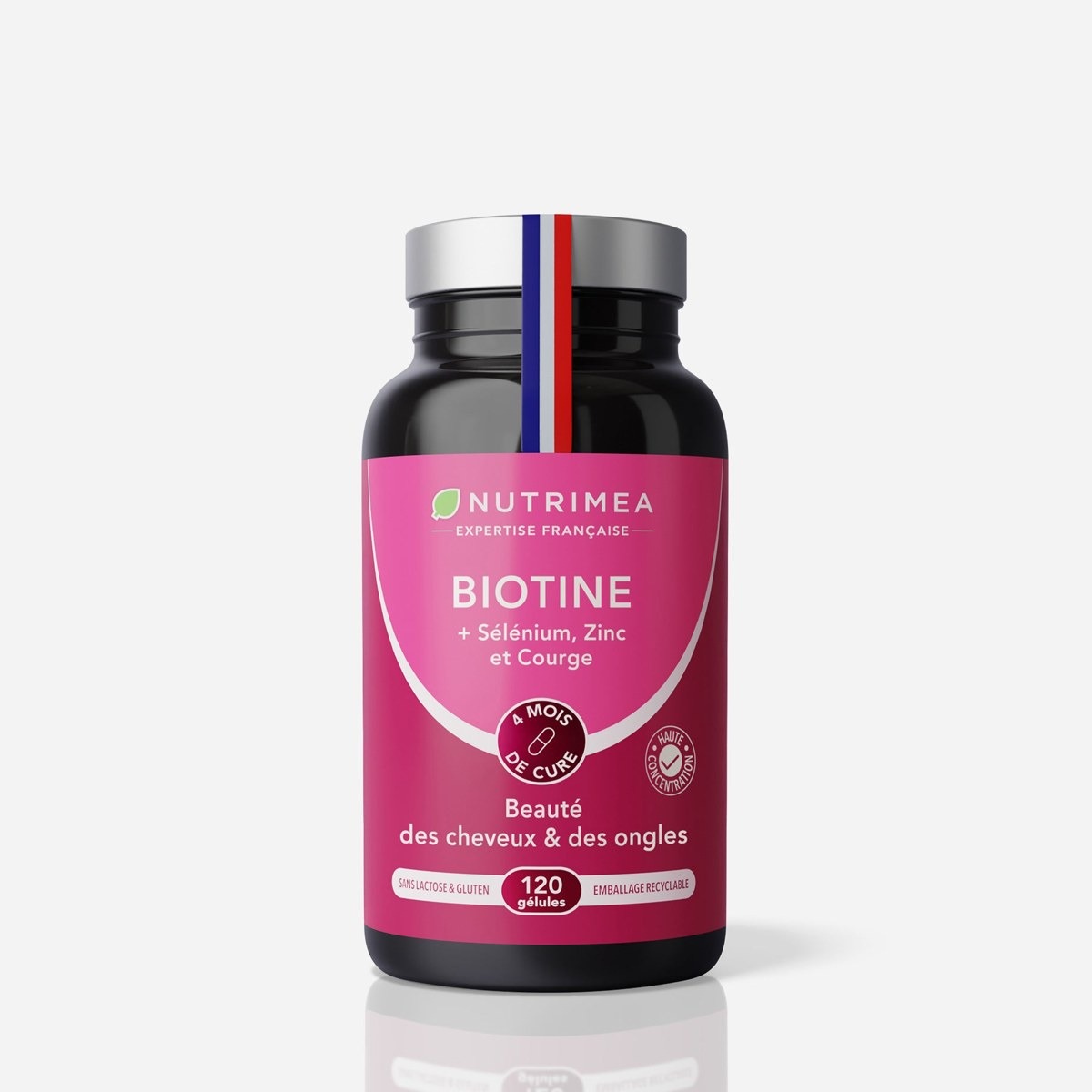
If you want to try biotin after ruling out other causes, Nutrimea’s Biotine offers a moderate dose in a very affordable format. Its label lists:
- 450 mcg of biotin per capsule (900% of the EU reference value);
- 12.34 mg of zinc (citrate) and 50 mcg of selenium (selenomethionine), two minerals whose deficiency can also affect hair;
- 200 mg of pumpkin seed powder in a vegetable capsule; vegan, gluten and lactose free;
- 1 capsule a day with a large glass of water, adults only; 120 capsules, a 4-month supply;
- €15.90 per jar (price checked on 22/11/2026), about €0.13 a day.
How does the dose compare? 450 mcg is well below the 2.5 mg of the nail trials and the 15 mg of the French medicine: the formula aims for a steady intake rather than a megadose. It is also far below the 10 mg of the JAMA study, which lowers the lab-test risk without removing it, so still tell the lab. The studies above did not test this product. Its zinc adds to any other zinc supplement you take.
The brand advises pregnant or breastfeeding women to seek professional advice and not to exceed the daily dose.
Partner link: we earn a commission if you order through this link, at no extra cost to you.
For keratin, iron or amino acid formulas, see our hair loss supplement comparison.
Frequently asked questions
What is biotin good for?
It is essential for metabolism. As a supplement, its benefit is proven in deficiency, which is rare. For brittle nails, a few small uncontrolled trials are encouraging; for hair growth without deficiency, evidence is lacking.
Does biotin help hair growth?
Not in people without a deficiency, as far as studies show. If you are losing hair, a check-up with your doctor is more useful than biotin on a hunch.
What are the side effects of biotin?
Mainly interference with blood tests (thyroid, troponin, other hormones), which can lead to a wrong diagnosis; occasionally allergic skin reactions.
How much biotin per day?
Adults need about 30 mcg a day, easily covered by food. Supplements often contain far more; the higher the dose, the greater the lab-test risk.
Can you take too much biotin?
Toxicity is low and no US upper limit exists, but high doses can skew lab results. Always tell the lab you take it.
Sources
- Patel D.P., Swink S.M., Castelo-Soccio L. A Review of the Use of Biotin for Hair Loss. Skin Appendage Disord, 2017; 3(3): 166-169. PubMed 28879195
- Trüeb R.M. Serum Biotin Levels in Women Complaining of Hair Loss. Int J Trichology, 2016; 8(2): 73-7. PubMed 27601860
- Lipner S.R., Scher R.K. Biotin for the treatment of nail disease: what is the evidence? J Dermatolog Treat, 2018; 29(4): 411-414. PubMed 29057689
- Li D. et al. Association of Biotin Ingestion With Performance of Hormone and Nonhormone Assays in Healthy Adults. JAMA, 2017; 318(12): 1150-1160. PubMed 28973622
- Katzman B.M. et al. Prevalence of biotin supplement usage in outpatients and plasma biotin concentrations in patients presenting to the emergency department. Clin Biochem, 2018; 60: 11-16. PubMed 30036510
- FDA. The FDA Warns that Biotin May Interfere with Lab Tests, safety communication of November 28, 2017 fda.gov (archive), updated November 5, 2019 fda.gov (archive).
- Biotine Bayer 5 mg tablets: summary of product characteristics (French public medicines database). base-donnees-publique.medicaments.gouv.fr
- Linus Pauling Institute, Micronutrient Information Center: Biotin. lpi.oregonstate.edu