Group · Cereals & grains
Rice flour
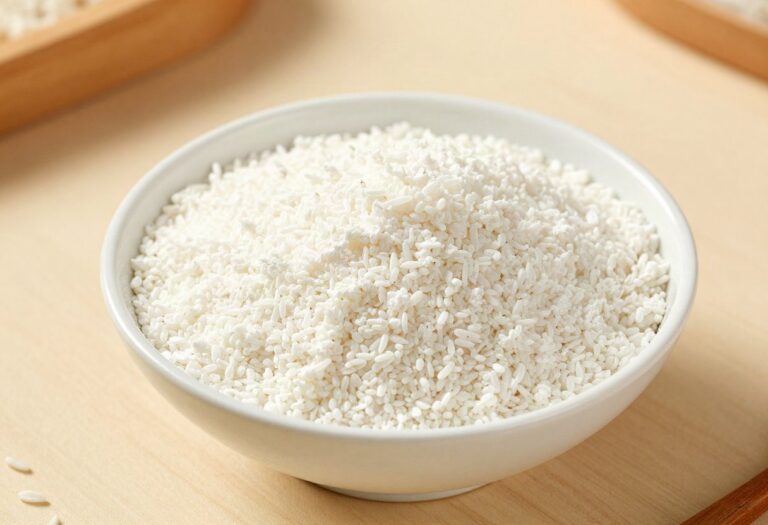
Rice flour is made by grinding grains of rice, white or brown. It is the base of rice noodles, rice cakes and a large part of gluten-free baking.
In terms of nutrition facts: 357 kcal per 100 g, with 73.9 g of carbohydrates, 8 g of protein and 3.3 g of fibre. It provides 300 mg of phosphorus, 270 mg of potassium, 110 mg of magnesium and 1.4 mg of zinc per 100 g.
Macronutrient breakdown
Nutrition table per 100 g
| Calories | 357 kcal |
| Kilojoules | 1510 kJ |
| Protein | 8 g |
| Carbohydrate | 73,9 g |
| Fat | 2,5 g |
| Fibre | 3,3 g |
Micronutrients per 100 g
All measured nutrients, ranked by share of the daily reference intake.
- Manganese2,3 mg115 %
- Phosphorus300 mg43 %
- Vitamin B10,33 mg30 %
- Magnesium110 mg29 %
- Copper0,18 mg18 %
- Vitamin B50,97 mg16 %
- Zinc1,4 mg14 %
- Potassium270 mg14 %
- Vitamin B9dietary folate equivalents25,1 µg
See the other 7 nutrients
- Vitamin B60,13 mg9 %
- Omega-6 LA0,88 g9 %
- Iron0,79 mg6 %
- Vitamin E0,66 mg6 %
- Vitamin K11,78 µg2 %
- Omega-3 ALA0,04 g2 %
- Calcium9,5 mg1 %
Anses Ciqual 2025. Source: Anses, 2025, Ciqual food composition table
Tips
Gluten-free, and that is its purpose. It develops no elastic network: a dough made with rice flour alone crumbles. In baking, it has to be combined with a gum or another binder.
It gives crispness, and that is its strength. In a tempura batter, a coating for fish or a shortbread, it gives a dry, brittle texture that wheat cannot match.
110 mg of magnesium: a good score. Much more than white wheat flour. Grinding the whole grain keeps some of the minerals in the bran.
Arsenic: a caution worth knowing. Rice accumulates inorganic arsenic from the soil more than other cereals. EFSA recommends varying your sources of cereals, and rice-based products should not make up the sole basis of a young child’s diet.
It does not replace wheat weight for weight. It absorbs more liquid: an adapted recipe generally needs more water or egg, and the result is still more crumbly.