Group · Sweet foods
Crystallised ginger
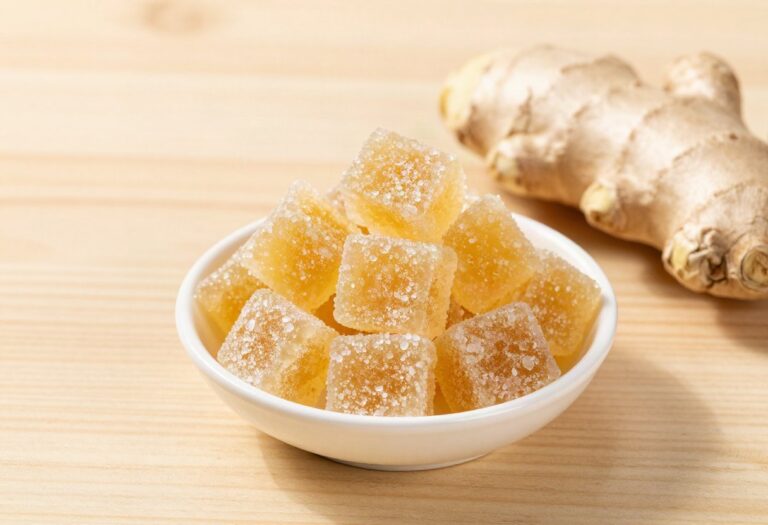
Crystallised ginger is a sweet made by cooking pieces of ginger root in a sugar syrup, then coating them, or not, in granulated sugar. It comes as slices, cubes or sticks, sometimes covered in chocolate. With its flavour that is at once sweet, spicy and slightly warming, it joins the sugary foods family as an original treat. In terms of nutrition facts, it provides around 297 kcal per 100 g and a very high carbohydrate content (72.4 g), mostly in the form of added sugars. Enjoyed for its distinctive taste, it should be eaten sparingly and has a place in a balanced diet as long as it stays occasional.
Macronutrient breakdown
Nutrition table per 100 g
| Calories | 297 kcal |
| Kilojoules | 1260 kJ |
| Protein | 0,3 g |
| Carbohydrate | 72,4 g |
| Fat | 0,1 g |
| Fibre | 3,3 g |
Micronutrients per 100 g
All measured nutrients, ranked by share of the daily reference intake.
- Calcium71 mg9 %
- Copper0,04 mg4 %
- Vitamin E0,41 mg3 %
- Potassium40 mg2 %
- Iron0,27 mg2 %
- Manganese0,03 mg2 %
- Magnesium4,7 mg1 %
- Phosphorus5,8 mg1 %
See the other 2 nutrients
- Vitamin B50,01 mg0 %
- Vitamin A0,49 µg0 %
Anses Ciqual 2025. Source: Anses, 2025, Ciqual food composition table
Tips
Crystallised ginger is first enjoyed for its aromatic intensity. One or two slices are enough to flavour the end of a meal, go with a tea or liven up a plate of fruit. There is no need to overdo it: its energy density is close to that of other confectionery, and its 72.4 g of carbohydrate per 100 g make it a very sugary food.
- Sensible portion: 10 to 15 g, a few pieces, lets you enjoy the taste without too much sugar.
- Culinary uses: chop it finely into gingerbread (pain d’épices), a compote, a cake or rice pudding. It also goes well with dark chocolate, citrus fruit and dried fruit.
- Storage: keep it in an airtight tin, away from damp, to preserve its softness.
Nutritionally, crystallised ginger provides essentially quick energy through its sugars, with very little protein and fat and no fibre. Its glycaemic index is high, like most products rich in added sugar. If you are watching your weight, treat it as an indulgence rather than an everyday food, in the same way as fruit jelly sweets or sugared almonds. To limit unnecessary intake, you can look into the question of empty calories and their alternatives.
For active people, crystallised ginger can be a handy little carbohydrate boost: one or two pieces slipped in a pocket provide quick sugar during a long endurance effort, like a refuelling stop. Its spicy taste can also help with feeling queasy during exercise. However, it replaces neither a proper balanced snack nor good hydration. For recovery and muscle building, rely instead on sources of protein, for example through protein snack ideas.
You can discover other treats and their calories in the sugary foods family, or compare its energy benchmarks on the food calorie table. In short, crystallised ginger remains a tasty sweet to include in moderation: a small aromatic pleasure that does not weigh too heavily on your day if you have a modest portion and keep a varied diet the rest of the time.