Group · Sweet foods
Fruit jellies (pâte de fruit)
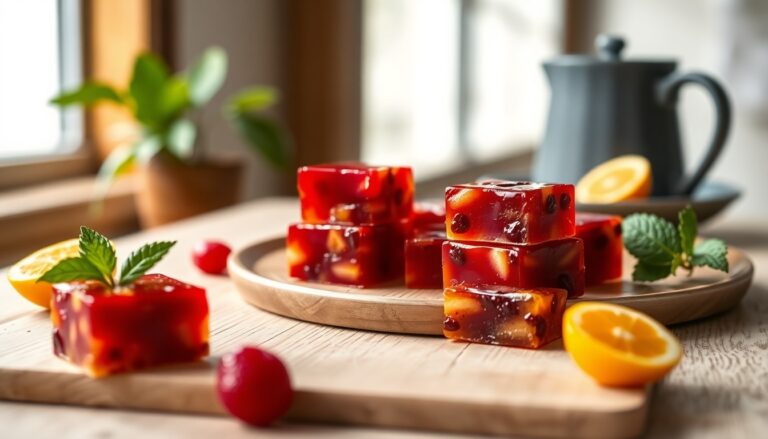
Pâte de fruit, or fruit jelly, is a traditional French sweet made by cooking fruit pulp or purée with sugar until it reaches a firm, melt-in-the-mouth texture. Quince, apricot, raspberry, pear, blackcurrant or citrus fruit: the varieties are many, often rolled in granulated sugar. A regional speciality enjoyed at festive times, it is eaten in small, colourful bites. In terms of nutrition facts, fruit jelly provides around 336 kcal per 100 g, mainly as carbohydrate (76.6 g), with a small share of fibre (3.9 g) from the fruit. Indulgent and concentrated in sugars, it remains a treat to enjoy in moderation as part of a balanced diet.
Macronutrient breakdown
Nutrition table per 100 g
| Calories | 336 kcal |
| Kilojoules | 1420 kJ |
| Protein | 1,7 g |
| Carbohydrate | 76,6 g |
| Fat | 1,8 g |
| Fibre | 3,9 g |
Micronutrients per 100 g
All measured nutrients, ranked by share of the daily reference intake.
- Vitamin E3,72 mg31 %
- Vitamin B60,34 mg24 %
- Vitamin B20,3 mg21 %
- Manganese0,34 mg17 %
- Vitamin B10,15 mg14 %
- Copper0,1 mg10 %
- Potassium170 mg9 %
- Vitamin C5,13 mg6 %
See the other 10 nutrients
- Phosphorus44 mg6 %
- Vitamin B912 µg6 %
- Magnesium18 mg5 %
- Iron0,58 mg4 %
- Zinc0,38 mg4 %
- Calcium25 mg3 %
- Vitamin B50,15 mg3 %
- Vitamin K11,84 µg2 %
- Vitamin A0,21 µg0 %
- Total omega-30 g0 %
Anses Ciqual 2025. Source: Anses, 2025, Ciqual food composition table
Tips
Fruit jelly appeals with its aromatic intensity and soft texture. To enjoy its pleasures without overdoing it, it is best to watch the portion: one or two bites (20 to 30 g) are enough to satisfy a sugar craving. It is a handy snack that keeps for a long time at room temperature in an airtight tin, away from humidity.
How to eat fruit jelly? It can be eaten as it is at teatime, at the end of a meal with a coffee, or as part of a plate of petits fours. You can also cut it into small cubes to flavour a plain yoghurt, a fruit salad or fromage blanc. In baking, it livens up cakes and financiers. To vary your sweet treats, explore other fruity delights such as apricot jam or fruit jelly preserve, which belong to the same large family of sugary foods.
Key nutrients. Fruit jelly is above all a source of simple carbohydrates: with 76.6 g of carbohydrate per 100 g, its glycaemic index is high, making it a quick source of energy. It contains little protein (1.69 g) and a small amount of fat (1.8 g). The fibre (3.9 g) comes from the fruit pulp used, but remains modest compared with a whole fresh fruit.
Tip for active people. Thanks to its quickly absorbed sugars, fruit jelly is an interesting snack before or during prolonged exercise (running, long bike ride): it provides a carbohydrate boost that is easy to carry. For recovery, pair it with a source of protein, for example via a post-workout shaker or high-protein snack ideas, to optimise muscle and energy replenishment.
Weight control. Very dense in sugars, fruit jelly is calorific and not very filling. If you are slimming or following a balanced diet, limit how often you have it and favour fresh fruit day to day. To compare energy density with other foods, consult the calorie table. Enjoyed mindfully, in small amounts, fruit jelly keeps its place as an occasional pleasure.