Group · Meat
Ox tongue
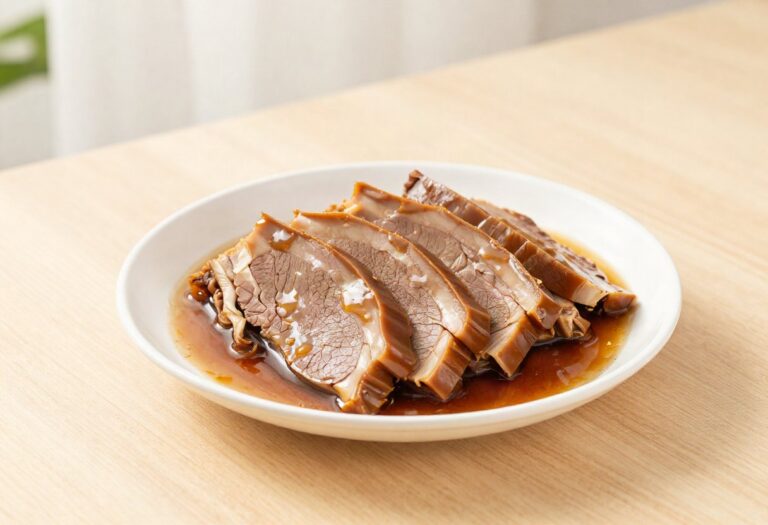
Ox tongue is an offal appreciated for its melting texture and delicate taste, long a feature of traditional French cooking. Sold fresh, salted or already cooked at the butcher’s, it is most often poached and then served with a sauce (Madeira, gribiche, piquant). Nutritionally, ox tongue provides around 236 kcal per 100 g, with nearly 23.7 g of protein, 0.22 g of carbohydrate and 15.6 g of fat. It is therefore a source of complete protein, but also a meat that is relatively rich in fat. Like all offal, it provides iron and B vitamins, and has a place in a varied diet as long as it is eaten in moderation.
Macronutrient breakdown
Nutrition table per 100 g
| Calories | 236 kcal |
| Kilojoules | 985 kJ |
| Protein | 23,7 g |
| Carbohydrate | 0,3 g |
| Fat | 15,6 g |
Micronutrients per 100 g
All measured nutrients, ranked by share of the daily reference intake.
- Vitamin B126,62 µg265 %
- Iron3,5 mg25 %
- Vitamin B33,9 mg24 %
- Zinc2,2 mg22 %
- Vitamin B20,3 mg21 %
- Phosphorus144 mg21 %
- Vitamin B51,07 mg18 %
- Copper0,13 mg13 %
See the other 14 nutrients
- Potassium184 mg9 %
- Vitamin B60,12 mg9 %
- Vitamin D0,4 µg8 %
- Omega-6 LA0,51 g5 %
- Vitamin B10,05 mg5 %
- Omega-3 ALA0,07 g4 %
- Vitamin B97 µg4 %
- Iodine5 µg3 %
- Magnesium9,44 mg3 %
- Vitamin E0,3 mg3 %
- Manganese0,04 mg2 %
- Calcium14,5 mg2 %
- Vitamin C1,3 mg2 %
- Vitamin K11,2 µg2 %
Anses Ciqual 2025. Source: Anses, 2025, Ciqual food composition table
Tips
Ox tongue needs long cooking: it is poached in a flavoured stock (onion, cloves, bouquet garni, carrot) for 2 to 3 hours, until a knife slides through easily. The thick skin is then peeled off while hot, and the tongue is sliced. It is served hot in a sauce or cold as a starter. To limit the fat intake, skim the stock well and choose gentle cooking rather than very fatty sauces.
Nutrition facts and strengths. With 23.7 g of protein per 100 g, ox tongue provides essential amino acids that help maintain muscle. It contains no carbohydrate or fibre, which makes it a suitable option for a low-carbohydrate diet. Like most offal, it provides well-absorbed haem iron, zinc and B vitamins (notably B12). However, its 15.6 g of fat make it higher in calories than lean cuts: to compare, check the food calorie table.
Tips for active people. Ox tongue can fit into a recovery meal thanks to its protein and iron content, which is of interest to endurance athletes. But its fat density makes it a poor choice for a pre-workout snack, as it slows digestion. Keep it for the evening meal instead, served with green vegetables and a portion of starchy foods. For a protein intake that is quicker to digest, lean beef or cuts such as sliced cold beef are often preferred.
Weight control. Its high fat content calls for moderation: a sensible portion of 100 to 120 g is plenty. Avoid breaded or fried versions and buttery sauces, which push up the calorie total. Serve it with raw vegetables or vegetables to balance the plate.
- Recommended portion: 100 to 120 g, once or twice a month.
- Storage: 2 days in the fridge once cooked, or freeze after cooking.
- Smart pairings: steamed vegetables, a lightened gribiche sauce, a light vinaigrette.
To explore other cuts and offal, browse the meat family and vary your protein sources through the week.