Group · Bread
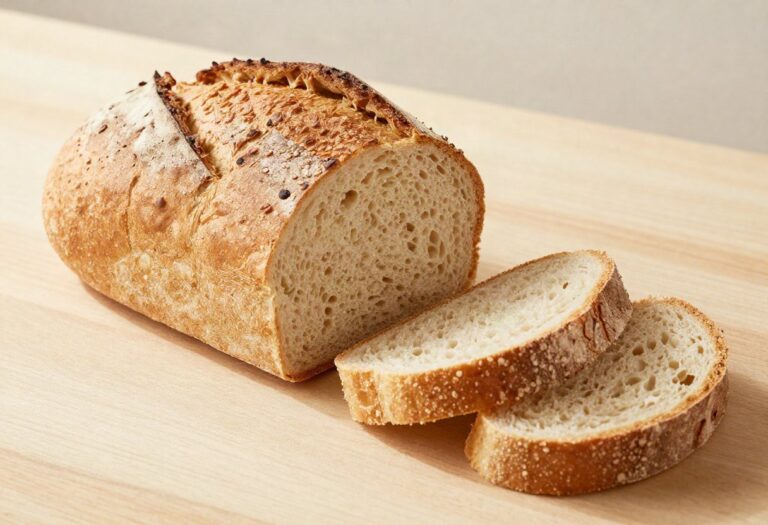
Pain bis (light wholemeal bread)
Pain bis bread is made with T80 or T110 flour, a compromise between white T55 flour and wholemeal flour T150. Part of the bran is kept, hence its grey colour and its name.
In terms of nutrition facts: 265 kcal per 100 g, with 54 g of carbohydrates, 9.43 g of protein, 4.2 g of fibre and only 0.33 g of fat. It provides 33 mg of magnesium, 178 mg of potassium, 140 mg of phosphorus and 1.31 mg of iron per 100 g, and contains 1.17 g of salt.
Macronutrient breakdown
Nutrition table per 100 g
| Calories | 265 kcal |
| Kilojoules | 1120 kJ |
| Protein | 9,5 g |
| Carbohydrate | 54 g |
| Fat | 0,4 g |
| Fibre | 4,2 g |
Micronutrients per 100 g
All measured nutrients, ranked by share of the daily reference intake.
- Manganese1 mg50 %
- Phosphorus140 mg20 %
- Vitamin B60,27 mg19 %
- Zinc1,2 mg12 %
- Vitamin B10,13 mg12 %
- Vitamin B31,66 mg10 %
- Iron1,31 mg9 %
- Potassium178 mg9 %
- Vitamin B9dietary folate equivalents22,4 µg
See the other 6 nutrients
- Magnesium33 mg9 %
- Vitamin B50,4 mg7 %
- Vitamin B20,06 mg4 %
- Calcium27,5 mg3 %
- Omega-6 LA0,13 g1 %
- Omega-3 ALA0,01 g0 %
Anses Ciqual 2025. Source: Anses, 2025, Ciqual food composition table
Tips
It is the best compromise on the bread shelf. More fibre and minerals than a white bread, without the density or bitterness of wholemeal. It is the easiest bread to stick with long term.
The T number shows the ash content, not the colour. T55 is white, T80 is bis, T110 is semi-wholemeal, T150 is wholemeal: the higher the number, the more bran is present.
Its phytic acid slightly hinders iron absorption. That is the downside of bran. Sourdough partly breaks it down: a sourdough pain bis is better than a yeast-raised one on this specific point.
1.17 g of salt: average for French bread. An agreement signed with the bakery industry aims to get below 1.4 g per 100 g, and it is broadly respected.
0.33 g of fat: it is bread, not a pastry. Everything that weighs down a slice comes afterwards: butter, chocolate spread, cheese.