Group · Dairy
Pélardon
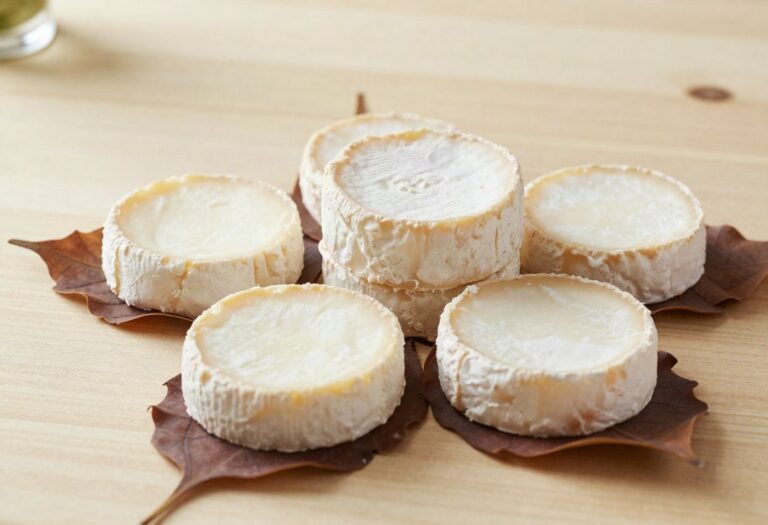
Pélardon is a small goat’s cheese from the Cévennes, PDO, weighing around sixty grams. Its name comes from the Occitan pèbre, meaning pepper, a reference to its bite when well matured. The goats graze the garrigue scrubland, which marks its flavour.
In terms of nutrition facts: 343 kcal per 100 g, with 27.8 g of fat of which 18.6 g is saturated, and 23.3 g of protein. It provides 242 mg of phosphorus, 147 mg of calcium, 95.5 µg of vitamin B9 and 9.5 µg of selenium per 100 g, with 1.43 g of salt.
Macronutrient breakdown
Nutrition table per 100 g
| Calories | 343 kcal |
| Kilojoules | 1420 kJ |
| Protein | 23,3 g |
| Fat | 27,8 g |
Micronutrients per 100 g
All measured nutrients, ranked by share of the daily reference intake.
- Vitamin B21,01 mg72 %
- Vitamin B995,5 µg48 %
- Phosphorus242 mg35 %
- Vitamin B60,28 mg20 %
- Iodine30 µg20 %
- Vitamin B51,2 mg20 %
- Calcium147 mg18 %
- Selenium9,5 µg17 %
See the other 6 nutrients
- Omega-3 ALA0,17 g9 %
- Vitamin B31,28 mg8 %
- Zinc0,57 mg6 %
- Magnesium20,5 mg5 %
- Vitamin E0,58 mg5 %
- Iron0,37 mg3 %
Anses Ciqual 2025. Source: Anses, 2025, Ciqual food composition table
Tips
One Pélardon weighs 60 g: count on 206 kcal. This is a cheese to share or to use in a dish, not to eat on its own at the end of a meal.
95.5 µg of vitamin B9 per 100 g. That is 48% of the reference intake, the best score among the PDO goat’s cheeses in this selection, slightly ahead of Crottin de Chavignol.
23.3 g of protein is high for a goat’s cheese. Its longer maturing evaporates the water and concentrates the solids. A 30 g portion provides 7 g of protein.
It can be eaten at any stage. Fresh and lactic at eleven days, dry and peppery at one month. A very dry Pélardon keeps for weeks and can be grated like a hard cheese.
Raw milk. The PDO requires it: not recommended for pregnant women or people with weakened immune systems, unless heated right through.