Group · Fruit
Gala apple
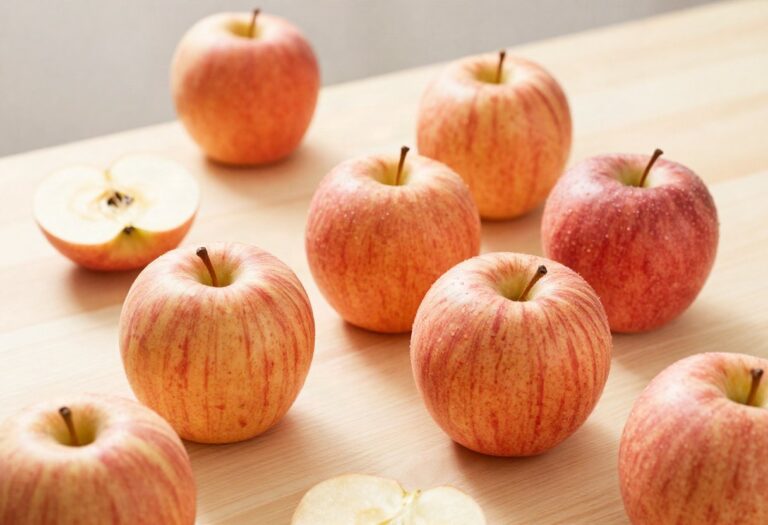
The Gala apple was born in New Zealand in the 1930s, a cross between Golden Delicious and Kidd’s Orange Red. Small, streaked with orange-red, it is crisp and sweet without being tart.
In terms of nutrition facts, raw flesh without skin: 51.6 kcal per 100 g, with 11.9 g of carbohydrates including 11.1 g of sugars and 1.9 g of fibre. It provides 91 mg of potassium and 1.33 mg of vitamin C per 100 g.
Macronutrient breakdown
Nutrition table per 100 g
| Calories | 52 kcal |
| Kilojoules | 218 kJ |
| Protein | 0,3 g |
| Carbohydrate | 11,9 g |
| Fibre | 1,9 g |
Micronutrients per 100 g
All measured nutrients, ranked by share of the daily reference intake.
- Potassium91 mg5 %
- Copper0,03 mg3 %
- Vitamin B60,04 mg3 %
- Vitamin B10,02 mg2 %
- Vitamin B50,1 mg2 %
- Vitamin C1,33 mg2 %
- Phosphorus7,8 mg1 %
- Manganese0,02 mg1 %
- Vitamin B9dietary folate equivalents6,98 µg
See the other 4 nutrients
- Magnesium3 mg1 %
- Calcium3,6 mg0 %
- Iron0,06 mg0 %
- Vitamin A0,97 µg0 %
Anses Ciqual 2025. Source: Anses, 2025, Ciqual food composition table
Tips
Its small size is a practical advantage. A Gala weighs 120 to 140 g against 180 g for a Golden: it is the apple for the school bag and the afternoon snack, portion included.
1.9 g of fibre, flesh alone. With the skin, it would be higher: it is the Ciqual measurement that excludes the skin here, not a quirk of the variety.
It is eaten raw, not cooked. Its melting flesh collapses quickly and its flavour fades when cooked. For a tart, a Granny Smith or a Canada does far better.
It browns fairly quickly. Once cut, it darkens within minutes. A squeeze of lemon or lime solves the problem.
Its season starts early: September. It is one of the first French apples of the year, which explains why it appears for back-to-school.