Group · Fruit
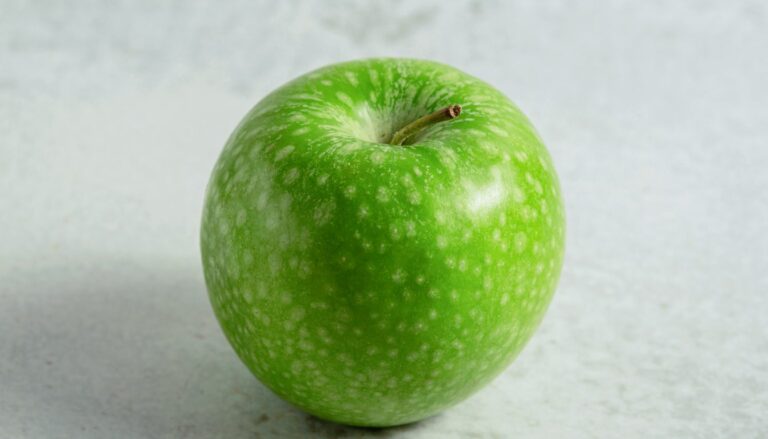
Granny Smith apple
The Granny Smith was born in Australia around 1868 from a chance seedling found by Maria Ann Smith. Its bright green skin and very firm, tart flesh make it an apple apart: it is like no other.
In terms of nutrition facts, raw flesh and skin: 48.6 kcal per 100 g, with 10.7 g of carbohydrates including 10.1 g of sugars and 2.8 g of fibre. It provides 110 mg of potassium and 2.31 mg of vitamin C per 100 g.
Macronutrient breakdown
Nutrition table per 100 g
| Calories | 49 kcal |
| Kilojoules | 205 kJ |
| Protein | 0,3 g |
| Carbohydrate | 10,7 g |
| Fibre | 2,8 g |
Micronutrients per 100 g
All measured nutrients, ranked by share of the daily reference intake.
- Potassium110 mg6 %
- Copper0,04 mg4 %
- Vitamin C2,31 mg3 %
- Vitamin B60,03 mg2 %
- Vitamin B50,07 mg1 %
- Phosphorus7,6 mg1 %
- Manganese0,02 mg1 %
- Magnesium2,8 mg1 %
- Vitamin B9dietary folate equivalents5,76 µg
See the other 3 nutrients
- Iron0,06 mg0 %
- Calcium3,2 mg0 %
- Vitamin A0,97 µg0 %
Anses Ciqual 2025. Source: Anses, 2025, Ciqual food composition table
Tips
It is the least sweet and lowest in calories of the apples in this batch. 48.6 kcal and 10.1 g of sugars, against 57.3 and 12.3 for a Pink Lady. A real argument if you watch your blood sugar.
Its tartness is not ascorbic acid. It is malic acid: it is no richer in vitamin C than the others, contrary to a stubborn myth.
It holds up remarkably well when cooked. Its firmness lets it keep its shape in a tart or a tarte tatin, where a Golden collapses. It is the pastry chef’s apple.
It barely browns. Its acidity slows oxidation: cut into slices, it lasts an hour without darkening, which is handy for a platter or a salad.
It pairs well with strong cheeses. Fourme d’Ambert, gorgonzola, mature cheddar: its acidity cuts the richness better than a sweet apple.