Group · Dairy
Cheddar
Cheddar takes its name from a village in Somerset, England, and its character from a particular technique: cheddaring, which involves stacking and turning blocks of curd to drive out the whey. It is the most widely produced cheese in the world.
On the nutrition side: 399 kcal per 100 g, with 32.6 g of fat, of which 20.1 g saturated, and 24.2 g of protein. It provides 739 mg of calcium and 509 mg of phosphorus per 100 g, along with 401 µg of vitamin A and 1.77 g of salt.
Macronutrient breakdown
Nutrition table per 100 g
| Calories | 399 kcal |
| Kilojoules | 1650 kJ |
| Protein | 24,2 g |
| Carbohydrate | 1,2 g |
| Fat | 32,6 g |
Micronutrients per 100 g
All measured nutrients, ranked by share of the daily reference intake.
- Calcium739 mg92 %
- Phosphorus509 mg73 %
- Vitamin B121,3 µg52 %
- Vitamin A401 µg50 %
- Zinc3,8 mg38 %
- Vitamin B20,4 mg29 %
- Selenium14,1 µg26 %
- Iodine37,7 µg25 %
- Vitamin B9dietary folate equivalents17,7 µg
See the other 13 nutrients
- Vitamin E1,27 mg11 %
- Omega-3 ALA0,19 g10 %
- Total omega-30,21 g8 %
- Magnesium28,5 mg8 %
- EPA0,02 g8 %
- Copper0,05 mg5 %
- Omega-6 LA0,45 g5 %
- Potassium79,9 mg4 %
- Vitamin K12,8 µg4 %
- Vitamin B60,05 mg4 %
- Vitamin B50,2 mg3 %
- Vitamin B10,03 mg3 %
- Manganese0,02 mg1 %
Anses Ciqual 2025. Source: Anses, 2025, Ciqual food composition table
Tips
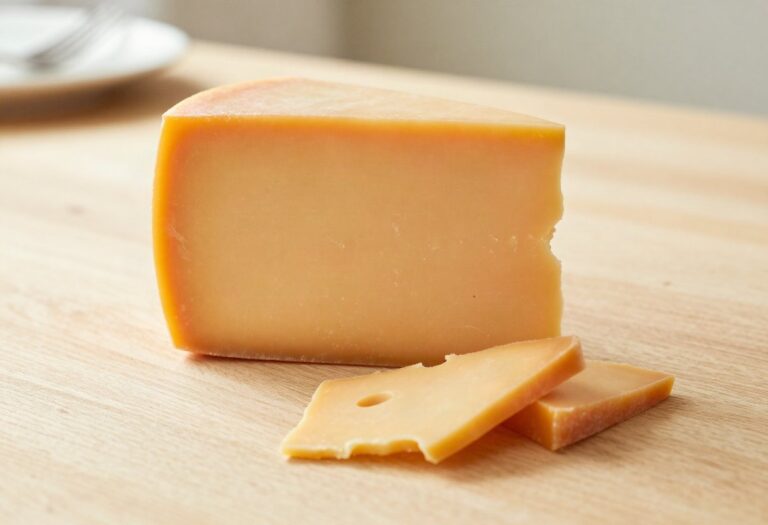
Its orange colour is not natural. It comes from annatto, a plant-based colouring added since the 17th century to imitate the shade of summer cheeses. A white cheddar and an orange cheddar of the same age have exactly the same composition.
Ageing changes the taste, not the calories. A young three-month cheddar and a two-year extra mature show very similar values. The second, however, has much more flavour: you use less for the same effect, and that is the only trade-off that really counts.
739 mg of calcium per 100 g. A 30 g portion covers more than a quarter of the reference intake. Pressed cheeses concentrate the calcium in milk better than any other dairy product.
It melts without stringing. Its structure lets it melt evenly rather than stretch like mozzarella: this is why it rules over croque-monsieur, gratins and burgers. Watch the quantity, which climbs quickly in these dishes.
Industrial sliced cheddar is not cheddar. Many « burger slices » are processed cheeses, with melting salts, added water and sometimes less than 50% cheddar. The ingredients list settles it in two seconds.