Group · Dairy
Saint-Nectaire
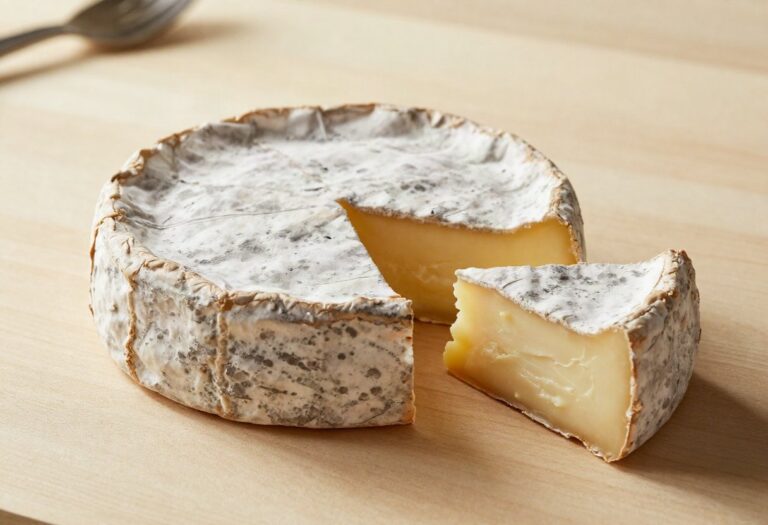
Saint-Nectaire is an Auvergne cheese with an uncooked pressed paste, matured on rye straw for at least twenty-eight days. Its grey rind flecked with yellow and red moulds is the sign of maturing in a natural cellar. It comes in a farmhouse version, made with raw milk, and a dairy version.
In terms of nutrition facts, the dairy version has 333 kcal per 100 g, with 27.2 g of fat of which 18.2 g is saturated, 21.3 g of protein and 0.9 g of carbohydrate. It carries 1.55 g of salt per 100 g.
Macronutrient breakdown
Nutrition table per 100 g
| Calories | 333 kcal |
| Kilojoules | 1380 kJ |
| Protein | 21,3 g |
| Carbohydrate | 0,9 g |
| Fat | 27,2 g |
Tips
Farmhouse or dairy: you can taste the difference. The farmhouse version, made from the raw milk of a single herd, carries an oval casein plaque; the dairy one a square plaque. The first has more character, so you use less.
A 30 g portion comes to 100 kcal. That is a sensible unit for a cheeseboard: a 30 g portion provides 6.4 g of protein. Saint-Nectaire sits around the average for uncooked pressed cheeses.
1.55 g of salt is moderate. Less than the Cantal or Salers from the same region. A portion provides 0.47 g of salt.
It melts well in a truffade or a gratin. Its supple paste makes it usable hot, which is not true of all pressed cheeses. Over potatoes, it stands in for raclette with more character.
The farmhouse version is made with raw milk. Not recommended for pregnant women or people with weakened immune systems; the pasteurised dairy version does not have this problem.